Choose orthonormal, flux-normalized incoming and outgoing channels and include all channels of this lossless scattering problem. Conservation of probability requires for every input vector. With ,For a square channel matrix this also gives . A submatrix obtained by omitting loss channels need not be unitary, but that is not the stated two-channel model.
The given real Hadamard matrix is symmetric, unitary and its own inverse. HenceThis same transformation preserves the canonical commutation relations for bosons and anticommutation relations for fermions. To extract probabilities one must use normalized number states, including their factorial factors, even when the supplied input expression is unnormalized.
For identical fermions, and . ThereforeThe minus sign is a global phase for this output. The only occupancy is , with probability one. Double occupancy of either specified single-particle mode is excluded; no extra internal states are present in this model.
Bosonic creation operators commute, so the cross terms cancel:ThusThe square root of two in is essential. Destructive interference removes the one-particle-per-output amplitude; the particles do not independently choose ports.
For photons this is the ideal Hong-Ou-Mandel effect. Its laboratory test combines one photon from each input at a balanced beam splitter and scans relative arrival delay while measuring output coincidences. Spatial, polarization and spectral indistinguishability must be controlled; distinguishable photons restore a nonzero coincidence baseline. The original experiment used down-converted photons, a translated beam splitter and coincidence counting, with an independently estimated accidental-coincidence background.[ref]
Measurement of Subpicosecond Time Intervals between Two Photons by Interference by C. K. Hong and others. Physical Review Letters 59 (1987), pp. 2044–2046, figure 1 and equations (2), (9): setup, balanced splitting cancellation, delay scan and accidental subtraction
The input squared norm is , so divide its stated expression by . Commutativity and the inverse channel transformation give the normalized outputAfter the binomial expansion, the coefficient of isHence every possible occupancy has even particle number in each port:All other occupancies have zero probability. The normalization identityfollows by taking the coefficient of in . For it reduces to (c), and symmetry under gives equal mean occupancies in both outputs.
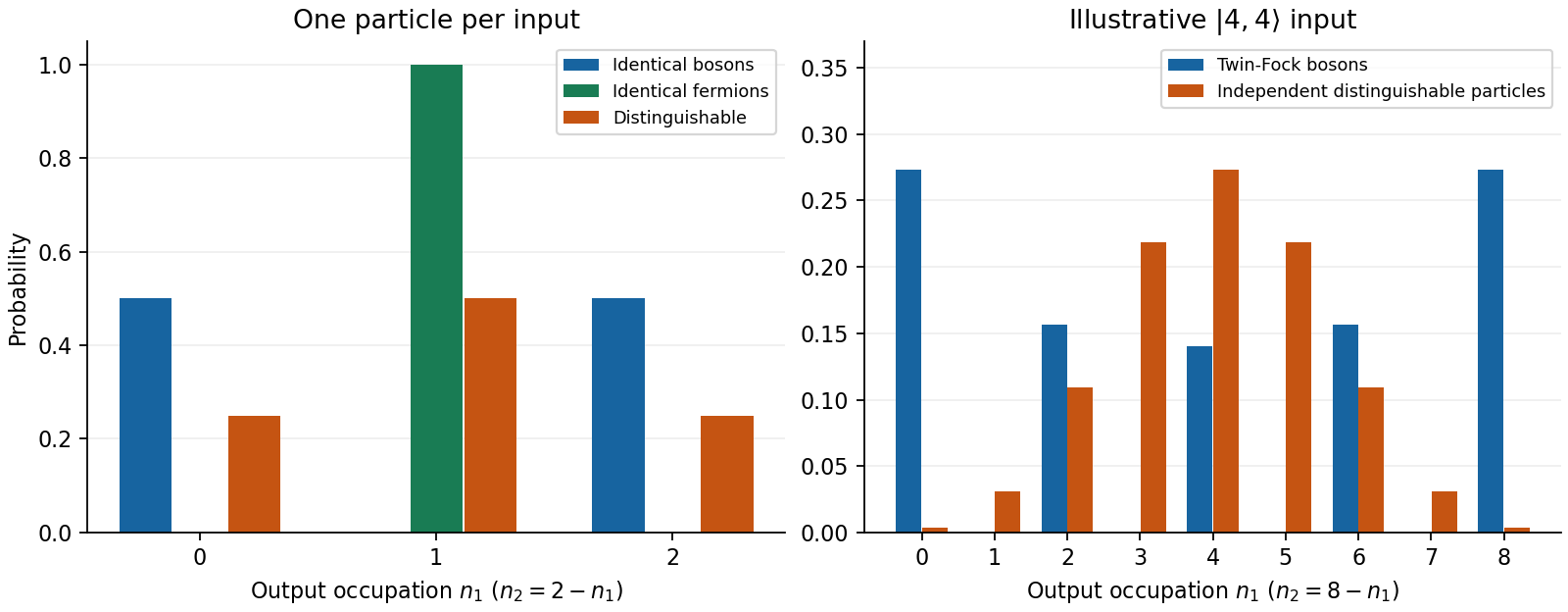
Original balanced-splitter occupations for two-particle statistics and twin-Fock bosons, with independent distinguishable-particle comparisons
. Details. 
The exponential input has norm squared . Its normalized form is a product of coherent states. Substitution of the inverse transformation givesSince the output creation operators commute, the normalized output factorizes as . For all nonnegative integers ,These are independent Poisson distributions, not a fixed-total-particle-number distribution. unitarity gives . Equal complex inputs make , so that port is certainly empty; opposite inputs empty port 1. This is amplitude interference of coherent inputs, distinct from the fixed-number two-particle interference in (c).
Articles by others on the same topic
There are currently no matching articles.