Original solutions to every optional question. [ref]
https://www.whatdotheyknow.com/request/natural_science_tripos_physics_e_2/response/2340776/attach/2/FOI%202023%20399%20Zahid%20materials.pdf?cookie_passthrough=1#page=375. Original public PDF, physical pages 375–381; dated 22 April 2015
The spin operators here are dimensionless: , so has units of inverse time and is a dimensionless pulse area. Integrating the Schrödinger evolution across an infinitesimally short pulse gives . The finite free Hamiltonian contributes a vanishing integrated phase within that pulse. Between pulses the free evolution is .
In the eigenbasis, and . ConsequentlyStarting just before a pulse, the kick acts first and the free interval second. Operators act on states right to left, henceThere are exactly kicks, at times ; the pulse at is excluded. Sampling just after kicks would change the displayed product order. This endpoint convention specifies the delta-kicked spin Floquet operator.
The Pauli matrix multiplication law givesFor a unit vector , it follows that . In the exponential series the even powers therefore multiply and the odd powers multiply . Summing them separately,Equivalently, the eigenvalues of are , so its two spectral projectors acquire phases . The half-angle belongs to a spinor rotation, while the associated physical spin vector rotates through .
For the axis-angle composition of orthogonal spin rotations, set and . Multiplication, including , givesOne checks that . For , chooseThis choice retains the full spinor sign and gives . Repeated periods have the same axis:Thus the spin expectation vector rotates through , interpreted modulo as a spatial rotation. The positive component comes from the stated ordering; reversing the two rotations changes that component's sign.
When , the one-period operator is or , and no unique rotation axis exists. The latter is a spatial rotation with a minus sign on a spin- state. It is safer to retain this central group element than to replace the angle by zero in a spinor calculation.
For general spin , use dimensionless generators obeying . The two exponentials represent the same group elements as for spin , now in the -dimensional representation of . A representation preserves products, sowith exactly the same axis and angle found in (c); after periods the angle is . One must not substitute higher-spin matrices into the two-term Pauli exponential in (b), which used a property special to spin .
The dimension and action on spin states change, but the spin-independent axis-angle composition does not. In particular,Integer-spin states return with positive sign and half-integer-spin states with negative sign. spin expectation vectors transform as spatial vectors in either case, while a general higher-spin state also carries higher multipole information.
Write , and for , with . Direct differentiation givesAlso and, for a smooth bounded test function ,Thus tends to a Dirac delta distribution as . Defining the retarded kernel supplies the initial impulse:The source term arises from the jump at in the distributional sense; differentiating only the smooth positive-time Gaussian would miss it.
Take and split it into intervals of width . The markov property and Gaussian convolution giveThis finite-dimensional identity is exact for every positive . Define the path-integral measure by these normalized time slices:In the time-sliced diffusion path integral, the discrete exponent is . Its conventional continuum notation is thereforeThe time-slice normalization is essential, not an arbitrary multiplicative constant. Brownian paths are almost surely nondifferentiable, so the displayed action is shorthand for the Gaussian limiting measure rather than an ordinary integral of the derivative of each typical path.
Multiply each time-sliced path weight by . A nonnegative finite is a local killing rate: the Feynman-Kac weight attenuates paths in proportion to the time spent in regions where . Let that rate tend to infinity outside the allowed interval. Paths that exit are removed, leaving Brownian motion killed at its first boundary hit.
Consequently the required kernel is the Gaussian path measure restricted to surviving paths, equivalentlywith the infinite-barrier interpretation stated above. It solves in the interior with absorbing Dirichlet boundary conditions at . A reflecting boundary condition for a diffusion would describe a different process.
Strictly, this is a transition probability density in the final position, jointly with survival; a probability for an interval of final positions includes an integral over . Its integral over the whole allowed interval is at most one. It is not the normalized endpoint density conditional on survival, which would require division by the survival probability. In these diffusion units and the eigenvalues of have units of inverse time.
The normalized Dirichlet eigenfunctions on and their decay rates areTheir norms are one because the sine-squared integral is . At the initial position zero, , so all even disappear. For , the two signs from and cancel, yieldingThis holds for and is zero outside. The kernel is even in , vanishes at both boundaries and tends weakly to the initial delta. The eigenvalues are decay rates rather than quantum energies unless one makes an additional unit convention.
The survival probability from an absorbing transition density follows by integrating over final position. Sincethe exact survival probability for isThe slowest Dirichlet mode dominates at large time:The first relative correction is . The approximation is a late-time result; extrapolating its prefactor to would incorrectly give a probability larger than one. The full alternating series tends to one there.
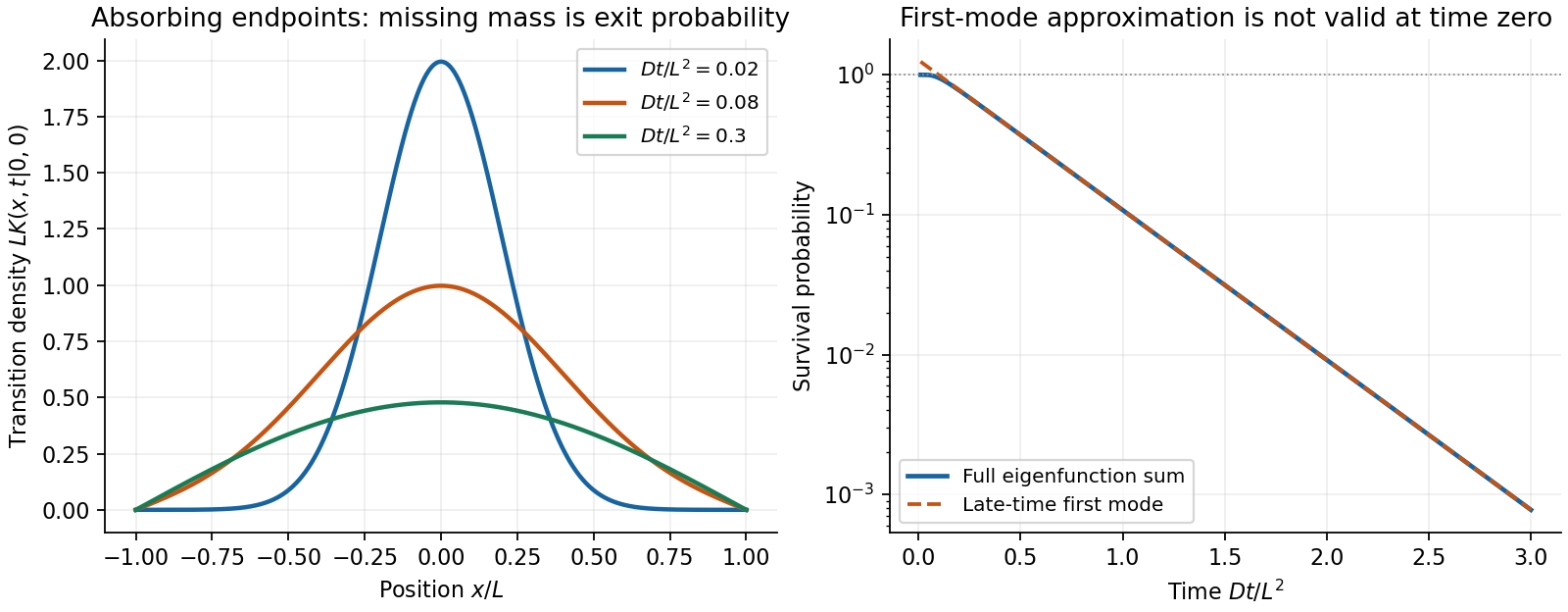
Original absorbing-interval transition densities and the approach of the survival probability to its slowest-mode asymptote
. Details. 
Outside a finite-range scattering potential, the stationary Schrödinger equation becomes the free Helmholtz equation. The specified incident state is a plane wave along . The scattered disturbance must be outgoing: the scattering experiment has an incoming incident beam but no independently imposed spherical wave arriving from infinity. At large radius its angular pattern is encoded by a scattering amplitude :An outgoing three-dimensional wave has amplitude proportional to because its probability current spreads over area proportional to . Indeed its radial current is to leading order, while the incident current density is . Therefore . The sign assumes the stationary time factor .
Rearrange the continuum equation asThe incident plane wave contributes zero to the left side. The outgoing Green function identity gives for the scattered term, henceThis fixes both the sign and the three-dimensional factor. The model is an isotropic point coupling, so the scattered amplitude has no angular dependence. Take real, as required by the displayed Hermitian pair of coupling equations; an arbitrary phase of the discrete state can be chosen accordingly.
The outgoing wave is singular at the origin, so its value there cannot be inserted without regularization. At a short radial distance , with ,The incident factor tends to one independently of the chosen approach direction; the singular part is isotropic. The discrete-state equation becomes, to the retained short-distance order,Keeping only and discarding would lose the outgoing-wave imaginary part and produce an amplitude inconsistent with scattering unitarity.
Define , which has units of energy times length. Substituting the result of (b) into (c) givesAbsorb the real cutoff shift into the physical detuning,It follows thatUsing , identifyHere has units of square root of energy. This is the small-cutoff, renormalized resonant-level amplitude; terms vanishing with have been omitted. Taking at fixed measured detuning requires the bare to depend on the cutoff.
The sign is checked by , which has the elastic -wave unitarity form. Thus , consistent with the optical theorem and . If the renormalized level is positive, at the amplitude is and the scattering cross-section reaches .
For the canonical quantum Gibbs state,If , its spectral form is , with a sum over any degeneracy and an integral where a continuous spectrum needs one. It is Hermitian, positive and has unit trace, and it commutes with . The formula presumes a well-defined finite partition function. At zero temperature a nondegenerate stable system approaches its ground-state projector; a degenerate ground space requires specifying the ensemble or preparation.
Put , which has units of energy. In the original oscillator basis,Write , , and . The transformed number and pair terms obeyHence the coefficient of is , which vanishes for
This cancels the requested pair terms but does not diagonalize the printed Hamiltonian. Its number-conserving coupling also transforms:After the pair cancellation, the last creation terms have coefficient , nonzero for . They create two quanta from the vacuum, so that vacuum is not an eigenstate of the literal Hamiltonian. This is an inconsistency in the ground-state assertion used by the next part, present in the printed PDF.
For the actual coordinate-coupled system, the normal coordinates and their conjugate momenta diagonalize into independent oscillators withA normalizable ground state requires . Eliminating just the two indicated cross-pair terms is not sufficient to establish that ground state.
The stated annihilation conditions can be solved algebraically, even though (b) shows they are not ground-state conditions for the full printed Hamiltonian. Invert the canonical transformation:For , the commutators giveThus both and annihilate it precisely whenThe normalized two-mode squeezed vacuum isThe factorial from the exponential cancels those generated by the two creation operators. Normalization follows from a geometric series; the problem does not require its value, but it makes the subsequent partial trace explicit.
For comparison, the actual ground wave function of the printed stable Hamiltonian isIt follows directly from the two normal-mode Gaussian vacua. The proposed is instead the exact ground state of the distinct pair-coupling Hamiltonian under its stability condition. Omitting the remaining terms of silently would change the problem.
First trace the state explicitly specified in (c). orthogonality in the oscillator removes terms with different occupation numbers:For a thermal oscillator of frequency , the ratio of successive Boltzmann weights is . Consequently the conditional answer for that two-mode squeezed state isAt this is interpreted by the limit . The reduced state is mixed for nonzero squeezing although the joint state is pure; its effective thermal statistics arise from entanglement, not from heating by a bath.
The ground-state identification must still be qualified. For the true coordinate-coupled ground state, direct normal-mode averages giveTheir ratio is , rather than . Therefore this reduced state is not thermal with respect to the original bare frequency for . It does have an exact thermal representation for an effective oscillator of mass and frequencyThe corresponding occupation basis is that of , not that of the original . This follows by matching the Gaussian variances to and its momentum counterpart. A direct reduced-Gaussian eigenfunction calculation gives the same effective frequency and geometric eigenvalues.[ref]
Entropy and Area by Mark Srednicki. Equations (1)–(5), printed pp. 2–3 of the preprint: two coupled oscillators, partial trace and the effective thermal oscillator frequency
Choose orthonormal, flux-normalized incoming and outgoing channels and include all channels of this lossless scattering problem. Conservation of probability requires for every input vector. With ,For a square channel matrix this also gives . A submatrix obtained by omitting loss channels need not be unitary, but that is not the stated two-channel model.
The given real Hadamard matrix is symmetric, unitary and its own inverse. HenceThis same transformation preserves the canonical commutation relations for bosons and anticommutation relations for fermions. To extract probabilities one must use normalized number states, including their factorial factors, even when the supplied input expression is unnormalized.
For identical fermions, and . ThereforeThe minus sign is a global phase for this output. The only occupancy is , with probability one. Double occupancy of either specified single-particle mode is excluded; no extra internal states are present in this model.
Bosonic creation operators commute, so the cross terms cancel:ThusThe square root of two in is essential. Destructive interference removes the one-particle-per-output amplitude; the particles do not independently choose ports.
For photons this is the ideal Hong-Ou-Mandel effect. Its laboratory test combines one photon from each input at a balanced beam splitter and scans relative arrival delay while measuring output coincidences. Spatial, polarization and spectral indistinguishability must be controlled; distinguishable photons restore a nonzero coincidence baseline. The original experiment used down-converted photons, a translated beam splitter and coincidence counting, with an independently estimated accidental-coincidence background.[ref]
Measurement of Subpicosecond Time Intervals between Two Photons by Interference by C. K. Hong and others. Physical Review Letters 59 (1987), pp. 2044–2046, figure 1 and equations (2), (9): setup, balanced splitting cancellation, delay scan and accidental subtraction
The input squared norm is , so divide its stated expression by . Commutativity and the inverse channel transformation give the normalized outputAfter the binomial expansion, the coefficient of isHence every possible occupancy has even particle number in each port:All other occupancies have zero probability. The normalization identityfollows by taking the coefficient of in . For it reduces to (c), and symmetry under gives equal mean occupancies in both outputs.
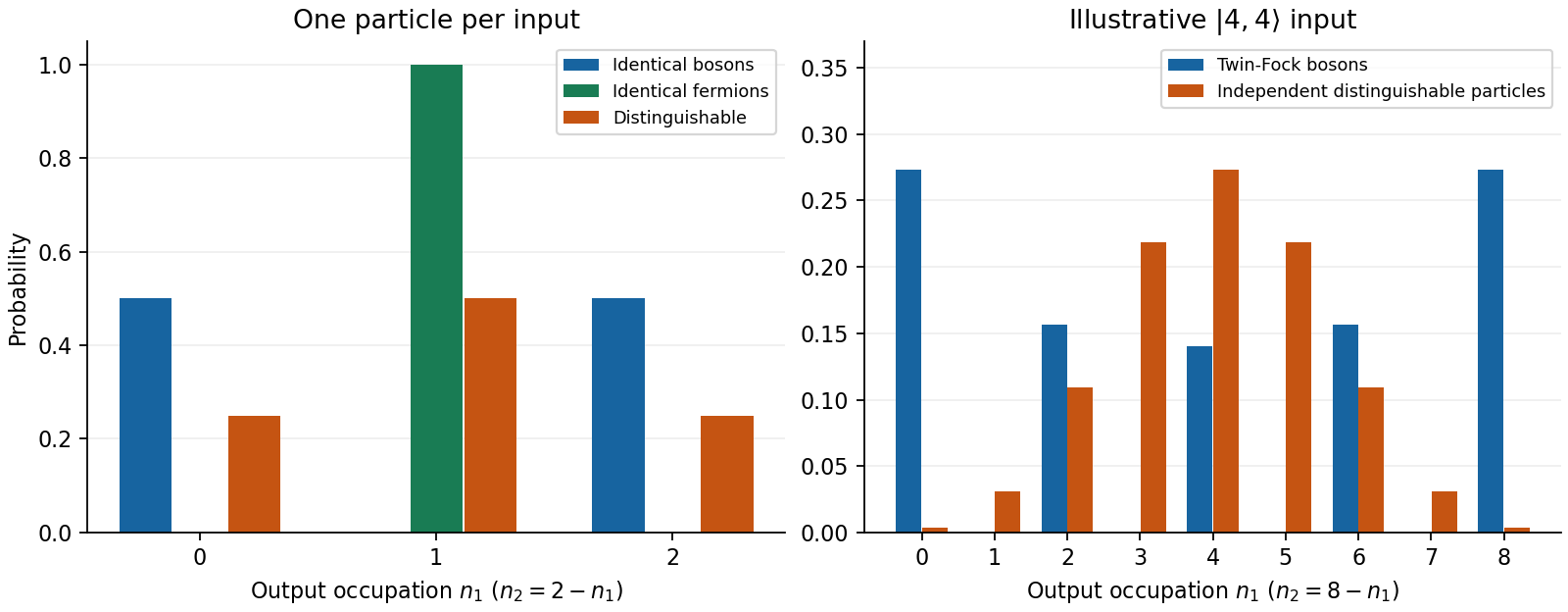
Original balanced-splitter occupations for two-particle statistics and twin-Fock bosons, with independent distinguishable-particle comparisons
. Details. 
The exponential input has norm squared . Its normalized form is a product of coherent states. Substitution of the inverse transformation givesSince the output creation operators commute, the normalized output factorizes as . For all nonnegative integers ,These are independent Poisson distributions, not a fixed-total-particle-number distribution. unitarity gives . Equal complex inputs make , so that port is certainly empty; opposite inputs empty port 1. This is amplitude interference of coherent inputs, distinct from the fixed-number two-particle interference in (c).
The defining condition isThe entries are complex and the matrices are invertible; products and inverses retain determinant one. There is no unitarity condition in general. Four complex entries subject to one complex determinant equation give three complex, or six real, local group parameters.
The association between four real coordinates and Hermitian two-by-two matrices is a real-linear bijection. Congruence by preserves Hermiticity, so defines another real four-vector depending linearly on the original. Its determinant isThus the induced invertible linear map preserves the Minkowski quadratic form:The maps obtained continuously from the identity are proper and orthochronous. For example, a future timelike vector gives a positive-definite , which remains positive definite under invertible congruence; its time direction is preserved. The matrices and induce the same four-vector transformation, illustrating the Lorentz spinor double cover.
The source uses in the upper-right entry, corresponding to for the standard Pauli matrices. This is a permissible basis convention, but its minus sign in the basis must also be retained in the spinor identification.
For nonzero , the outer product is rank-one Hermitian positive semidefinite, so and . It therefore represents a future-directed null vector. Conversely any nonzero future-null Hermitian has eigenvalues and zero, so its positive eigenvector multiplied by supplies . The phase leaves unchanged. A past-directed null vector needs , rather than the positive outer product alone.
For the printed normalized spinor, direct multiplication yieldsComparing with the printed convention givesIts usual spatial azimuth is , not . The source's asserted usual-angle identification has a sign inconsistency. Either conjugating the two spinor phases or replacing the upper-right matrix entry by restores the usual azimuth . Neither alteration is made silently here. A further positive scale factor sets the magnitude of an arbitrary future-null vector; the displayed normalized spinor fixes in the chosen coordinate units.
The spinor transformation is , with . Its squared norm becomesDividing by isolates the new direction without discarding the physical scale factor in . The lower-to-upper component ratio givesEquivalently,This is relativistic aberration for the active positive- boost specified in the question. At the poles, azimuth is undefined rather than a measurable transformed variable. Under the literal matrix convention from (c), the actual azimuth is likewise unchanged. The time coordinate is multiplied by ; normalizing a spinor for its direction must not erase that boost-induced change of null-vector scale.
The generator acts only in the plane, with its square equal to the identity on that two-dimensional subspace. Its exponential isFor the vector in (c), this giveswhile and . Since the vector is future-null, its spatial magnitude is . ThereforeThe transverse azimuth does not change. These are exactly the direction and scale obtained from the spinor congruence. In particular and . The azimuth-sign qualification in (c) is compatible with this check because a boost along leaves both transverse coordinates unchanged.
Articles by others on the same topic
There are currently no matching articles.