The continuous internal symmetry is local gauge invariance. With the source's gauge covariant derivative convention it acts asso transforms like and is unchanged. Constant phases are its global subgroup, not an additional independent internal rotation group.
In flat four-dimensional space-time the continuous external symmetry is the Poincaré group: four translations and six Lorentz transformations. Noether's theorem associates translations with conserved energy and momentum, spatial rotations with angular momentum, and boosts with the relativistic center-of-energy/boost charges. In tensor notation the latter two are the six components of the conserved total angular-momentum tensor , including field spin contributions where appropriate. The nonzero dimensionful parameter prevents exact scale invariance. Discrete transformations, such as parity, are outside the requested continuous-symmetry list.
Use and define the physical electromagnetic source by . For a constant infinitesimal phase , the matter Noether current isA definition using phase parameter instead divides this expression by ; the Maxwell source includes the electric coupling shown here. Current signs must be tied to the printed convention.
To verify the equation of motion, vary the matter kinetic term with respect to :Varying and integrating by parts gives . The stationary action therefore requiresThe potential has no explicit dependence on and contributes no extra source term. Antisymmetry of implies on the equations of motion; the same conservation law follows from the scalar equations. The source current is gauge-invariant although its expanded derivative and vector-potential pieces are not separately invariant.[ref]
Quantum Field Theory by David Tong. §§6.1.1 and 6.3.2, gauge symmetry and scalar coupling; the sign here follows the source's minus-sign covariant derivative
Keep the index convention of b: , so and the spatial gauge covariant derivative is . The physical three-current is the spatial part of :Equivalently, writing gives . Under the gauge transformation in a, and , so this expression is manifestly invariant. Switching to a convention with the opposite spatial gauge sign reverses the phase-gradient term, not the screening term proportional to .
For static fields the spatial Ampère-Maxwell equation is , while . Taking its curl yields the general magnetic-field equationNo uniform-condensate approximation has yet been used. For a varying scalar amplitude the gradient terms must be kept; simply replacing by a constant before deriving the current would conceal their origin. The homogeneous-condensate limit supplies the London screening equation in d.
The scalar potential is . Minimizing it with respect to givesChoose a gauge with constant condensate phase and take the homogeneous-amplitude London limit, . Then c reduces toThe London screening with an unnormalized complex condensate has a factor of two from the complex-field kinetic term as printed; no has been included in the definition of the real positive . Equivalently, the gauge mass is .
For a planar surface at and conductor in , take a tangential field . The solution bounded at large depth isThe exponentially growing solution is excluded. The screening current is nonzero near the surface, demonstrating the Meissner effect through a persistent surface current. The constant-amplitude approximation describes London screening away from any region where the condensate itself is strongly suppressed.
In the stipulated static gauge, . Where this equilibrium screening current is nonzero, the assumed local Ohm's law therefore demands . The simultaneous equality deep in the bulk would by itself place no constraint on ; it is not a valid standalone proof of superconductivity.
The lossless condensate also supplies the dynamical check. With fixed amplitude and phase in temporal gauge, differentiating the London relation gives . A steady field accelerates the supercurrent rather than producing a stationary dissipative current. Thus the ideal condensate has zero electrical resistivity, or an infinite electrical conductivity, consistent with the static screening solution. This is the superconducting component of the toy model; normal carriers and dissipation are not included. The nonzero field expectation is understood in a gauge-fixed description of the Higgs phase, not as a gauge-invariant local observable.
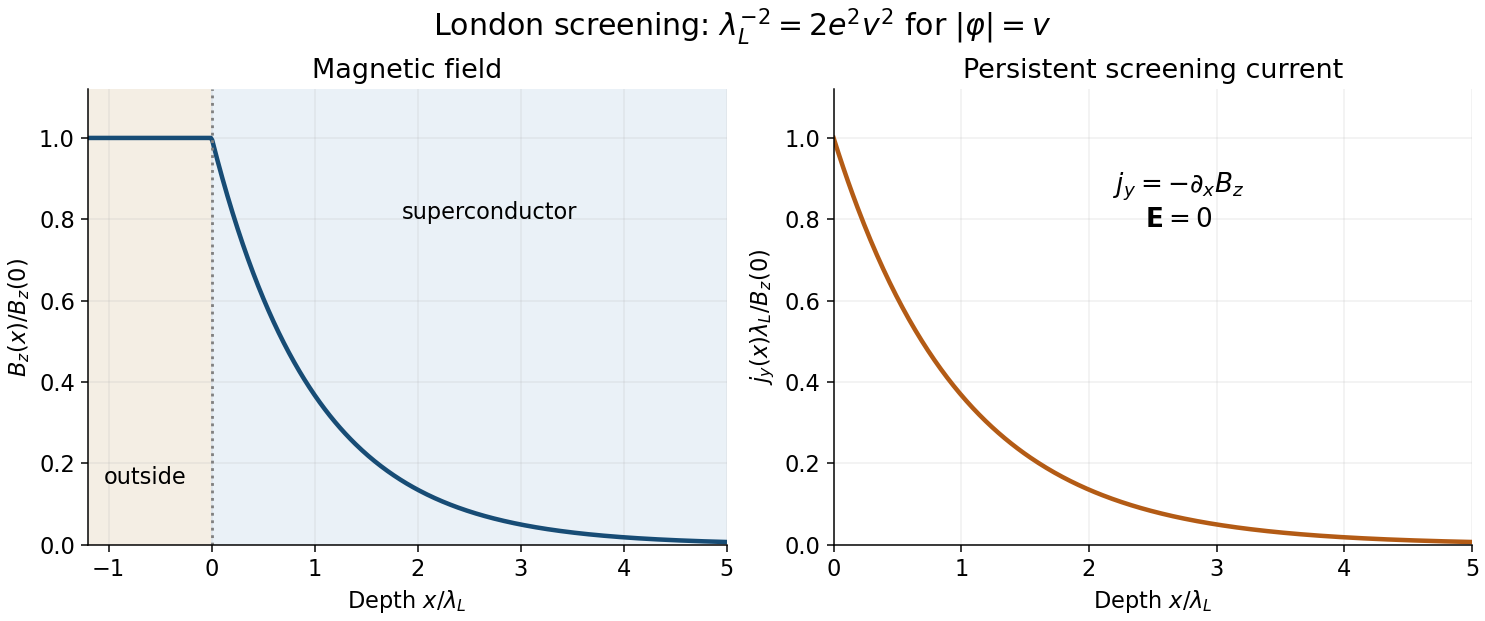
Exponential magnetic screening and the persistent surface current
. Original London-limit half-space solution. The magnetic field and screening-current magnitude share the decay length lambda L; their boundary values set the plotted normalization. Details.
Articles by others on the same topic
There are currently no matching articles.