Use . Taking the trace of the imaginary-time time-evolution operator identifies the initial and final position, giving the path integralThe measure includes integration over the common endpoint. The paths are real periodic bosonic paths on the imaginary-time circle, not paths with fixed zero endpoints and not only classical trajectories. The kinetic measure is defined by time slicing; typical contributing paths need not be differentiable. For the free expansion assume . The interacting partition function requires a potential bounded below; otherwise the following formulas have the meaning of a formal perturbation series about the free harmonic oscillator.
Here the imaginary-time Heisenberg picture position operator is , where . Bosonic time ordering places the larger imaginary time to the left without an exchange sign. The brackets denote the normalized thermal expectation valueThe trace is cyclic and is time independent, so the two-point correlation function depends only on the time difference and extends periodically with period . This periodicity is a property of the thermal correlation function, not the operator identity .
The free Euclidean action has inverse propagator . Therefore the thermal Green's function obeyswhere is the periodic Dirac delta function. It is continuous, has continuous first derivative away from its source, and satisfies . These conditions follow by integrating the differential equation across the source and using the bosonic thermal trace.
For , solving the homogeneous equation on and imposing these conditions givesIn particular . Equivalently with bosonic Matsubara frequencies .
Keep the same measure normalization as in the free generating functional and defineHere is the source-dependent partition function, despite the common alternative convention in which that letter denotes its logarithm. A functional derivative of brings down one factor at the differentiated point. Expanding the interaction exponential and replacing each such factor by therefore givesCompleting the square in the free Gaussian integral gives because with periodic boundary conditions. Restoring replaces the upper limit by and the interaction coefficients by and , exactly as in the source.
Set the external source to zero in solution and apply Wick's theorem. At a single quartic vertex, the four position insertions have three pairings; at a single sextic vertex, six insertions have pairings. ThusThermal time-translation invariance makes this , with from solution. If desired the absolute corrections follow by multiplying by the free partition function .
The first Vacuum Feynman diagram is one quartic vertex carrying two self-loops, with weight before time integration. The second is one sextic vertex carrying three self-loops, with weight . No disconnected subtraction is appropriate for itself. The top row of the following figure shows these first-order terms and the conventions for solution.
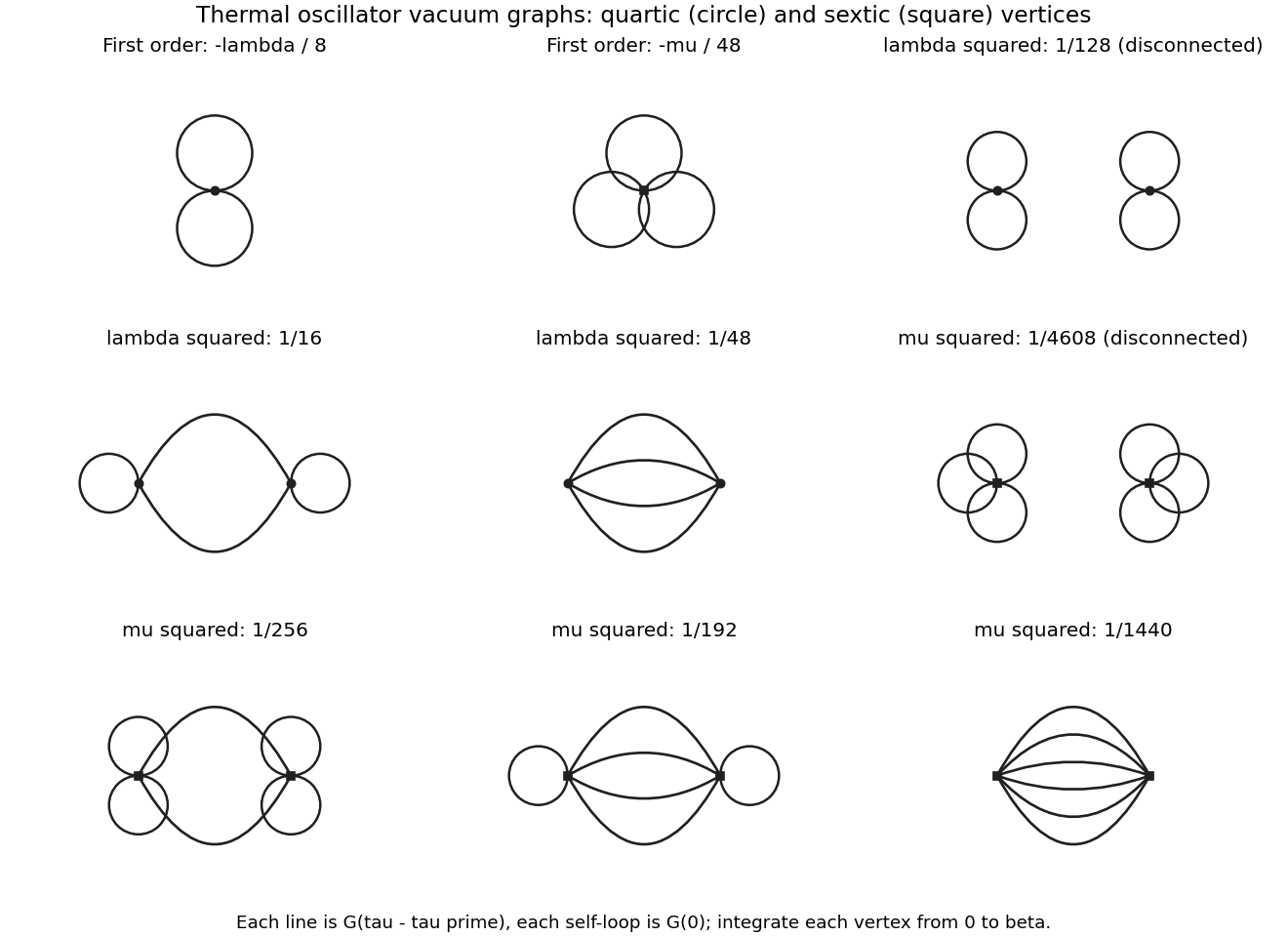
Quartic and sextic oscillator vacuum graphs through second order; the displayed coefficients include factorials and vertex interchange, and each vertex is integrated over the thermal circle
. Details. 
Write and . With two identical degree- vertices, let lines join them. The remaining half-edges on each vertex form self-loops. Both and are even. The number of Wick contractions issince one chooses and matches the joining half-edges and then pairs the rest independently. Dividing by the expansion denominator gives every symmetry factor weight without guessing graph multiplicities.
For two quartic vertices, givesThe graphs are respectively the product of two first-order two-loop graphs; two vertices joined by two lines with one self-loop on each; and two vertices joined by four lines with no self-loops.
For two sextic vertices, givesThe corresponding numbers of self-loops on each vertex are . All seven second-order graphs are drawn in solution; in each series the graph is disconnected and the others are connected.
For completeness, a mixed quartic-sextic pair, not needed for the two pure second-order coefficients, contributesTaking removes the products of first-order graphs, that is, the terms. The requested partition function retains them.
Articles by others on the same topic
There are currently no matching articles.