All eight questions are solved. Set unless a thermal factor is written explicitly. Relativistic calculations use the Minkowski metric . The unbracketed sums in the first two printed energies are read as sums over all the displayed bond terms, with the common prefactor applying to the entire summand.
Let and sum over all configurations of the Ising spins. The canonical partition function and Helmholtz free energy per site areBoth spins in each cell count as sites. In particular the denominator is , rather than .
The mean spin magnetization per site is the Boltzmann distribution averageEquivalently introduce a uniform magnetic field through and differentiate:This convention absorbs the microscopic magnetic moment into . Simultaneous reversal of every spin leaves invariant and changes the sign of the numerator, so at zero field for finite .
For each pair of adjacent spins, define the transfer matrix for a classical spin chain by . Multiplying its entries gives the Boltzmann factor of a whole configuration. The periodic boundary condition identifies the last index with the first, soThe assumed interchange symmetry of makes a real symmetric matrix, hence it has an orthonormal eigenbasis. At finite positive temperature, every matrix entry is strictly positive, so the Perron–Frobenius theorem supplies a unique positive largest eigenvalue , larger in modulus than every other one. Therefore .
Local observables become matrix insertions. For example, with ,Thus partition functions and correlation functions reduce to a fixed-dimensional eigenvalue problem, rather than a sum over exponentially many microstates.
For the sawtooth Ising chain, each apex spin occurs in only one triangle. Put . Summing that spin first gives the effective transfer matrixIn the ordered basis this isIts symmetric and antisymmetric eigenvectors are and , with eigenvaluesConsequentlyAt , the result is , correctly counting independent Ising spins. As , , the energy of three satisfied ferromagnetic bonds per two sites.
The printed summand lacks grouping brackets. The result above uses the translation-invariant common- interpretation. If base and apex bonds instead have independent couplings , the same derivation gives ; specifying those couplings is essential before giving a different answer.
Let be the base-spin insertion matrix. In the eigenbasis from solution, its diagonal matrix elements vanish: . Hencenot only at large but for every finite ring at zero field.
This vanishing is not merely an averaging artifact hiding a finite-temperature ordered phase. The two-point correlation function is . In the thermodynamic limit it becomes , with finite correlation length for every and . Thermal domain walls destroy long-range alignment in this one-dimensional short-range system. At zero temperature, the two fully aligned ground states are degenerate; that limiting case must be distinguished from any fixed positive temperature.
For a uniform classical spin with , the energy per bond isThe strict inequalities among the couplings make the direction the unique easy axis. ThusThese uniform configurations are also global classical minima: the largest singular value of the diagonal exchange matrix is , so each bond has energy at least , and both configurations saturate that bound.
A global rotation by about the axis sends to , preserves every exchange product, and exchanges the two ground states. A rotation about does the same. The broken discrete symmetry can be represented by either operation.
The Hamiltonian has the discrete symmetry described in solution, whereas either selected easy-axis ground state has a nonzero order parameter and is not invariant under it. This is spontaneous symmetry breaking: the equations preserve the symmetry while the selected macroscopic quantum state does not.
An infinitesimal longitudinal magnetic field selects one orientation. The defining order of limits isin the ordered zero-temperature phase, with the opposite sign for . A symmetric finite-volume quantum state can instead have zero magnetization. Quantum ordered states are generally dressed by fluctuations rather than exact fully polarized product states, because unequal transverse exchange can create pairs of spin waves. Discrete easy-axis symmetry does not imply a gapless Goldstone mode; indeed solution finds a nonzero spin wave gap. Nor does this argument assert positive-temperature order in a one-dimensional short-range chain.[ref]
Statistical Field Theory by David Tong. Section 1.2.1, spontaneous symmetry breaking and the order of thermodynamic and zero-field limits
The Holstein–Primakoff transformation replaces each finite-dimensional spin algebra by a bosonic creation operator and annihilation operator, while restricting the local occupation number to . The number counts deviations from the fully polarized reference quantum state. Its zero-boson Fock vacuum has .
The representation is exact on this physical subspace: the ordered square root gives and , reproducing the spin commutation relations. For ,so the leading Hamiltonian is quadratic in bosons and describes spin waves.
The square root generates boson interactions beyond leading order and its operator ordering matters. Truncation also enlarges the Hilbert space to unphysical occupations unless the low-density approximation remains self-consistent. Large fluctuations, particularly near a gap closing or in low dimensions, can invalidate the linear spin-wave approximation even when its algebraic manipulation is straightforward.
Choose the positive- reference ground state and use the cyclic rotationThis is a right-handed permutation, so it preserves the spin commutation relations. It puts the ordered direction along the Holstein–Primakoff transformation's quantization axis. To the required order,The longitudinal exchange contributes . The transverse terms contributeDropping the constant and all terms of order or smaller gives the stated linear spin-wave approximation, withThe anomalous pair terms are present because the two transverse couplings differ. A different right-handed choice of transverse axes can change the sign of by a boson phase convention, while leaving the dispersion relation unchanged.
Use the unitary discrete Fourier transform , where . Thenwith and . The factor accounts for the duplicated pair in the full momentum sum.
Make a bosonic Bogoliubov transformation . Its coefficients preserve the canonical commutation relation because . The coefficient of the pair term vanishes when . ThusThe dropped constant is in addition to the classical ground-state energy. Since , at every , so the bosonic Bogoliubov diagonalization is stable. The minimum occurs at and gives the energy gap . In the isotropic limit the pair coefficient vanishes and the familiar quadratic small- ferromagnetic dispersion relation is recovered.
Use . Taking the trace of the imaginary-time time-evolution operator identifies the initial and final position, giving the path integralThe measure includes integration over the common endpoint. The paths are real periodic bosonic paths on the imaginary-time circle, not paths with fixed zero endpoints and not only classical trajectories. The kinetic measure is defined by time slicing; typical contributing paths need not be differentiable. For the free expansion assume . The interacting partition function requires a potential bounded below; otherwise the following formulas have the meaning of a formal perturbation series about the free harmonic oscillator.
Here the imaginary-time Heisenberg picture position operator is , where . Bosonic time ordering places the larger imaginary time to the left without an exchange sign. The brackets denote the normalized thermal expectation valueThe trace is cyclic and is time independent, so the two-point correlation function depends only on the time difference and extends periodically with period . This periodicity is a property of the thermal correlation function, not the operator identity .
The free Euclidean action has inverse propagator . Therefore the thermal Green's function obeyswhere is the periodic Dirac delta function. It is continuous, has continuous first derivative away from its source, and satisfies . These conditions follow by integrating the differential equation across the source and using the bosonic thermal trace.
For , solving the homogeneous equation on and imposing these conditions givesIn particular . Equivalently with bosonic Matsubara frequencies .
Keep the same measure normalization as in the free generating functional and defineHere is the source-dependent partition function, despite the common alternative convention in which that letter denotes its logarithm. A functional derivative of brings down one factor at the differentiated point. Expanding the interaction exponential and replacing each such factor by therefore givesCompleting the square in the free Gaussian integral gives because with periodic boundary conditions. Restoring replaces the upper limit by and the interaction coefficients by and , exactly as in the source.
Set the external source to zero in solution and apply Wick's theorem. At a single quartic vertex, the four position insertions have three pairings; at a single sextic vertex, six insertions have pairings. ThusThermal time-translation invariance makes this , with from solution. If desired the absolute corrections follow by multiplying by the free partition function .
The first Vacuum Feynman diagram is one quartic vertex carrying two self-loops, with weight before time integration. The second is one sextic vertex carrying three self-loops, with weight . No disconnected subtraction is appropriate for itself. The top row of the following figure shows these first-order terms and the conventions for solution.
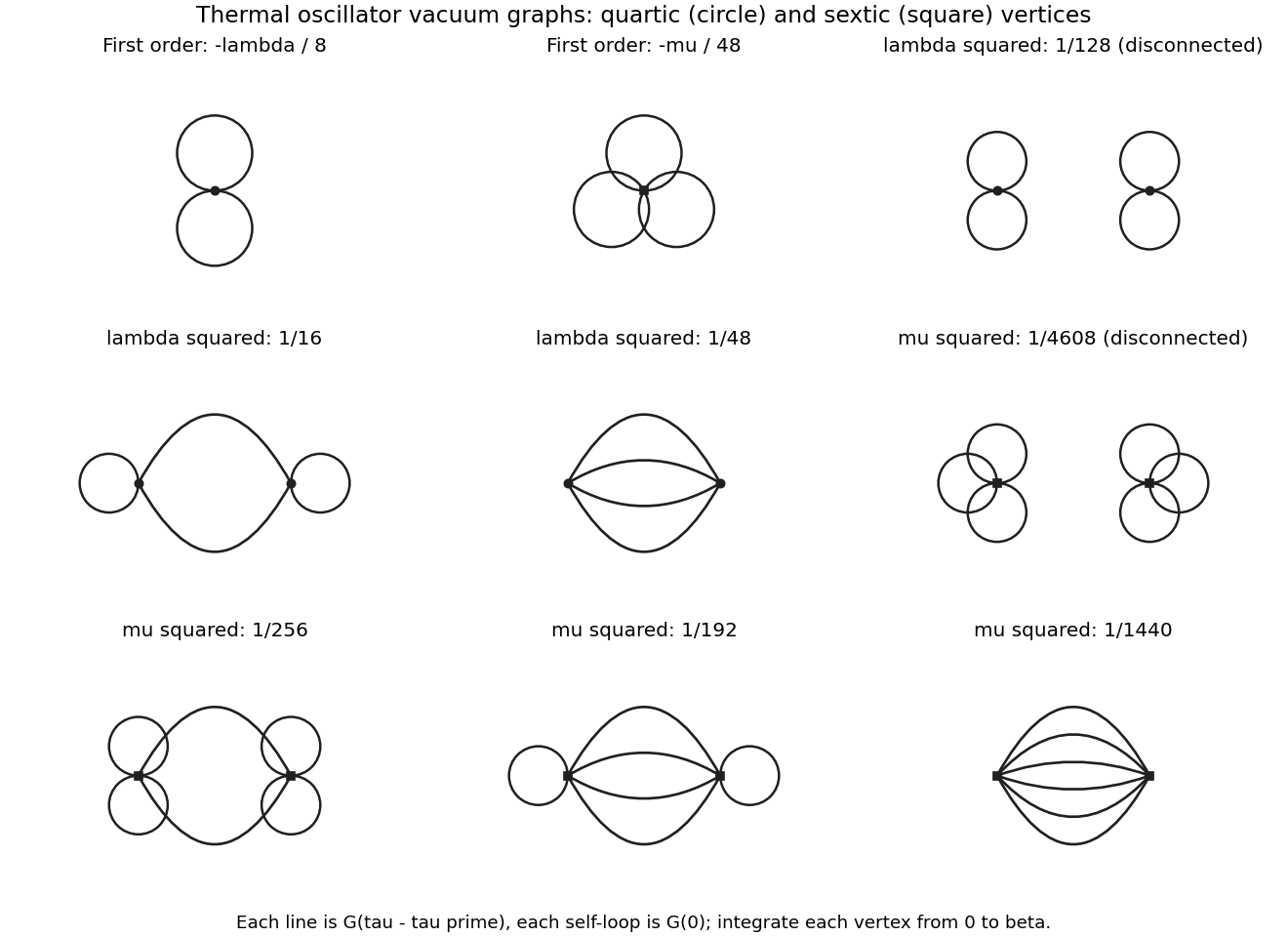
Quartic and sextic oscillator vacuum graphs through second order; the displayed coefficients include factorials and vertex interchange, and each vertex is integrated over the thermal circle
. Details. 
Write and . With two identical degree- vertices, let lines join them. The remaining half-edges on each vertex form self-loops. Both and are even. The number of Wick contractions issince one chooses and matches the joining half-edges and then pairs the rest independently. Dividing by the expansion denominator gives every symmetry factor weight without guessing graph multiplicities.
For two quartic vertices, givesThe graphs are respectively the product of two first-order two-loop graphs; two vertices joined by two lines with one self-loop on each; and two vertices joined by four lines with no self-loops.
For two sextic vertices, givesThe corresponding numbers of self-loops on each vertex are . All seven second-order graphs are drawn in solution; in each series the graph is disconnected and the others are connected.
For completeness, a mixed quartic-sextic pair, not needed for the two pure second-order coefficients, contributesTaking removes the products of first-order graphs, that is, the terms. The requested partition function retains them.
The term is directed self-propulsion at fixed speed, while the two components of generate translational Brownian motion with diffusion coefficient . The angle has systematic angular velocity and rotational diffusion coefficient . With independent standard Brownian motions, the precise stochastic differential equations areIndependent translational and rotational noises are the usual interpretation; the supplied autocorrelations alone would not specify arbitrary cross-correlated noises.
The complete state is a Markov process: its future increments depend only on its present state and independent future noise. Its generator is . Position alone generally lacks the Markov property, since an unobserved current orientation carries memory into future displacements. At long scales orientation averaging produces the effective positional diffusion equation in solution.
Use the unwrapped angle on the real line. Integrating its Langevin equation gives , where is a centered Gaussian random variable with variance . ThereforeA wrapped angular difference is bounded and would not satisfy this formula.
For the orientation correlation, . The characteristic function gives , soThe translational noise is independent of the orientation, hence the cross terms vanish. Summing its two component correlations gives . Consequently, for ,The extension to negative time uses . Because the position contains Brownian motion, the instantaneous noise velocity and its correlation are distributions; the delta contribution is not a finite ordinary velocity at .
Integrate the two velocity factors over the time square . The white noise contribution is . The orientation contribution depends only on the time separation, givingThis double-integral derivation fixes the delta contribution without ambiguity about a half-weight at an endpoint. Put . Elementary integration givesUsing and multiplying out the second term yieldsThe constant and decaying terms cancel at , as required. The apparently singular case is evaluated from the integral, giving .
For , expand the exact expression:At asymptotically short time, translational diffusion dominates if . A ballistic window occurs when , provided these scales are separated. The swimmer then retains nearly constant direction.
For and , the oscillatory exponential decays andAt intermediate times, the angular drift bends persistent trajectories into arcs. If , several rotations occur before orientational decorrelation, producing oscillatory shoulders rather than a long straight ballistic regime. In the limit , , the active contribution is bounded and periodic: . At , it remains ballistic forever, so ordinary late-time active diffusion does not follow.
For , the central-limit coarse graining of the position gives the late-time Fokker-Planck equationThere is no surviving drift after orientation averaging. This is an effective large-time, large-distance equation, not the exact closed equation for position at all times.
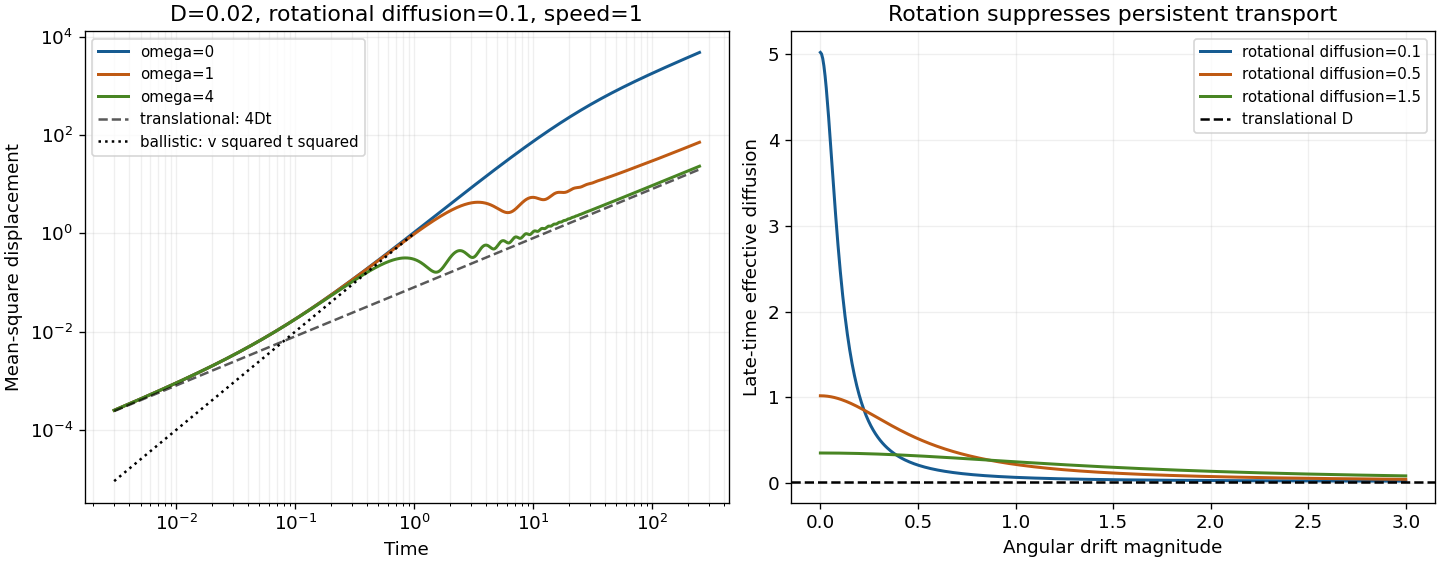
Exact displacement of a persistent chiral swimmer: ballistic and diffusive windows, rotation-induced shoulders, and suppression of active diffusion by angular drift
. Details. 
Varying the real scalar field gives the Euler-Lagrange field equation . Since , the answer isFor , introducing gives , the Sine-Gordon equation. The proposed real localized kink requires ; arbitrary real do not guarantee that condition. In what follows put . The displayed potential itself requires , unless a limiting prescription is specified.
Allow a freely chosen center , set and . Direct differentiation of the proposed Sine-Gordon kink givesThe angle identity givesSince , these formulas show , precisely the static equation of motion.
For and , the field approaches and respectively. These are neighboring minima of the scalar potential when , and vanishes exponentially at either end. The energy is therefore finite and the topological charge is one. Reversing gives the corresponding antikink. If , the printed real exponential profile is unavailable; its formal imaginary scale is not a real finite-energy solution of the stated form.
The Lagrangian density is Lorentz invariant, so a scalar-valued static solution can be composed with a Lorentz transformation. Let , with and . If , the chain rule givesThe boosted equation of motion is therefore exactly the static one already verified in solution, andis a solution. The center moves as : is the physical velocity in units where the limiting speed is one. The kink width contracts from to , while its topological charge remains unchanged.
For a static finite-energy field, the Hamiltonian density is . Multiply the static equation of motion by and integrate once:At either vacuum endpoint both terms vanish, so . The total energy density is consequently . Its integral givesFor the usual positive convention this isThe coefficient depends on the dimensionless parameter ; it is not a universal numerical constant independent of the potential. In two spacetime dimensions, and , so the dimensions are consistent. If both and are negative while , the real answer is instead ; the literal factor would not be real.
An equivalent positive-parameter calculation substitutes in and uses the provided integral of . The following original plot shows that the localized energy density sits where the field passes between the vacua.
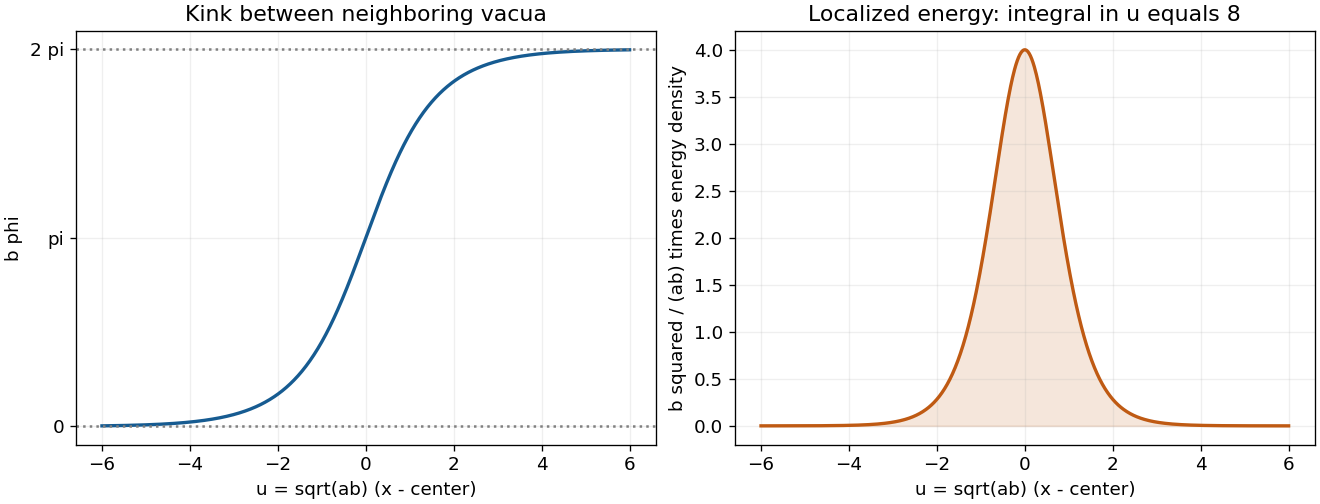
The dimensionless sine-Gordon kink profile and its localized static energy density, with total dimensionless energy eight
. Details. 
The continuous spacetime symmetries are translations, spatial rotations and Lorentz boosts, together the connected Poincaré group. The theory also has local electromagnetic U(1) gauge symmetry, which is an internal symmetry rather than a spacetime transformation. A nonzero mass and a dimensionful interaction do not give an additional exact scale invariance.
In four dimensions the action is dimensionless and . The two kinetic terms giveThe axion-photon operator has mass dimension five, so this is an effective field theory. Its dimensionless interaction strength grows with energy as . Without information about an ultraviolet completion, a conservative parametric validity condition is with , and must also lie below that scale for the axion to be a degree of freedom in the effective theory. Numerical factors such as depend on the ultraviolet dynamics and on the chosen perturbative criterion; the Lagrangian alone does not fix them.
The axion variation gives , soFor the photon variation, the dual electromagnetic field tensor obeys . Antisymmetry then givesThere is no undifferentiated , henceThe last equality uses the electromagnetic Bianchi identity . These signs follow from the positive interaction in the source; reversing that interaction reverses both source terms. The induced electromagnetic current is identically conserved: its divergence contracts a symmetric second derivative of with an antisymmetric tensor, while the remaining term vanishes by the same Bianchi identity.
Evaluate the two-body Lorentz-invariant phase space in the parent's rest frame, . The spatial Dirac delta function sets . For massless daughters , soThe factor in the last step is the derivative of the delta-function argument. Substituting into the decay width gives, for labelled or distinct daughters,The angular domain is one sphere: and , equivalently . The printed negative-to-positive polar-angle interval is not a second independent coverage of the sphere.
For identical daughters, integration over the full labelled two-body phase space counts each physical final state twice. One must therefore include an additional factor , or equivalently integrate over an unordered half-domain. This distinction is necessary for the two identical photons in solution.
With outgoing physical photon polarization vectors, the Feynman rule givesThe overall phase does not affect the decay width. Replacing either polarization vector by its own four-momentum gives zero by antisymmetry. Thus the Ward identity permits replacement of each physical photon polarization sum by inside this amplitude. The printed sum is not an equality of free-standing physical two-polarization tensors: for a photon moving along , its physical component is zero whereas . Gauge-dependent longitudinal terms cancel only after contraction with the transverse amplitude.
The contraction of the two Levi-Civita symbols givessince and . No initial spin average is needed for the spin-zero axion. The result is independent of direction in its rest frame. Including the identical-particle factor explained in solution therefore givesOmitting would overestimate the physical rate by two. The normalization agrees with the standard axion-photon convention.[ref]
Review of Particle Physics by Particle Data Group (2022). Axions and Other Similar Particles, page 4, equation (90.8): two-photon decay width for the coupling multiplying a F dual-F divided by four
Impose the discrete Z2 symmetry . The quadratic and quartic trace invariants are unchanged, while changes sign. Invariance therefore forbids a nonzero coefficient of that cubic operator. This is an additional symmetry of the scalar potential, not a consequence of SU(5) conjugation alone; cubic traces are permitted by the latter.
The spectral theorem for a Hermitian matrix gives a unitary diagonalizer with and real . Similarity preserves the trace, so .
To ensure that the diagonalizer belongs to SU(5) rather than only the unitary group , write and put . Its determinant is one, and the scalar phase cancels from its conjugation action. ThusThe same argument shows why no additional reality condition beyond Hermiticity is needed. Permuting the real eigenvalues merely changes their order in the diagonal form.
Write and impose tracelessness by a Lagrange multiplier . Differentiating givesFor , each eigenvalue is a real root of the same nonzero cubic polynomial, so at most three distinct values occur at any stationary point, in particular at any existing minimum. If the multiplicities are , the unbroken subgroup is the block centralizerIts connected Lie algebra is . The partitions allowed by this upper bound are , , , , and . These are candidate patterns, not a proof that every one is a stable minimum for given couplings. For three distinct roots, the absent quadratic coefficient also implies that their unweighted sum is zero; tracelessness imposes an additional multiplicity-weighted relation.
The unrestricted printed claim has an exception. If , and , every traceless matrix with is a global minimum. For examplehas five distinct eigenvalues and attains that minimum. Its unbroken subgroup is the maximal torus . The cubic argument therefore requires a nonzero , or another condition excluding the identically vanishing stationarity polynomial. Couplings for which the potential is unbounded below have no global minimum to classify.
Use a Hermitian gauge field and . With fundamental covariant derivative , the adjoint derivative isIt transforms as , provided .
The infinitesimal parameter in must be Hermitian and traceless, from unitarity and unit determinant. It is not generally antisymmetric as the hint states. The valid generator is a concrete counterexample to that assertion.
Choose canonical adjoint kinetic normalization , which gives . For the diagonal vacuum expectation value , the matrix unit obeys . Thus the mass of the gauge boson associated with either normalized Hermitian generator joining is .
Within the three-dimensional and two-dimensional blocks, or for diagonal generators, the commutator vanishes. There are therefore massless gauge bosons. The interblock pairs supply two real generators each, hence 12 equally massive gauge bosons:The absolute mass formula assumes the stated kinetic normalization, which the question leaves implicit. Writing instead without rescaling would multiply these squared masses by .
This is the gauge group of the Standard Model, up to its global quotient, arising from one adjoint Higgs mechanism in a simple unified group. The unbroken abelian generator can be chosen as , so . This is the characteristic first breaking step of an SU(5) grand unified theory, rather than electroweak breaking all the way to electromagnetism.
Let be the free real-scalar Feynman propagator and the free complex-scalar one. Expanding the interaction exponential once and applying Wick's theorem gives the connected decay Green's functionThere is one allowed contraction of each external field with the appropriate vertex field, so no factorial remains. Fourier transformation gives the momentum-conserving delta factor times , and amputation of external propagators gives the decay vertex . An on-shell physical decay additionally requires .
If one literally asks for the full three-point correlation function without a connected restriction or a tadpole condition, it also containsthe product of the induced heavy-field one-point function and the free light-field two-point function. This disconnected tadpole diagram does not describe a three-particle decay and drops out of its connected amputated amplitude.
For two equally charged daughters the corresponding Green's function vanishes to every perturbative order:Every interaction contains equal numbers of and , so the two excess conjugate fields can never be paired. Equivalently the exact global U(1) symmetry , leaves the vacuum and action invariant, whereas this insertion has charge . Charge conservation forbids the decay of a neutral particle into two particles of the same nonzero charge.
The first-order Dyson series contains . For an amputated three-point Feynman diagram, each of the three distinct field types contracts in exactly one way. Writing each external plane wave in momentum space producesThus the momentum-space Feynman rule, with all four-momenta incoming, isAfter stripping the conservation delta factor, it is simply . There is no combinatorial factor because the interaction has three distinct field slots. The charged lines carry opposite charge-flow orientations and the real heavy line is neutral.
Put . The heavy-field equation of motion isThis solution describes the low-energy sector without an independent incoming heavy-particle wave. It is valid when all external momentum invariants and light masses squared are small compared with .
After an integration by parts, the terms involving the heavy field are . Substituting the solution into both terms, rather than the source term alone, givesHence, with the question's sign convention for the local quartic interaction,This is integrating out a field followed by a derivative expansion. The negative quartic means attraction. It also makes the truncated potential unbounded at large fields; minimizing the original potential over reveals the same negative quartic. Thus neither displayed model, without extra stabilizing interactions, supplies a globally stable nonperturbative vacuum. The matching describes perturbative low-energy scattering about the local vacuum. The simple equation-of-motion matching fixes the leading tree-level coefficient; precision quantum matching requires consistent loop renormalization and the additional effective operators at the requested accuracy.
Label the initial particle and antiparticle and the corresponding final momenta , with and . Charge flow permits an -channel heavy-scalar annihilation graph and a -channel heavy-scalar exchange graph. It excludes a third -channel graph for these fixed charge assignments. The effective theory has one contact graph.
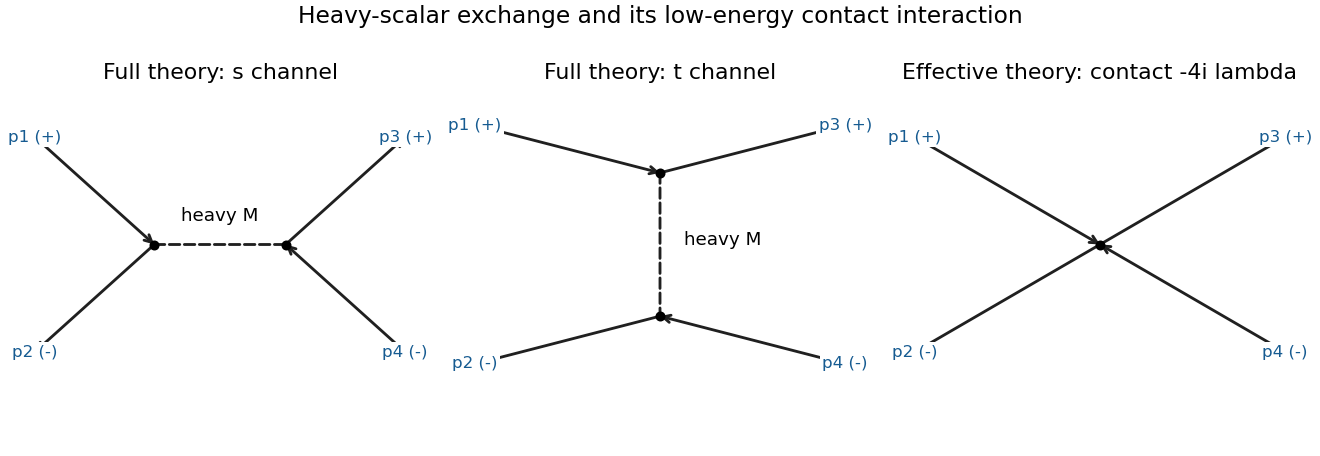
Particle-antiparticle scattering by heavy scalar annihilation and exchange, compared with its low-energy quartic contact interaction; external charge labels are held fixed
. Details. 
The two cubic Feynman vertices and the heavy propagator giveFor ,This independently checks the sign and the factor in solution. The next difference is the derivative correction of order in the amplitude.
Let denote the total center-of-mass energy, with . The final particle and antiparticle are distinct, so no identical-particle factor is needed. The leading isotropic differential scattering cross-section and total cross section areCorrections are relatively of order and, in a high-energy expansion, , in addition to loop corrections when they matter. If instead denotes each beam particle's energy, substitute before comparing numerical prefactors.
Articles by others on the same topic
There are currently no matching articles.