Let . Each independent fermion orbital is either empty or occupied once, so its grand partition factor is . Multiplying factors and taking the logarithm givesSince , this is the requested form. Spin or other orbital degeneracy is already included in .
For the Fermi-window convolution of the grand potential, defineDirect differentiation gives . The supplied PDF hint has the opposite sign; using that sign would contradict its grand-potential formula. Integrating twice with and vanishing upper boundary terms,At zero temperature , confirming .
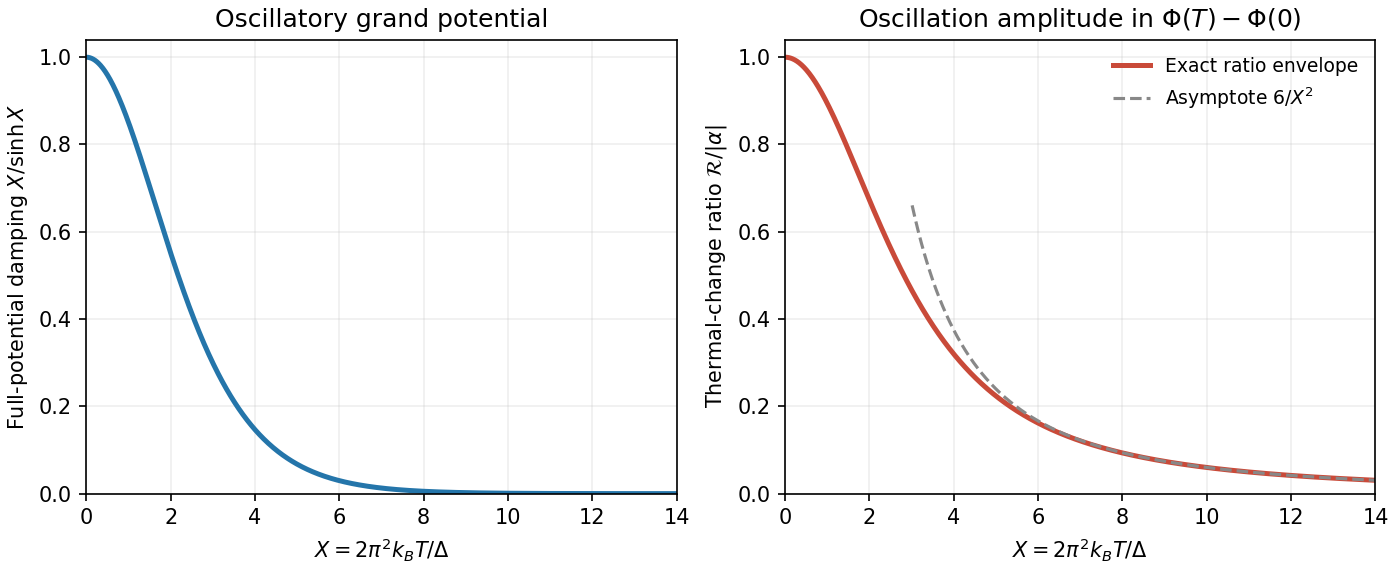
Use the source's implicit unit normalization of the constant density of states; restoring a constant baseline multiplies the following potentials by . For the sinusoidal density of states, direct integration givesPhysical nonnegative density of states requires . Write and . The Fermi windowis even, with full-line moments , and . The last integral follows, for example, by expanding on into its alternating exponential series. When , extending the lower integration limit to introduces only exponentially small band-edge corrections. The supplied Fourier transform givesThe odd sine term vanishes. Substitution provesThe thermal damping of a sinusoidal density of states is therefore in the full oscillatory potential. The requested ratio instead concerns the thermal change . Its oscillatory thermal-change amplitude ratio isFor positive it decreases smoothly from the limit to zero:At exactly both thermal changes vanish; the quoted value is their limiting ratio. The amplitude is the envelope in chemical potential. At a particular fixed , the signed contribution ratio has in place of ; at an oscillation node the actual oscillatory contribution is zero. The large- behaviour still requires , so the useful range is .

Articles by others on the same topic
There are currently no matching articles.