Original paper: Public original PDF, physical pages 199–202; cover on page 199 and questions on pages 200–202.
Use thermal de Broglie wavelength and spacing . Degeneracy onset from thermal wavelength occurs atThe numerical factor depends on the convention for a typical momentum, but the scale does not. For fermions the Fermi temperature gives a comparable scale for spin degeneracy two.
Representative estimates, with the assumed densities stated explicitly, are:
| System | Assumed number density | Assumed particle mass | |
|---|---|---|---|
| Conduction electrons | |||
| Dilute heavy atomic cloud | |||
| Neutrons at nuclear-scale density |
Here is the atomic mass constant. Thus the characteristic orders are for electrons, sub-microkelvin for a dilute heavy atomic gas, and for neutrons. There is no density-independent quantum-degeneracy temperature for atomic gases: for example, taking and mass instead gives about . These are illustrative input estimates, not values supplied by the paper. Denser neutron-star cores require relativistic and interaction corrections; the estimate identifies the degeneracy scale rather than a precise stellar temperature.
Assume three-dimensional isotropic gapless excitations, zero chemical potential and one independent branch. Momentum-state counting givesSubstituting into the Bose energy integral shows and . The observed exponent therefore gives .
For the quadratic-boson heat-capacity coefficient, the required Bose integral isThe equality follows by expanding and integrating term by term. HenceThe supplied units make its a heat capacity per volume. Equating its coefficient to givesEquivalently has . For identical branches, the measured coefficient fixes , so instead . The one-branch convention is necessary for the quoted numerical value. The supplied integral with is not the moment arising for the exponent determined here.
For either phase, the entropy differential at fixed composition isThe pressure derivative uses the Maxwell relation from . Differentiating the equality of entropies along coexistence gives the general relationFor a differentiable coexistence curve with pressure varying, equality of Gibbs free energies also implies . Since , the two phases then share . Thus, with ,This is the Ehrenfest entropy-continuity relation. Entropy equality alone would give without the shared-volume condition; a constant-pressure boundary or vanishing discontinuities needs separate limiting analysis.
Landau theory expands a thermodynamic potential in an order parameter, constrained by symmetry. For a scalar with sign-reversal symmetry, a useful free-energy density isHere is the conjugate field. At , minimizing rather than merely finding stationary points givesThe symmetry-related minima represent spontaneous symmetry breaking, as for a simple uniaxial ferromagnet with magnetization as order parameter. An infinitesimal field selects one sign. Above , the susceptibility is ; below it the stable-branch susceptibility is . Minimization lowers by below , producing a heat-capacity density jump with continuous entropy.
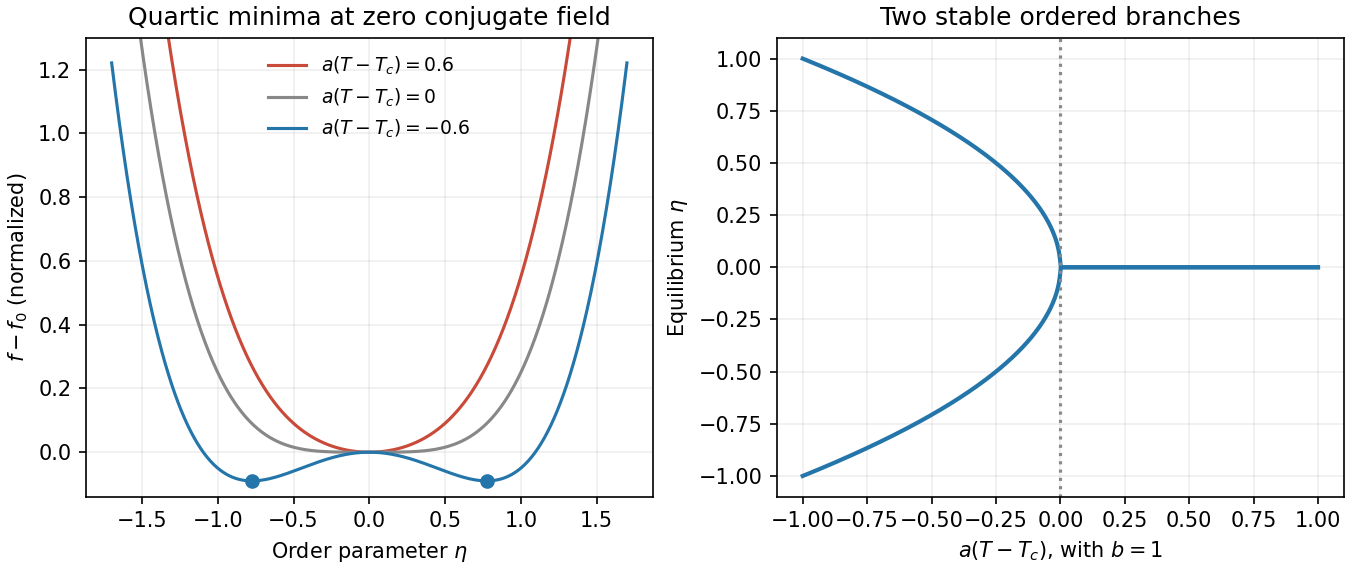
Landau minima
. Original normalized quartic free-energy curves above, at and below a continuous transition, with the two symmetry-related equilibrium order-parameter branches. Details.
A negative quartic coefficient requires a stabilizing with . It can produce a first-order transition before the quadratic coefficient changes sign: coexistence occurs at and . Odd terms are allowed when the assumed symmetry is absent. Landau theory predicts mean-field exponents; spatial fluctuations can change critical behaviour, especially close to a critical point in low dimensions. A gradient term extends the model to nonuniform order parameters but does not by itself supply dynamical equations.
Brownian motion arises from many microscopic collisions. A one-dimensional Langevin description isThe fluctuation-dissipation relation ties random forcing to drag, ensuring thermal equilibrium. For a free particle set . With initially thermal velocities, its mean-square displacement isIt is ballistic, , at short times and diffusive, , for . In three dimensions the corresponding long-time result is . At diffusive times, the position propagator from a specified origin is Gaussian with variance per coordinate. A small sphere in a viscous liquid supplies a physical example; in the slow unbounded-fluid limit its drag is .
For a harmonic trap, overdamped relaxation has time , equilibrium variance and stationary correlationConsequently stationary trapped Brownian displacement obeysConfinement makes this displacement saturate, unlike free diffusion. A trajectory initialized exactly at the centre instead has variance ; confusing that conditional variance with the stationary displacement gives an erroneous factor of two. The equilibrium position distribution is proportional to . More general finite confinement has a geometry-dependent equilibrium distribution and bounded displacement, not necessarily a Gaussian one.
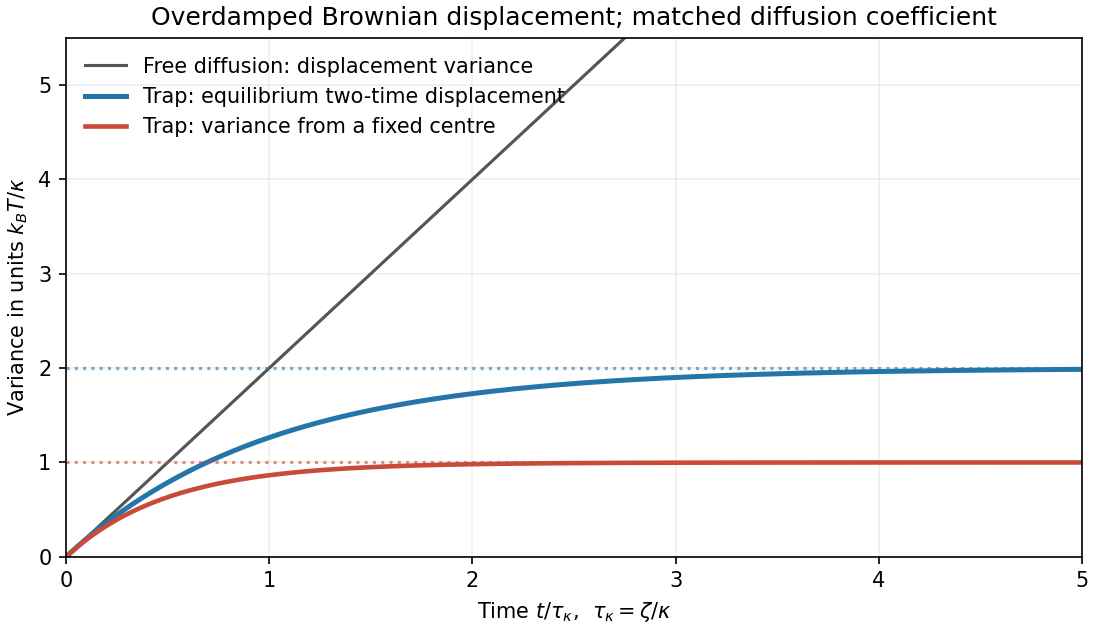
Free and trapped Brownian motion
. Original analytic mean-square-displacement curves compare free overdamped diffusion, a stationary harmonic trap and a fixed-origin harmonic-trap variance. The last two have different initial ensembles. Details.
Bose-Einstein condensation is macroscopic occupation of a single lowest-energy one-particle state. For a homogeneous three-dimensional ideal gas of conserved massive bosons, set that energy to zero. The excited-state population isHere . As , the excited states can hold only particles. Additional particles occupy the ground state. ThusThe isolated ground state must be counted separately from the continuum density of states; otherwise one misses the condensate. A dilute atomic gas is a physical realization of the quantum-degeneracy regime, but trapping geometry and interactions modify the homogeneous ideal-gas formulas.[ref]
Statistical Physics by David Tong. §3.5.3: saturation of excited states, separate ground-state occupation and ideal-gas condensation temperature
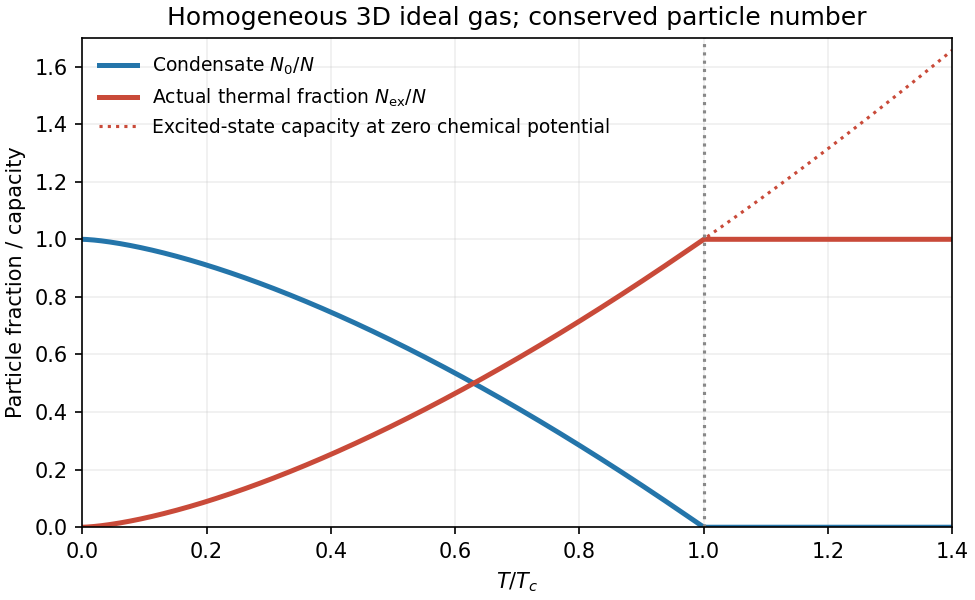
Ideal Bose condensate fraction
. Original homogeneous three-dimensional ideal-gas condensate fraction and maximum thermal population, normalized to the critical temperature. No trapped-gas or experimental data are implied. Details.
In the homogeneous ideal gas, one and two dimensions do not have finite-temperature condensation in the thermodynamic limit because the low-energy population integral diverges. Finite size or a trap changes that conclusion's assumptions. Condensation and superfluidity are distinct: the ideal quadratic gas has zero Landau critical velocity, while interactions can support a sound mode and superfluid flow. Neither zero viscosity nor phase-rigid flow follows from the occupation formula alone.
Let . Each independent fermion orbital is either empty or occupied once, so its grand partition factor is . Multiplying factors and taking the logarithm givesSince , this is the requested form. Spin or other orbital degeneracy is already included in .
For the Fermi-window convolution of the grand potential, defineDirect differentiation gives . The supplied PDF hint has the opposite sign; using that sign would contradict its grand-potential formula. Integrating twice with and vanishing upper boundary terms,At zero temperature , confirming .
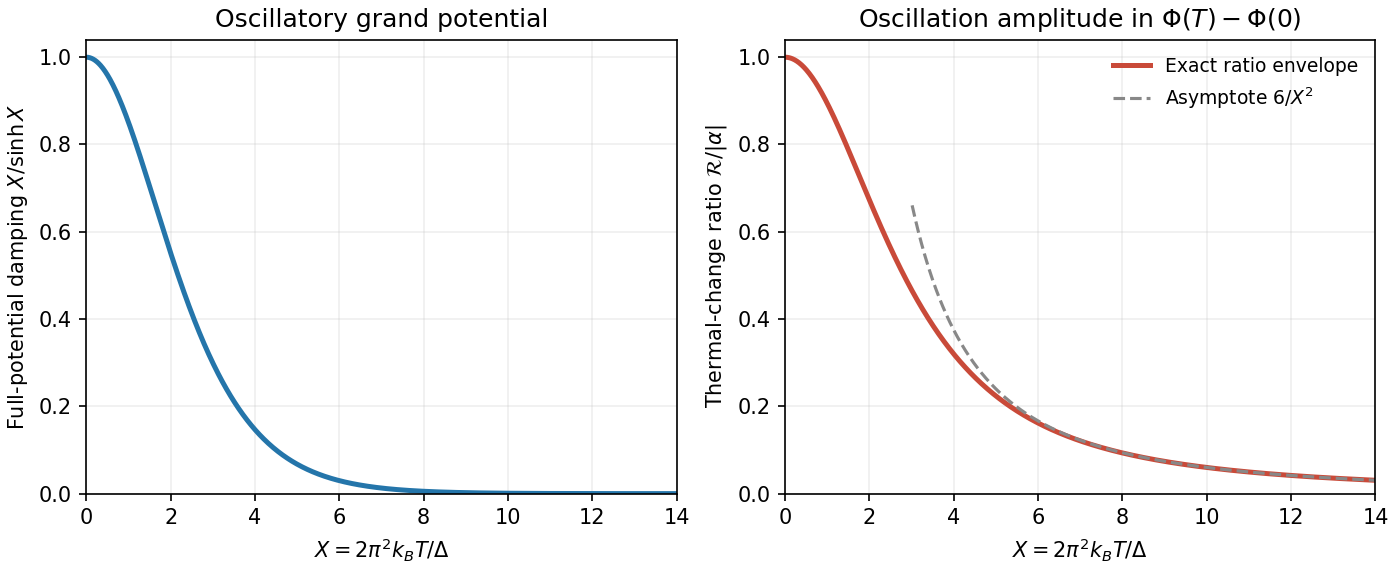
Use the source's implicit unit normalization of the constant density of states; restoring a constant baseline multiplies the following potentials by . For the sinusoidal density of states, direct integration givesPhysical nonnegative density of states requires . Write and . The Fermi windowis even, with full-line moments , and . The last integral follows, for example, by expanding on into its alternating exponential series. When , extending the lower integration limit to introduces only exponentially small band-edge corrections. The supplied Fourier transform givesThe odd sine term vanishes. Substitution provesThe thermal damping of a sinusoidal density of states is therefore in the full oscillatory potential. The requested ratio instead concerns the thermal change . Its oscillatory thermal-change amplitude ratio isFor positive it decreases smoothly from the limit to zero:At exactly both thermal changes vanish; the quoted value is their limiting ratio. The amplitude is the envelope in chemical potential. At a particular fixed , the signed contribution ratio has in place of ; at an oscillation node the actual oscillatory contribution is zero. The large- behaviour still requires , so the useful range is .

For two localized energy levels with degeneracies , let . Canonical equilibrium givesHere is the total upper-level occupation probability and are per unit. For nondegenerate levels the entropy rises from zero to , while the heat capacity vanishes at both low and high temperatures and has a Schottky maximum near . A spin one-half in a field, or a localized defect with two configurations, supplies an example. Higher levels must be thermally inaccessible; unequal degeneracies change the populations and peak. Distinguishable localized units have total partition function , unlike a gas of indistinguishable particles sharing just two orbitals.
For the magnetic atom, choose level labels with , . Put . Its partition function and exact entropy of a finite magnetic multiplet areThe ratio form has removable limit . Since is a function of only, it depends on field and temperature solely through . For fixed at small , symmetry removes the odd powers and the supplied sum of givesFor large , the expansion requires , not merely .
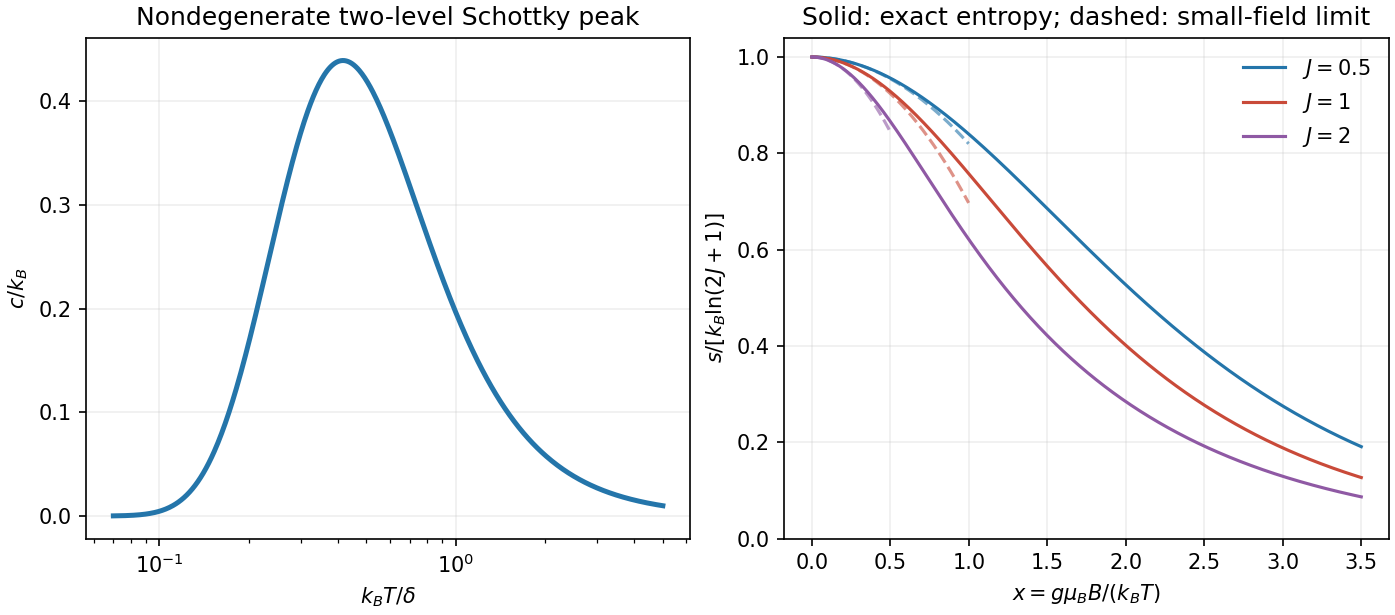
Two-level heat and magnetic entropy
. Original Schottky heat-capacity curve and exact finite-spin entropies show the entropy deficit removed by isothermal magnetization. Quadratic high-temperature expansions are shown only over a limited small-field interval. Details.
For demagnetization with a linear-heat-capacity load, integrate its specified :Isothermal magnetization at removes spin entropy; the bath receives the corresponding heat. During the following reversible, thermally isolated demagnetization, it is the combined entropy of spins and load that stays constant. At the minimum-field endpoint , the ideal independent spins reach . ThereforeThe bracket is the initial magnetic entropy deficit. The PDF's intermediate equality uses the initial entropy itself instead; with its preceding definition of , that equality omits the maximum-entropy term. The corrected balance recovers its final temperature formula:Without the small-field expansion, the exact independent-spin prediction is . As a check, zero initial field gives zero entropy deficit and no cooling. The incorrectly printed intermediate balance would fail this check.
The result requires the load law throughout the temperature interval, hence ; a small initial Zeeman splitting, quantitatively ; positive final temperature; negligible additional heat capacities and heat leaks; thermal equilibration between subsystems; and a reversible sweep slow enough to maintain equilibrium. A negative extrapolated temperature is a breakdown of this approximation, not a cooling prediction. Spins alone would keep fixed, but the attached load changes that adiabat by transferring entropy to them as it cools.
Interactions invalidate the product of independent one-site partition functions. The entropy must be computed from the many-body energy spectrum or a justified interacting approximation. Correlations and possible magnetic ordering introduce an interaction scale and can remove the independent-spin entropy available for cooling near zero field. Internal fields and ordering commonly limit practical demagnetization. The detailed correction and any residual entropy depend on the interaction Hamiltonian, dimensionality and frustration; neither a universal ordering temperature nor a numerical final-temperature correction is specified here.
Articles by others on the same topic
There are currently no matching articles.