A black body absorbs incident electromagnetic radiation and, in equilibrium, emits a spectrum determined by temperature alone. A cavity with a small aperture approximates this ideal. Photon number is not conserved in thermal equilibrium, so its chemical potential is zero. Combining the Bose occupation with the two-polarization electromagnetic mode density gives the spectral energy densityChanging variable to shows directly why the total energy density is proportional to :Three powers of T arise from the number of thermally populated modes and one from their characteristic energy. Isotropic radiation incident on a surface has outward hemispherical flux , givingThe factor 1/4 is the hemispherical angular average; multiplying energy density by c alone would overcount. The spectrum's frequency scale grows with T. Classical equipartition over all modes would instead produce the Rayleigh-Jeans ultraviolet divergence; the Planck occupation suppresses high-frequency modes. Real materials can have wavelength-dependent emissivity, and a body's net radiative exchange also includes absorbed environmental radiation.
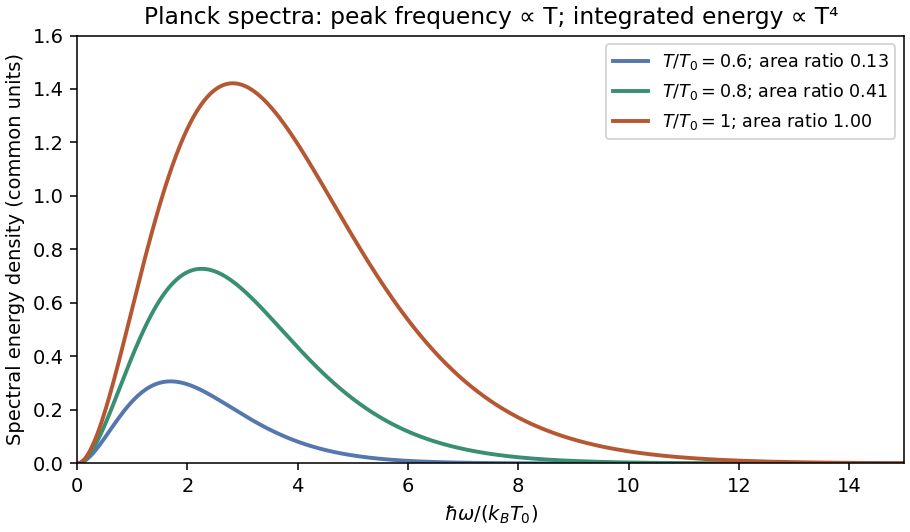
Original Planck energy spectra for three relative temperatures, showing the shift to higher frequencies and the growth of the integrated energy as temperature to the fourth power
. Details. 
Articles by others on the same topic
There are currently no matching articles.