Original paper: Public original PDF, physical pages 242–245; cover on page 242 and questions on pages 243–245.
In the classical equilibrium circuit, the capacitor stores . Equipartition assigns this quadratic term mean energy , soThe mean voltage is zero and its variance is . Resistance determines the equilibration time and noise spectrum, not this full-band equilibrium variance. A finite-bandwidth or appreciably loading readout can measure less than the ideal result.
Let and choose the nondegenerate energy levels as 0 and . For N independent identical units, ; set N=1 for a single two-level system. Differentiating its logarithm givesAt low temperature, and : the upper level is frozen out. At high temperature, the two levels approach equal populations, giving while . The energy therefore rises monotonically to a plateau, while the heat capacity has a Schottky peak:Unequal degeneracies would change the populations and peak; the usual equal-degeneracy model is stated here. Shifting both energy levels changes the energy baseline but not heat capacity.
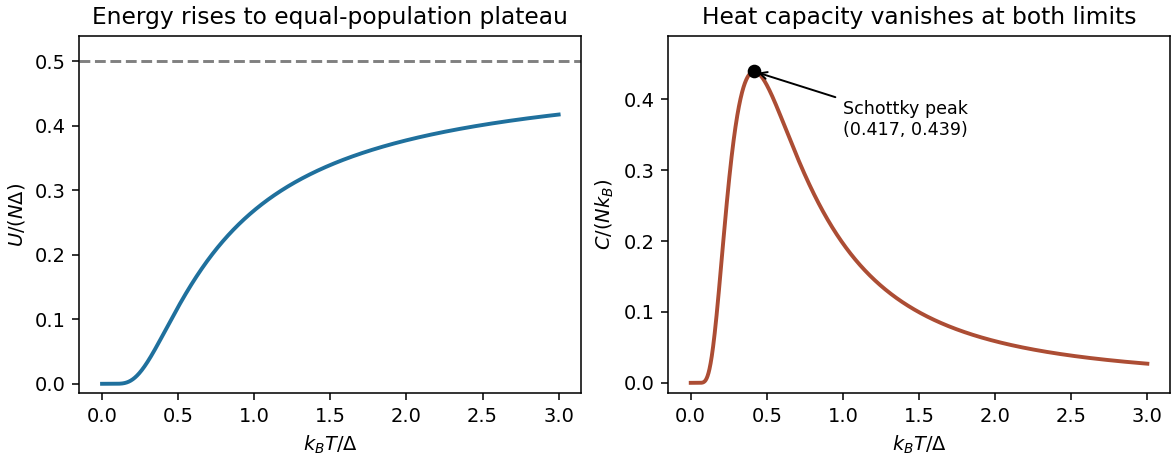
Original equal-degeneracy two-level internal-energy and heat-capacity curves, with the high-temperature plateau and Schottky peak marked
. Details. 
Use a three-dimensional ideal gas at the same number density n for both isotopes. An unpolarized helium-3 gas has spin degeneracy two, henceHelium-4 has a single spin state, and the ideal Bose-gas saturation condition givesEliminating n, using and , yieldsThe fermionic spin degeneracy must be included. This is an ideal-gas estimate; strong interactions in liquid helium prevent identifying it with an exact experimental transition temperature.
Equipartition gives mean energy for each independent quadratic term in a classical canonical Hamiltonian. For example, and each contribute this amount in a harmonic oscillator. It is a thermal average, not an instantaneous equality; constraints, nonquadratic terms or quantum level spacings large compared with require a different calculation.
The fluctuation-dissipation theorem connects equilibrium fluctuations with the dissipative part of linear response. If an applied force couples as , use response to and define the two-sided angular-frequency spectrum . The classical relation isFor a viscously damped particle, , the corresponding white-noise force satisfies . Noise replenishes energy lost by friction; their strengths cannot be varied independently at fixed equilibrium temperature.
Electrically, the one-sided voltage-noise spectrum per hertz of an equilibrium resistor is . A capacitor in parallel filters it toThe same equilibrium voltage variance follows from equipartition. Increasing R makes the spectrum taller and narrower without changing its integrated area. This thermodynamic connection between dissipative conductance and thermal electrical fluctuations is the content of the classical noise calculation.[ref]
Thermal Agitation of Electric Charge in Conductors by Harry Nyquist. 1928, abstract: equilibrium thermodynamic and statistical calculation of thermal electromotive force
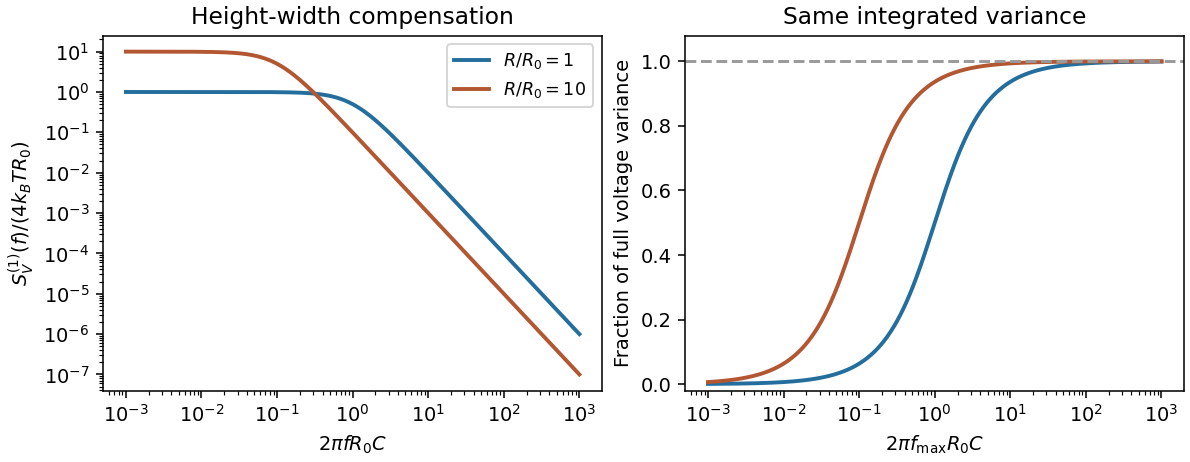
Original normalized resistor-capacitor noise spectra: increasing resistance changes the spectral width and height while preserving the full equilibrium variance
. Details. 
A black body absorbs incident electromagnetic radiation and, in equilibrium, emits a spectrum determined by temperature alone. A cavity with a small aperture approximates this ideal. Photon number is not conserved in thermal equilibrium, so its chemical potential is zero. Combining the Bose occupation with the two-polarization electromagnetic mode density gives the spectral energy densityChanging variable to shows directly why the total energy density is proportional to :Three powers of T arise from the number of thermally populated modes and one from their characteristic energy. Isotropic radiation incident on a surface has outward hemispherical flux , givingThe factor 1/4 is the hemispherical angular average; multiplying energy density by c alone would overcount. The spectrum's frequency scale grows with T. Classical equipartition over all modes would instead produce the Rayleigh-Jeans ultraviolet divergence; the Planck occupation suppresses high-frequency modes. Real materials can have wavelength-dependent emissivity, and a body's net radiative exchange also includes absorbed environmental radiation.
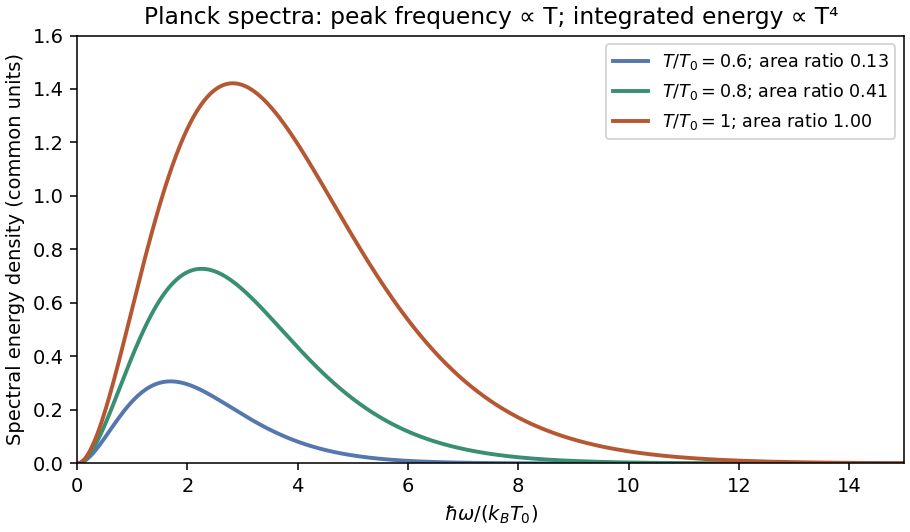
Original Planck energy spectra for three relative temperatures, showing the shift to higher frequencies and the growth of the integrated energy as temperature to the fourth power
. Details. 
An equation of state relates equilibrium pressure, temperature and density. The ideal-gas form neglects intermolecular forces and excluded volume. A low-density real-gas expansion iswhere the virial coefficients encode interaction effects and generally depend on temperature.
A simple phenomenological example is the molar Van der Waals equationHere v is molar volume, b represents excluded volume and the attractive interaction lowers pressure through a. Its dilute expansion gives . It recovers the ideal-gas limit but is not a quantitatively universal equation for all real gases.
Below its critical temperature, the raw isotherm contains a region with , corresponding to negative isothermal compressibility and mechanical instability. Equilibrium phase separation replaces that segment by a coexistence pressure satisfying equal chemical potentials, equivalently the Maxwell equal-area construction. The critical point follows from :The distinction between an unstable homogeneous branch and a stable two-phase state is essential when interpreting a real-gas equation of state.
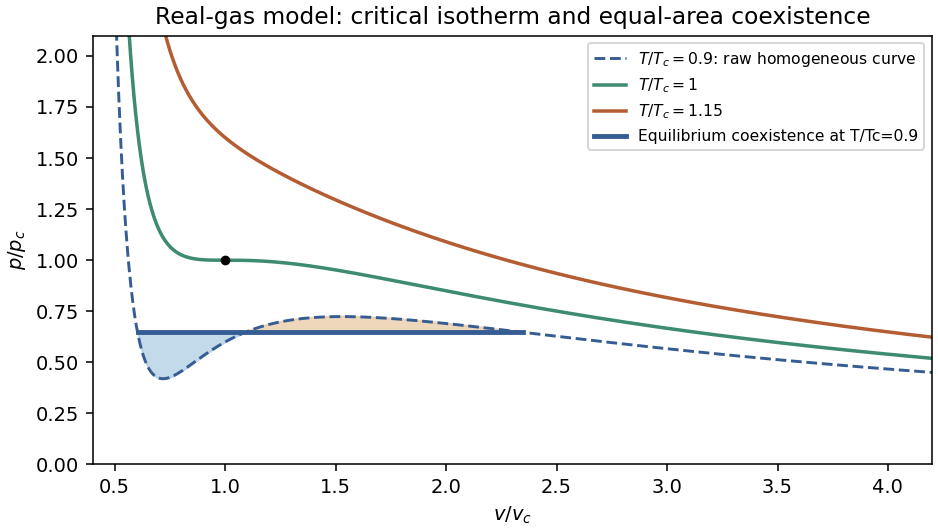
Original reduced van der Waals isotherms and a calculated Maxwell coexistence segment; these are model curves, not copied experimental data
. Details. 
Write . For one nondegenerate fermionic quantum state, the allowed occupations 0 and 1 give . For a bosonic state, summing all nonnegative occupations gives , requiring or . Differentiating the logarithm,The interacting point defect has two distinct spin states, not one fermionic state. Its four microstates have grand-canonical weights , with . The first two single-electron weights are separate up/down spin possibilities; the double state has one electron of each spin. ThusFor , and . The sketch is a single smooth step from 0 to 2, centred on , where . As its width tends to zero.
For positive U with , the lowest grand energies are successively , and . Away from the two crossings,Finite temperature smooths each step over an energy range of order . Near the lower step double occupation is exponentially suppressed, so . Near the upper step put and neglect the empty state, giving . Spin degeneracy shifts the half-step positions to and .
For a grand-canonical probability , differentiation gives . Multiplying by and summing provesFor this defect, direct state counting givesAt , and thereforeThe same limit gives : empty, up and down states have equal weights, while the double state is suppressed. Replacing this degeneracy by a two-outcome equal-weight model would incorrectly give variance at this chemical potential.
Across the full chemical-potential range the variance has two well-separated narrow peaks and tends to zero on the 0, 1 and 2 plateaux. The limiting shapes are near the lower step and near the upper one. Each peak has height , at the shifted half-step position; the variance at the unshifted crossings is instead .
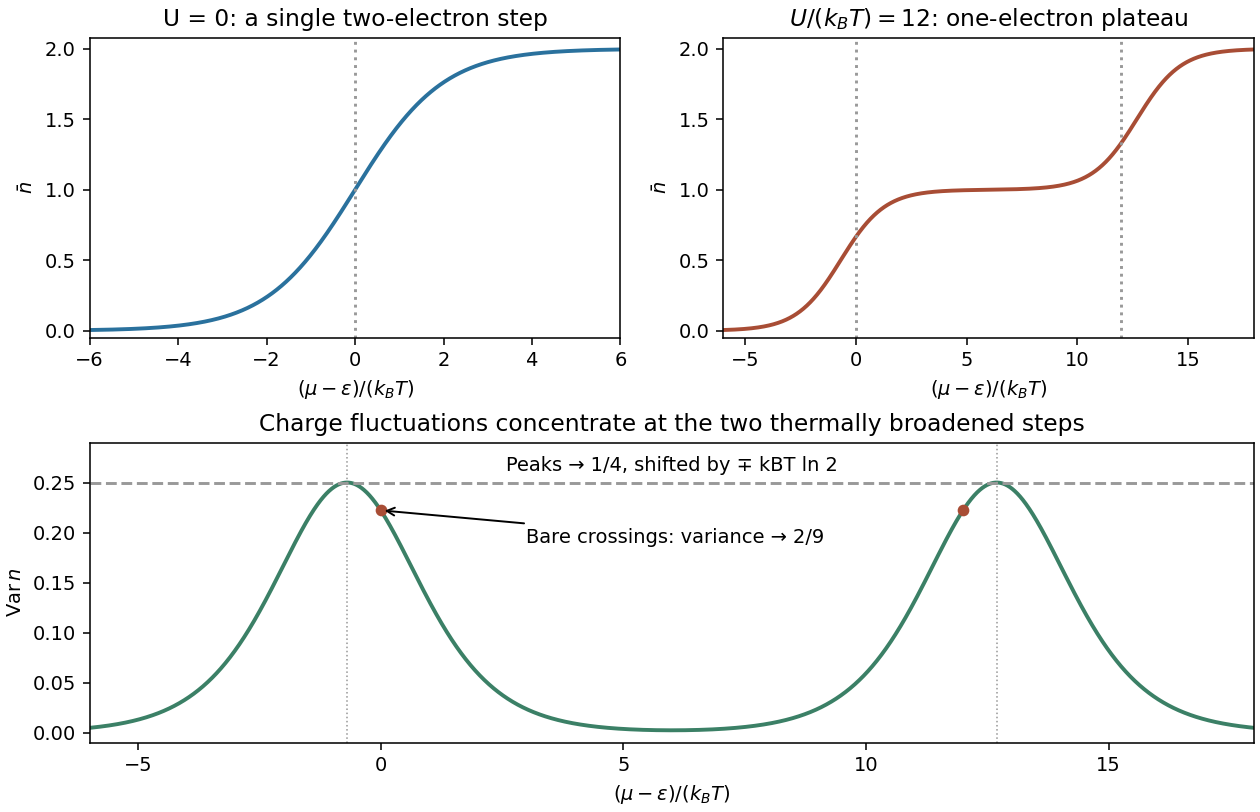
Original grand-canonical defect occupations and number variance, showing the interaction-induced one-electron plateau and spin-degeneracy shifts of the variance peaks
. Details. 
For and , is a symmetric single well. Its only minimum isThe zero is relative to the smooth background omitted from the supplied expansion.
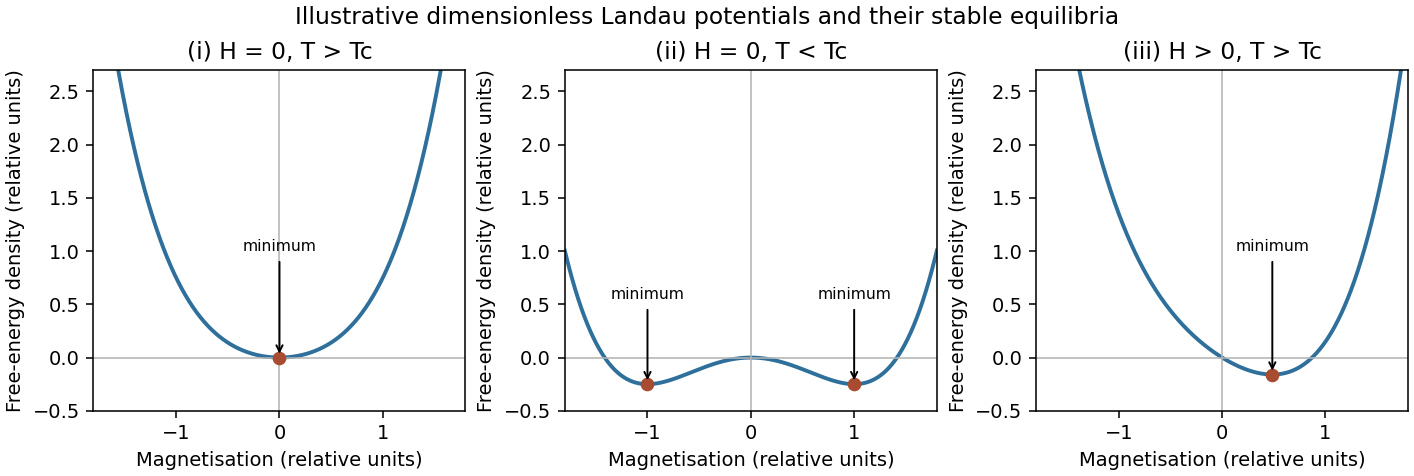
Original dimensionless quartic Landau free-energy sketches for the three printed cases, with their equilibrium minima marked
. Details. 
For and , the free energy is a symmetric double well. The central stationary point is a maximum; the two stable minima areThese are the magnetisations of the two symmetry-broken phases, selected by an infinitesimal field or a boundary condition. An exactly symmetric finite-system ensemble can have by averaging both wells; that does not make the central maximum a stable homogeneous phase.
For and , the field tilts the single well toward positive M. Since everywhere, there is exactly one minimum, at the positive solution of the equation of state. At that solution,This follows by eliminating from F. At weak field, and .
At zero applied field, time-reversal symmetry interchanges and without changing the free energy, so the analytic expansion contains only even powers. The term breaks this symmetry at fixed nonzero H. Stationarity and local stability requireFor at small field, the cubic term is higher order and . Thus the susceptibility as defined in the question isThe three requested free-energy sketches and their minima are given separately above.
For the plotted isotherms, divide the equation of state by nonzero M and rearrange:This is an Arrott plot: its slope determines b, and the isotherm through the origin identifies the mean-field Curie temperature.[ref]
Criterion for Ferromagnetism from Observations of Magnetic Isotherms by Anthony Arrott. 1957, abstract: molecular-field criterion from cubic magnetisation versus internal field at the Curie temperature
Under the paper's stated uniform-field Landau model, use H as supplied on its axis.The ordinate unit is . Reading the original graph gives slopes about – ordinate units per unit H/M, so the physical slope is approximately . ConsequentlyApproximate horizontal intercepts and the corresponding are:
The sign change brackets the transition between 19 and 25 K. A linear fit of across the four read-offs gives approximately andInterpolating only the two nearest isotherms also gives about 22 K. These are graph estimates, not exact recovered measurements.
Below at zero field, the stable branches have . Substitution gives the free-energy density relative to the omitted smooth background:The equilibrium excess heat-capacity density is below and zero above it. ThereforeThe all-isotherm linear fit gives about . Estimating the slope only between the 19 K and 25 K curves instead gives and a jump near . The lines are not exactly parallel and the intercepts are not perfectly linear in T, so a jump of order a few is supported; finer precision is not. This is per volume because F is a density; no sample volume is given to convert it to a total heat capacity.
If , the quartic truncation is unbounded below. Add a positive sixth-order term with . At zero field the coexistence conditions giveThus the zero-field transition is generically first order, with a discontinuous spontaneous magnetisation and possible metastability. It occurs before the quadratic coefficient reaches zero. The case is the tricritical boundary of this mean-field model; no value of c is invented.
Articles by others on the same topic
There are currently no matching articles.