Use the number-density virial expansion, following the density versus molar second virial convention, with :Thus is the coefficient of the first density correction and has units of volume. With molar density instead, the molar coefficient is . For a classical pair potential ,Attractive separations contribute negatively and short-range repulsion contributes positively. For inert-gas interactions the attractive contribution dominates at sufficiently low temperature, crosses zero at the Boyle temperature, and repulsion dominates above it.
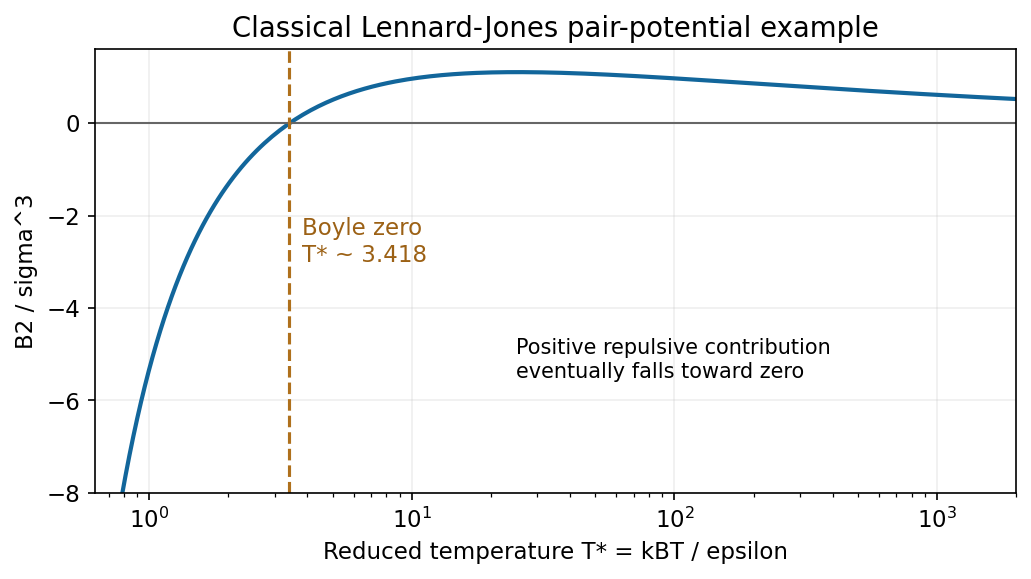
An illustrative Lennard-Jones second virial coefficient is negative at low temperature, crosses zero and has a broad positive maximum
. Source. Details. 
The soft-core high-temperature second virial coefficient illustrates why the far-high-temperature tail depends on the model. A hard-core estimate tends to positive excluded volume . A soft repulsive potential, such as the Lennard-Jones potential in the original diagram, allows a positive maximum followed by decay toward zero. The sign change is the main attraction-versus-repulsion feature; neither sketch should be interpreted as measured data for a specified gas. This classical, dilute-gas sketch omits low-temperature quantum-exchange corrections.[ref]
Classical Gases by David Tong. Section 2.5: interacting gas, virial expansion and Mayer pair function
Articles by others on the same topic
There are currently no matching articles.