The virial expansion describes the first departures from the ideal gas law as a power series in number density. For a homogeneous, single-species gas in three dimensions at thermal equilibrium, write , with the volume, and define the dimensionless compressibility factor byHere is absolute pressure, is absolute thermodynamic temperature, and is the Boltzmann constant. The second virial coefficient determines the initial slope away from ; higher coefficients describe further corrections. The symbol here is an equation of state ratio, not a canonical partition function. [ref]
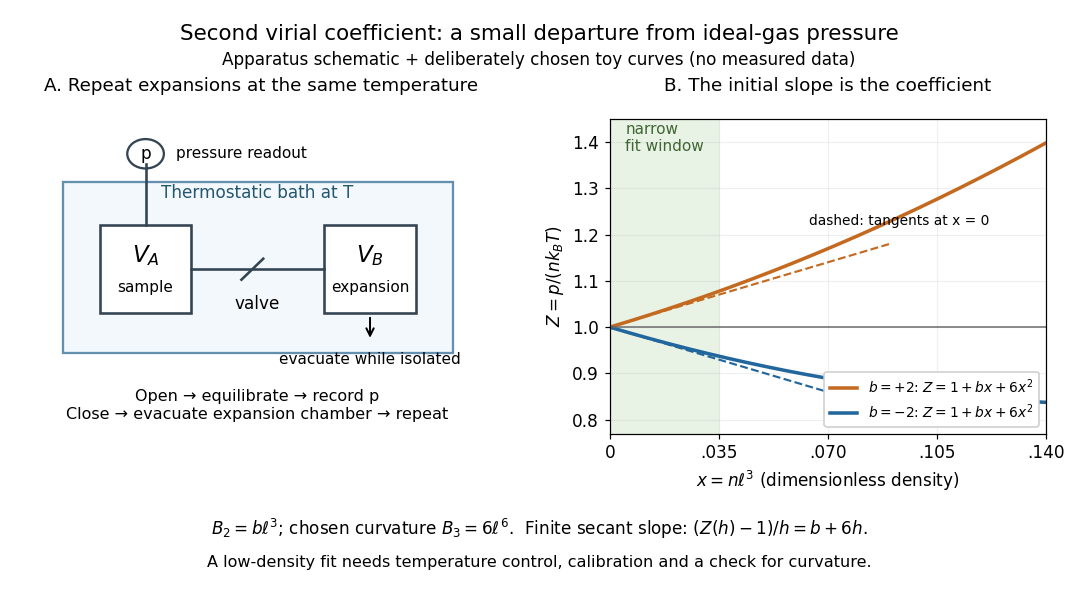
Controlled gas expansion and extraction of a dilute-gas slope: schematic apparatus and explicitly chosen toy curves
. Details. The left panel sketches the measurement principle; the right panel uses deliberately chosen polynomials, with and , where is a reference length. These curves are not measured data. Their initial slopes have opposite signs, but both bend because of the quadratic term. Using a finite secant from to gives , rather than : reducing the fitting range reduces this particular truncation bias. This algebra explains why measuring one nonideal pressure is insufficient to extract a reliable second virial coefficient.
Waxman and Hastings's 1971 Burnett experiment used sample and expansion chambers in a thermostatic bath, with a valve between them and a pressure transducer linked to a piston gauge. They measured successive isothermal expansions: evacuate the expansion chamber, open the valve, record the equilibrated pressure, isolate and evacuate that chamber again, then repeat. This avoids separately measuring the absolute gas amount and chamber volumes. For carbon dioxide at , their measurements below bar gave a molar second virial coefficient of approximately . [ref]
https://nvlpubs.nist.gov/nistpubs/jres/75C/jresv75Cn3-4p165_A1b.pdf. Waxman and Hastings, Journal of Research of the NBS 75C (1971), pages 165–176, abstract and apparatus
An idealized reduction makes the signal explicit. Let be the calibrated chamber volume ratio, the pre-expansion pressure, and the post-expansion pressure. Particle conservation during one valve opening gives . At the same temperature, division of the two equations of state yieldsThus the intercept determines , while the dilute-limit slope determines the second virial coefficient. In the actual experiment, helium runs calibrated the cell constant and chamber deformation corrections were included. Agreement of the carbon dioxide low-pressure intercept with the helium calibration, and the absence of an anomalous low-pressure upturn, checked for gas adsorption on chamber walls. [ref]
https://nvlpubs.nist.gov/nistpubs/jres/75C/jresv75Cn3-4p165_A1b.pdf. Waxman and Hastings (1971), data reduction and adsorption checks, especially equation 13 and page 176
For a limited dilute-gas fit, hold temperature fixed, allow thermal equilibrium after every expansion, calibrate absolute pressure and the chamber ratio, and check leaks and sample composition. Repeat the analysis with a smaller upper pressure cutoff and an added curvature term; compare the resulting second virial coefficients with their uncertainties. Too wide a range mixes in higher coefficients; too narrow a range makes the nonideal signal hard to distinguish from instrument error. The displayed chamber equation neglects deformation, dead spaces and adsorption, so it is a teaching reduction rather than the complete experimental analysis.
Units matter. With number density in , has units and has units . For molar density in , the same equation of state isHere is the Avogadro constant and is the molar gas constant; the molar coefficients have units and . A coefficient tabulated per mole must therefore multiply molar density, not number density.
For the classical formulas below, use a nondegenerate gas with thermal de Broglie wavelength satisfying , negligible quantum corrections to relative motion, and a stable, sufficiently short-ranged pair potential. Diluteness must also control the omitted interaction terms: alone is not enough when positive and negative contributions cancel. A finite truncation is a local low-number density approximation, not an equation of state for a dense liquid or across a phase transition. [ref]
https://davidtong.org/teaching/statistical-physics/statmechhtml/S2#S2.S2.SS4. Tong, section 2.2.4: classical-density condition
[ref]https://davidtong.org/teaching/statistical-physics/statmechhtml/S2#S2.S5.SS1. Tong, section 2.5.1: dilute interacting gas
The second virial coefficient is the leading interaction correction to the ideal gas law: at fixed temperature, , where and is number density. For identical classical particles in a homogeneous three-dimensional gas, with an isotropic pair potential and the centre-to-centre separation,The function is the Mayer f-function. The factor counts the volume of a thin spherical shell; the factor counts each unordered pair once. The result has units of volume. Repulsive regions, , contribute positively, while attractive regions, , contribute negatively. [ref]
This is a striking bridge from a microscopic pair potential to a macroscopic pressure reading. At sufficiently small number density, raises pressure relative to an ideal gas at the same temperature and number density, while lowers it. A single value of , however, cannot determine the entire pair potential: many different functions have the same weighted integral. Measurements over several temperatures supply more information.
The integral must exist. For example, a bounded short-range attraction outside a hard core has no difficulty. If instead as , then and the radial tail behaves like : it converges only for . A bare unscreened Coulomb potential therefore falls outside this formula's ordinary short-range setting. This condition on the tail does not by itself establish the stability or convergence of the full virial expansion.
For an exactly integrable toy attraction, choose the following square-well pair potential, with diameter , attraction depth , and range multiplier :Set and , the second virial coefficient of a hard-sphere gas. Integrating the core and attractive shell separately gives the exact toy resultThe core contributes ; the shell contributes . Heating weakens the relative Boltzmann factor enhancement of attractive configurations, so approaches the positive hard-core value as . For the illustrative choice , the zero occurs atAt this temperature, : cancellation removes the linear correction, not every correction. At low , the negative shell contribution becomes large, requiring a correspondingly smaller number density for a useful truncated virial expansion. The square well is a deliberately chosen model, not a fit to the carbon dioxide experiment.
The cluster expansion organizes the logarithm of a dilute interacting system's canonical partition function as a sum over connected clusters built from Mayer bonds.
Articles by others on the same topic


The virial expansion is a series expansion used in statistical mechanics and thermodynamics to describe the behavior of gases. It relates the pressure of a gas to its density and temperature through a power series in density. The significance of the virial expansion lies in its ability to account for interactions between particles in a gas, which are not considered in the ideal gas law.