Use the number-density virial expansion, following the density versus molar second virial convention, with :Thus is the coefficient of the first density correction and has units of volume. With molar density instead, the molar coefficient is . For a classical pair potential ,Attractive separations contribute negatively and short-range repulsion contributes positively. For inert-gas interactions the attractive contribution dominates at sufficiently low temperature, crosses zero at the Boyle temperature, and repulsion dominates above it.
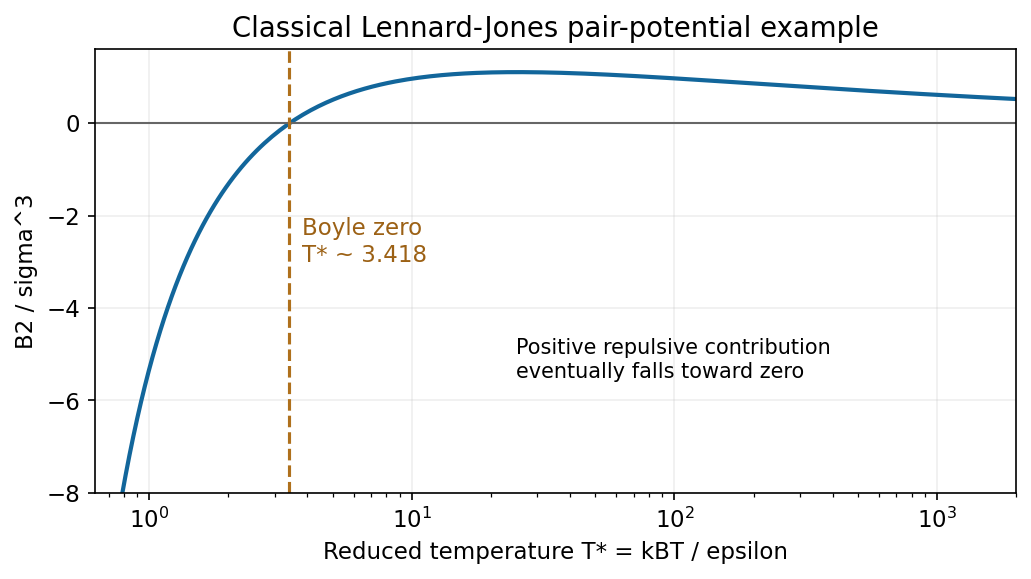
An illustrative Lennard-Jones second virial coefficient is negative at low temperature, crosses zero and has a broad positive maximum
. Source. Details. 
The soft-core high-temperature second virial coefficient illustrates why the far-high-temperature tail depends on the model. A hard-core estimate tends to positive excluded volume . A soft repulsive potential, such as the Lennard-Jones potential in the original diagram, allows a positive maximum followed by decay toward zero. The sign change is the main attraction-versus-repulsion feature; neither sketch should be interpreted as measured data for a specified gas. This classical, dilute-gas sketch omits low-temperature quantum-exchange corrections.[ref]
Classical Gases by David Tong. Section 2.5: interacting gas, virial expansion and Mayer pair function
Take to be the magnitude of either spin projection's magnetic moment, so the independent magnetic levels are . Their partition function and magnetic energy arewhere and . The canonical entropy is consequentlyThis independent-spin magnetic entropy counts the two orientation states of each independent moment; translational entropy and interactions are excluded.
Along the magnetic-entropy demagnetization adiabat, constant magnetic entropy fixes , hence is constant. Lowering the field therefore gives the ideal adiabatic demagnetization relationA useful cycle first magnetizes isothermally while releasing heat to a reservoir, then thermally isolates the sample and lowers the field. Cooling the entire sample requires its other heat capacities and spin-lattice equilibration to be accounted for. Magnetic interactions, residual fields and heat leaks prevent extrapolating the independent-moment formula to an attainable zero temperature.[ref]
The Fundamentals of Statistical Mechanics by David Tong. Canonical ensemble: two-state partition function, entropy and thermodynamic derivatives
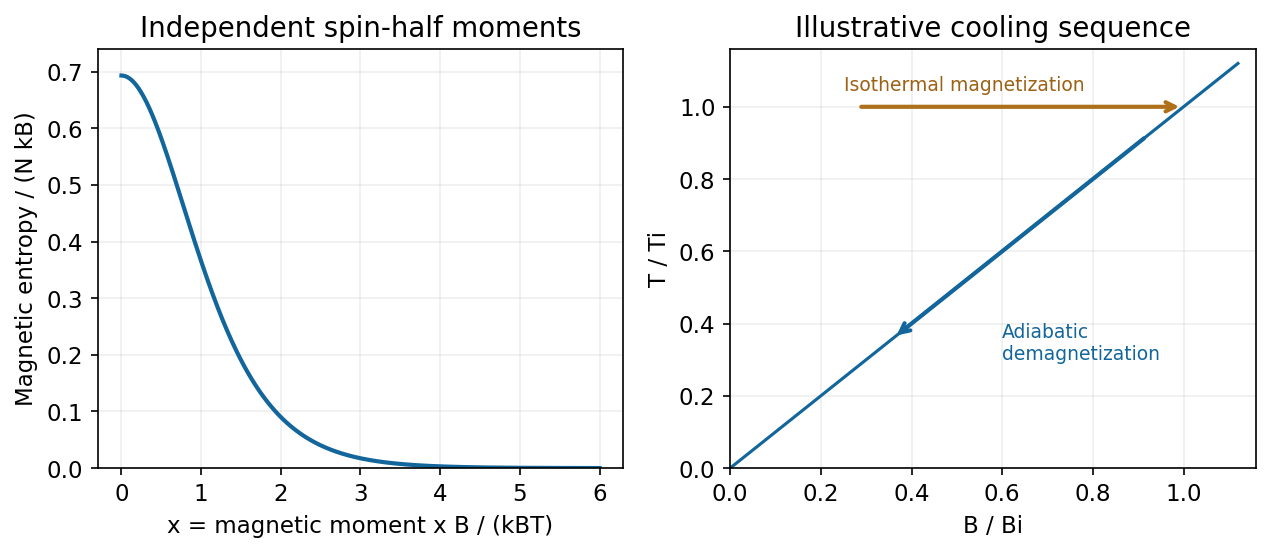
Magnetic entropy decreases with B over T, while an ideal demagnetization adiabat has constant B over T
. Source. Details. 
For a complete single-particle state, the Fermi-Dirac distribution isHere denotes the chemical potential, distinct from the magnetic-moment symbol in (b). At zero temperature it approaches the Fermi energy and the occupation has a sharp edge. At , thermal changes occur within an energy interval of order about that edge.
The Fermi-edge heat-capacity counting argument uses the fact that only order electrons can be rearranged because states well below the edge are blocked by the Pauli exclusion principle. Each active excitation carries energy of order , so and . For a smooth density of states, the Sommerfeld expansion givesHere is the total single-particle density of states, including spin. In a three-dimensional free-electron gas, , giving . This is the low-temperature normal-state electronic contribution, not the lattice heat capacity or a description across a superconducting transition.[ref]
Quantum Gases by David Tong. Sections 3.6.2–3.6.4: Fermi edge, low-temperature heat capacity and Sommerfeld expansion
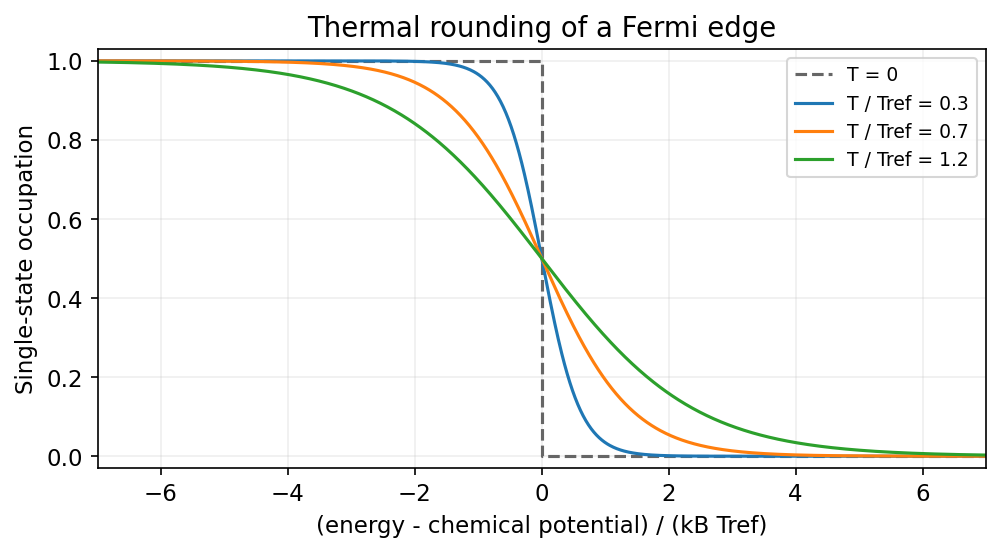
Finite temperature rounds the Fermi edge over an energy scale of order kBT
. Source. Details. 
Articles by others on the same topic
There are currently no matching articles.