The law of mass action makes each elementary reaction rate proportional to the product of its reactant concentrations, with the stoichiometric change determining its contribution. Let be maintained constant, and let be the diffusion coefficients. The first reaction consumes two molecules, the second creates one net , the third consumes one each of , and the fourth consumes while creating . Fick's laws for diffusion giveHere the standard deterministic convention takes the event rate of the first reaction as , so its loss is . A convention absorbing a combinatorial factor into leads to the same nondimensional model after consistently redefining that rate constant. The maintained reactant makes this an open chemical model; there is no conservation law requiring to decrease with reaction progress.
Choose , , , and an independently selected positive representing its reference or supplied concentration. Set , , , . Dividing the first equation by and the second by yields the stated system withThe parameter can be changed through the chosen or physically supplied reference concentration while these other combinations remain fixed. The combinations satisfy for this reaction mechanism, so they need not be algebraically independent. The spatial scale makes the diffusion coefficient one, and the time and scales balance linear autocatalytic growth against the quadratic loss.
The equal-diffusivity Fisher reduction uses equal diffusion coefficients and the invariant relation . The second equation then requires , while the first becomes . They agree whenThis reduction requires compatible initial and boundary data on that invariant relation. Tuning a parameter alone does not force arbitrary solutions of the two-field system onto it. For positive physical , the displayed normalization also requires . More generally the line works when ; the same positivity restriction remains for .
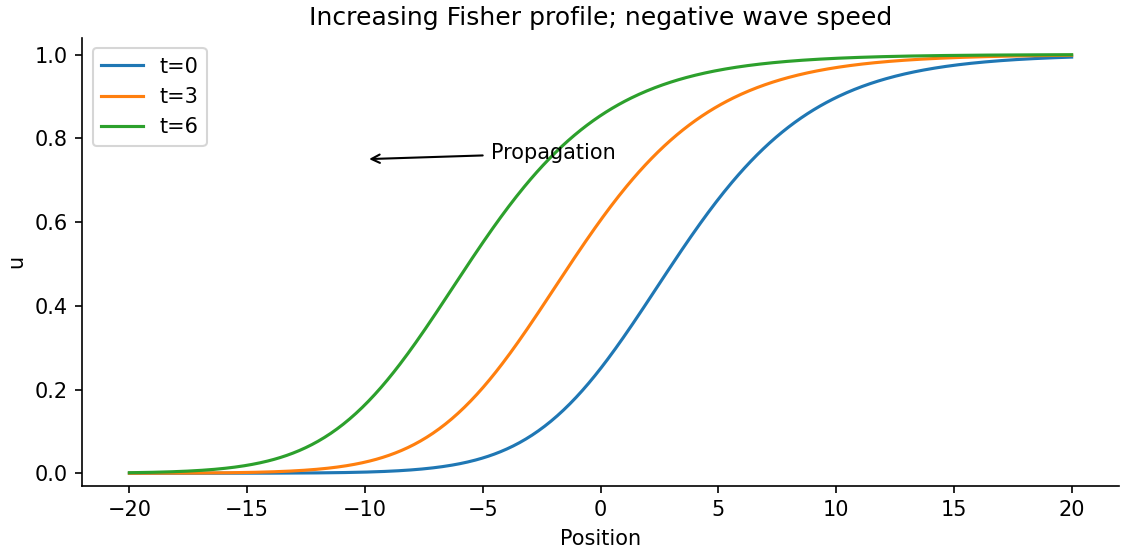
Let and with , . The profile equation is . Multiplication by and integration givesConsequently : the increasing front moves left, with the state invading . Linearization at its leading edge gives real monotone exponents only when , yielding the usual Fisher front speed range. A convenient exact example isSubstitution verifies it and the figure shows its leftward displacement. The source uses for the end limits after defining ; they denote the same spatial coordinate here.

Yes. An immobile concentration can still change locally through reaction while diffusing transports activation. Vanishing diffusion of one component does not prohibit a propagating reaction front.
In the invariant special case , the first equation is already Fisher's equation with growth coefficient one, so it has travelling fronts regardless of . A one-diffuser reaction front also gives a coupled example with nonzero . For , the equations with areFor , choose , , and setIndeed and , giving the second equation. In the first, division by leaves , whose constant and coefficients both vanish with these choices. Ahead of the left-moving wave ; behind it . This explicitly demonstrates a travelling front with substrate depletion but no diffusion, rather than relying solely on the uncoupled special case.
Articles by others on the same topic
There are currently no matching articles.