Let be population flux. For any fixed control volume , mass conservation with local production givesAssume local, isotropic random dispersal, no imposed advection, and constant diffusion coefficient . Fick's first law is . The divergence theorem and arbitrariness of yieldThe coefficient has units length squared per time; has units population density per time. Smoothness sufficient to pass from the integral balance to the local equation is understood. This is a reaction-diffusion equation.
The travelling-wave reduction of a reaction-diffusion system of Fisher's equation isMultiplying by and integrating gives , so the decreasing invasion front has . The linearization at has spatial eigenvaluesFor they are complex: approaching zero spirals in the plane and changes the sign of , which is inadmissible for a density. Thus is necessary.
It is also sufficient. Write and choose . The triangleis forward invariant for , . On , . On ,The boundary points left, and the boundary at consists only of the origin. The unstable branch from the saddle enters this triangle, where decreases and remains nonnegative. Its limiting state must have and ; since it has left , it tends to . Therefore a monotone positive front exists for every , including the double-root endpoint:This is the Fisher-KPP minimum wave speed, obtained with an explicit invariant-region existence argument.
Set and . The proposed profile with givesSubstituting into and dividing in the interior by yieldsEquating the constant and coefficients givesHence the exact generalized Fisher front isThe free positive translates the front. It connects one on the left to zero on the right and is strictly decreasing. At , its speed is .
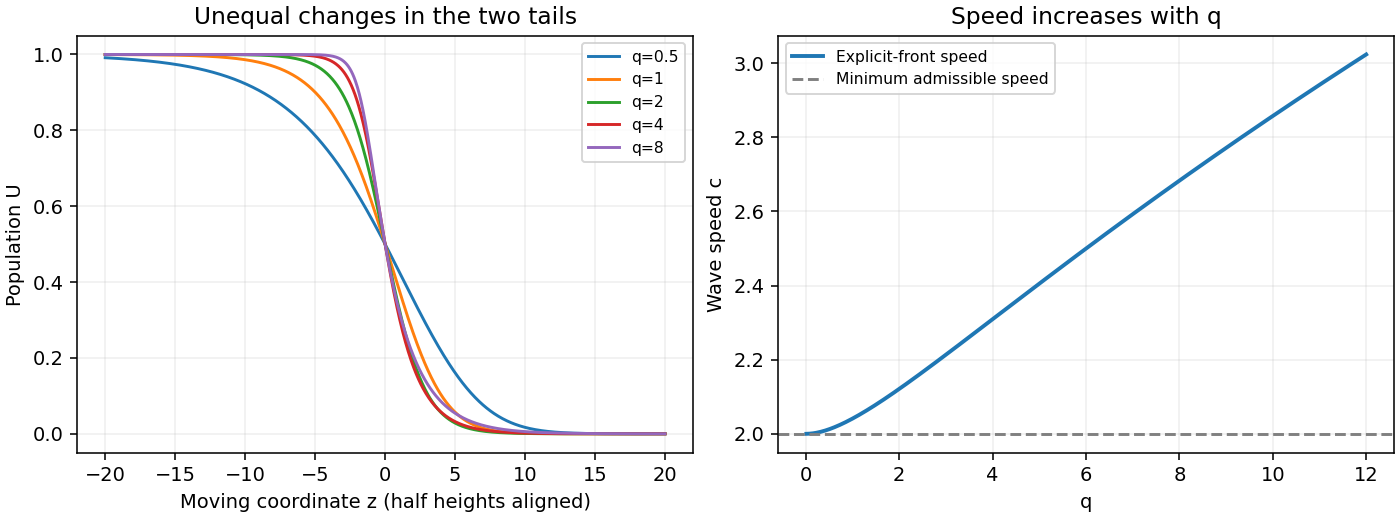
The explicit travelling wave speed increases with :Its two tails change differently. Near the leading empty state, with decreasing as grows: that tail lengthens. Near the filled state, , with increasing: that tail becomes steeper. Thus the change is not a uniform sharpening of the whole profile. For example the half-height slope is .
For meaningful comparison, the figure aligns all fronts at by choosing . It displays the speed increase and the unequal changes of the two tails. Since for every , the minimum admissible speed remains two; the explicit family has for . The invariant-triangle proof above extends with boundary derivative .

Articles by others on the same topic
There are currently no matching articles.