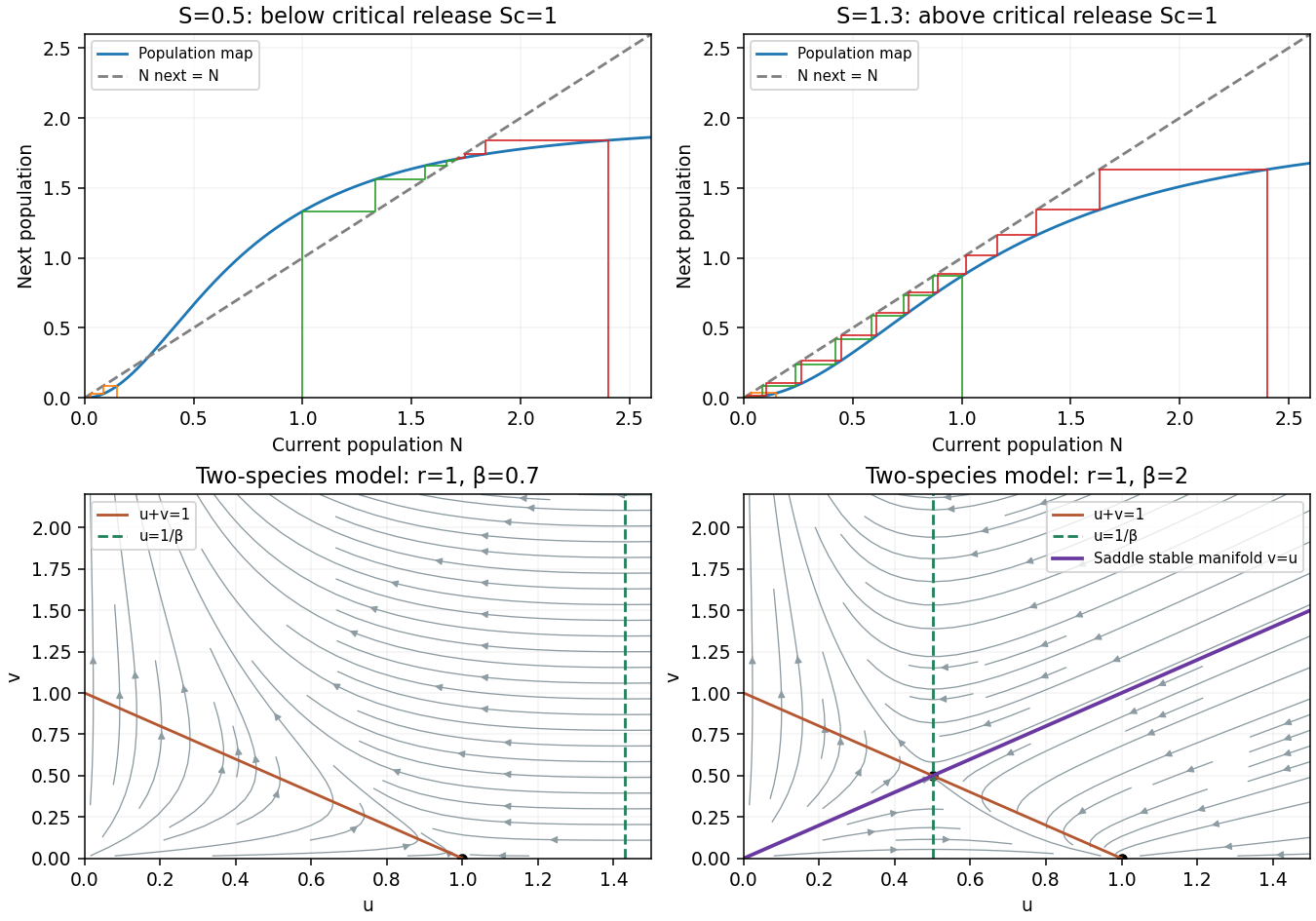
Write . Its nonnegative fixed points are and, when ,Indeed a positive fixed point satisfies . The linear stability multiplier isAt a positive fixed point, , henceFor strict discriminant positivity, is attracting and repelling; the extinction state is superstable. At equality the positive point has multiplier one. Sinceit attracts from above and repels from below at equality. This is a semistable fixed point, whose one-sided behavior requires the nonlinear calculation.
The two positive fixed points merge whenHere , , and increasing decreases , so this is a saddle-node bifurcation of the map. For , the cobweb descends to zero below , rises towards between the positive fixed points, and descends towards above it. Monotonicity of prevents a trajectory from overshooting across the attracting fixed point. Thus is an extinction threshold.
For , for every . The iterates decrease to a nonnegative fixed point, necessarily zero. At , initial states below tend to zero and those above tend to . The sterile-release population threshold therefore combines bistability below the critical release with extinction above it.
The term is unrestricted growth of species , and represents its density-dependent self-limitation, with scaled carrying capacity one. The interaction suppresses in the presence of species .
Species has intrinsic growth and suppression by . Thus both interspecific effects are harmful: this is a competition model, with no self-limitation term for . Its unbounded growth when disappears is a consequence of that modeling choice. The parameter is the growth-time ratio, while measures the effect of on .
The equilibrium points areThe third is biologically interior only for , and coincides with at . The Jacobian matrix isAt the eigenvalues are , so it is a repelling node. At they are , giving a stable node for and a saddle for .
At the interior equilibrium,so coexistence is a saddle. The formal equilibrium with negative for is not a population state; there its trace is negative and determinant positive.
At the boundary equilibrium is nonhyperbolic. To determine its behavior into the positive quadrant, put . A local center manifold has , so for small positive . Thus it is unstable to introduction of species , though attracting along the axis. The boundary/interior branches undergo a transcritical bifurcation at this parameter.
The positive quadrant is invariant. The non-axis nullclines are and . Below , increases; above it, decreases. To the left of , increases; to the right, it decreases.
For , the stable manifold of the interior saddle separates trajectories tending to from those for which and . Exactly on that manifold, the trajectory tends to the saddle. For the illustrated , the separating manifold is exactly , since the vector field preserves that diagonal.
For , every strictly positive initial state ultimately has and . Indeed implies , so eventually is bounded below by a positive constant. Then grows exponentially, forcing down. At , a positive eventually drives below one; thereafter increases. A finite positive limit for would force , inconsistent with , so the same exclusion outcome holds.
There are no interior periodic orbits: the Bendixson-Dulac criterion with multiplier givesThe phase portraits in the preceding figure show the threshold geometry and the absence of a bounded attracting coexistence state. Initial states on the axes retain the corresponding one-species dynamics.
Let be population flux. For any fixed control volume , mass conservation with local production givesAssume local, isotropic random dispersal, no imposed advection, and constant diffusion coefficient . Fick's first law is . The divergence theorem and arbitrariness of yieldThe coefficient has units length squared per time; has units population density per time. Smoothness sufficient to pass from the integral balance to the local equation is understood. This is a reaction-diffusion equation.
The travelling-wave reduction of a reaction-diffusion system of Fisher's equation isMultiplying by and integrating gives , so the decreasing invasion front has . The linearization at has spatial eigenvaluesFor they are complex: approaching zero spirals in the plane and changes the sign of , which is inadmissible for a density. Thus is necessary.
It is also sufficient. Write and choose . The triangleis forward invariant for , . On , . On ,The boundary points left, and the boundary at consists only of the origin. The unstable branch from the saddle enters this triangle, where decreases and remains nonnegative. Its limiting state must have and ; since it has left , it tends to . Therefore a monotone positive front exists for every , including the double-root endpoint:This is the Fisher-KPP minimum wave speed, obtained with an explicit invariant-region existence argument.
Set and . The proposed profile with givesSubstituting into and dividing in the interior by yieldsEquating the constant and coefficients givesHence the exact generalized Fisher front isThe free positive translates the front. It connects one on the left to zero on the right and is strictly decreasing. At , its speed is .
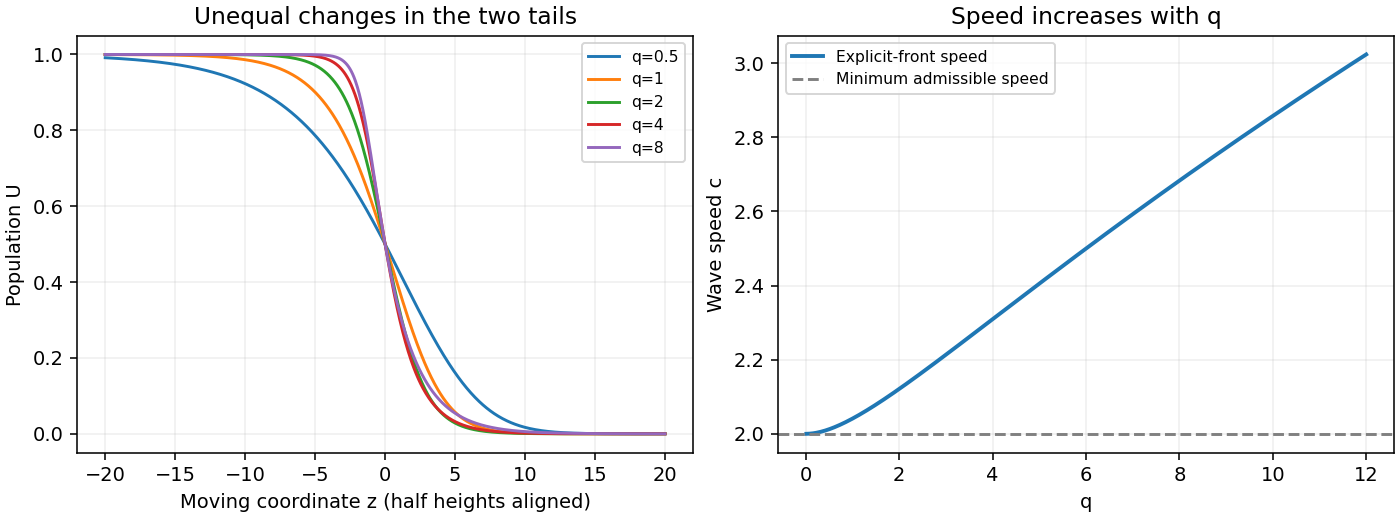
The explicit travelling wave speed increases with :Its two tails change differently. Near the leading empty state, with decreasing as grows: that tail lengthens. Near the filled state, , with increasing: that tail becomes steeper. Thus the change is not a uniform sharpening of the whole profile. For example the half-height slope is .
For meaningful comparison, the figure aligns all fronts at by choosing . It displays the speed increase and the unequal changes of the two tails. Since for every , the minimum admissible speed remains two; the explicit family has for . The invariant-triangle proof above extends with boundary derivative .


Let be bacterial intrinsic growth rate, carrying density, chemical production per bacterial density per time, and chemical decay rate. The bacterial flux iscombining random diffusion with chemotaxis up the chemical gradient. Chemical flux is . The two local balances give the Keller--Segel model with logistic growth:All transport and rate parameters are positive. The production rate is constant per cell, so total production is proportional to .
Choose any positive chemical concentration scale and setAfter dropping hats, substitution giveswhereFor explicit dimensional checks, write bacterial-density and chemical-concentration units as . Then , , and . Since and , each displayed ratio has unit one. The new spatial domain is .
The nonzero homogeneous equilibrium is . Without transport its Jacobian matrix iswith negative eigenvalues .
Zero chemical flux gives at the endpoints; zero bacterial flux then gives . Linear perturbations therefore have Neumann boundary conditions and modes , . For each mode, the amplitude matrix isIts trace is always negative. Its determinant isA mode grows exactly when . In particular, any nonzero mode is destabilized by sufficiently large . For continuously variable , a nonempty unstable band exists precisely whenWriting , its squared-wavenumber endpoints are . On the finite interval, at least one allowed must lie inside this band. The uniform mode stays stable. This is the chemotactic pattern-instability criterion.
Chemotaxis supplies positive feedback: a local increase in bacterial density produces more attractant, whose gradient draws in more bacteria. Ordinary cell diffusion opposes aggregation. Chemical diffusion spreads the signal and removes very sharp gradients, while decay and logistic growth stabilize the uniform kinetics.
The dispersion relation from the preceding matrix makes the competition quantitative: the positive term stabilizes sufficiently short wavelengths, whereas the negative chemotactic contribution can destabilize intermediate wavelengths. Increasing cell diffusivity or chemical decay raises the attraction threshold. A growing allowed spatial mode produces correlated patterns in cell density and chemical concentration; the eigenvector relation puts their peaks in phase for the growing real mode.
This predicts initial pattern formation. Nonlinear saturation and stability of the eventual pattern require the nonlinear equations, beyond the linear instability test.
The Poincaré-Bendixson theorem states that the omega-limit set of a forward orbit confined to a compact region of the plane, containing no equilibrium points, is a periodic orbit.
Put , . Direct calculation givesHere and . Thus on the inner circle the radial velocity is positive, and on the outer circle it is negative. In their closed annulus,so there is no equilibrium. The theorem gives a periodic orbit in this trapping annulus.
It is asymptotically stable: the vector-field divergence isthroughout the annulus. Its nontrivial Floquet multiplier is . This proves an attracting periodic orbit exists. There can be only one there: two such nested orbits would enclose an annular region with zero outward flux, contradicting the strictly negative divergence via the divergence theorem.
A positive equilibrium must have . LetIt is the unique positive root of . At this point the Jacobian matrix isConsequentlyIt is linearly asymptotically stable when , and unstable when . In either region it is a node or focus according as is nonnegative or negative. At the linear eigenvalues are purely imaginary. If , it is stable for every .
To prove a limit cycle exists in the unstable case, a compact trapping set must stay away from the singular boundary . The following construction supplies it. Choose large enough to contain the positive equilibrium and the orbit being considered. On , , and on with , . Put . Using and completing the square in givesChoose so small that times the square bracket is less than , and then choose . The setis compact in the positive quadrant and forward invariant. On the curved boundary , and . On , gives . Its other boundaries were checked above. The constants can be chosen so the equilibrium is interior.
When , the equilibrium is a hyperbolic repeller. Remove a sufficiently small outward-flow neighborhood of it from . This leaves a compact trapping region containing no equilibria. The Poincaré-Bendixson theorem gives a periodic omega-limit orbit of a nonequilibrium trajectory, hence a limit cycle. The analytic vector field excludes an accumulating family of periodic return-map zeros unless the whole local return map is the identity, which is incompatible with the repelling equilibrium and the nonperiodic approaching trajectory. This is the positive trapping construction for the Leslie-Gower model.
A periodic orbit of least period is a list of distinct points satisfying for and . Equivalently , with no smaller positive iterate fixing . For this is a fixed point.
Follow a perturbation through one complete circuit. The chain rule givesAfter circuits the linear perturbation is . With distinct eigenvalues, the eigenvectors span over the complex numbers, and each component is multiplied by . Thus the periodic orbit is linearly asymptotically stable exactly whenThese are the orbit's discrete Floquet multipliers. Any modulus greater than one causes instability; a unit modulus prevents decay in the linear system, and nonlinear stability then needs further analysis. The finitely many intermediate derivative factors do not affect convergence to zero between complete circuits.
A period- orbit of a Poincaré map corresponds to a closed trajectory, hence a periodic orbit of the underlying flow, meeting the chosen section at the distinct successive return points. Its time period is the sum of the return times, not necessarily times a single common time. Stability of the return-map orbit describes transverse stability of that closed trajectory; the flow itself also has the neutral time-translation direction.
There is always the fixed point . For , the first fixed-point equation gives , and the second gives . Thus for there is exactly one positive fixed point,For , every point , , is fixed. There are no other nonnegative fixed points.
At the origin the Jacobian matrix has eigenvalues . It is asymptotically stable for and a saddle for . For , the bounds and also prove global extinction in the nonnegative quadrant.
At the positive fixed point,Here and for . The discriminant is negative because the positive trace is less than two and determinant exceeds one. The conjugate multipliers have modulus , so the positive fixed point is always unstable. This is the instability of the Nicholson-Bailey equilibrium.
For completeness, on the fixed line,For , linear perturbations are bounded but have a neutral component along the fixed line; there is no asymptotic stability of an individual point. For there is transverse instability. At , the repeated unit eigenvalue has a nontrivial Jordan block, so powers have an unbounded off-diagonal entry and the linearized system is unstable. This degenerate case is not covered by a distinct-eigenvalue assumption.
For uniform nearest-neighbor bonds of strength on a ring with , retain the normalization of the given model:with indices interpreted modulo . On an open chain the interior equations are the same, whileFor nonuniform bonds, replace each by the corresponding . A convention without the factor is obtained by rescaling the bond strengths; it is not silently substituted here.
For all-to-all coupling define the Kuramoto order parameterIt is the centroid of unit phase vectors: measures phase coherence and the mean phase. Multiplying by and taking imaginary parts givesThus only the two components of the Kuramoto order parameter mediate interaction.
For the symmetric stationary continuum branch, choose the rotating frame with . Oscillators with lock at , choosing for stability. Those with drift, with stationary phase density proportional to . Their real contribution to the order parameter vanishes, since the integral of over a period is the change of a periodic logarithm. Their imaginary contributions cancel between and because is symmetric.
The locked oscillators therefore give the real self-consistency relationSet and divide by to obtainThis is the Kuramoto self-consistency equation for partial synchronization. The incoherent state must be considered before this division. If is continuous at zero with , the branch meets incoherence at .
Put , . The system isIts equilibria are . At , the eigenvalues are , of opposite signs, so these are saddles for every .
At the origin, the eigenvalues are . It is a stable focus for , a stable node for , an unstable focus for , and an unstable node for . At it is the corresponding repeated-eigenvalue improper node. At , linearization gives a center, but nonlinear damping matters: withsmall closed energy sublevels are invariant and forces convergence to the origin. Thus it is a weak attracting focus, not a nonlinear center.
Local bifurcation. Write . Averaging the radial equation near the origin, or eliminating nonresonant cubic terms, givesThe restoring term has zero average radial contribution, while . Thus is a supercritical Hopf bifurcation as increases: a stable cycle appears for small , with leading amplitude .
Global changes. Two further bifurcations must be retained. Define as the parameter where the upper unstable branch from reaches . Central symmetry supplies the lower connection in the opposite direction, forming a heteroclinic cycle. Define as the subsequent collision of an inner attracting and an outer repelling periodic orbit. The complete phase portraits for are:
- : an attracting origin between the two saddles; no periodic orbit, since off the zero-velocity axis.
- : a repelling origin surrounded by one attracting cycle. Appropriate inward saddle branches approach that cycle; trajectories outside its basin escape the central potential well.
- : the attracting cycle persists inside a repelling two-saddle heteroclinic loop.
- : an inner attracting cycle and an outer repelling cycle coexist. The outer cycle separates the bounded oscillations from escape.
- : the two cycles merge into a semistable cycle, attracting from its inside and repelling from its outside.
- : no periodic orbit remains; generic nonstationary trajectories escape, with the saddle stable manifolds as exceptional trajectories.
Here escape means leaving the central well and becoming unbounded; it is not an additional finite equilibrium. The softening Rayleigh-Duffing phase portrait in the figure includes the two critical cases.
The return-map calculation underlying this classification is useful because the two global critical parameters are very close. On the section , let be minus the velocity at the next crossing of , so a symmetric cycle is a root of . Any periodic orbit must have its extrema inside , since at a positive maximum requires . Its index is one, so it surrounds the origin and neither saddle. Every such cycle is centrally symmetric: its reflected image cannot be a distinct nonintersecting cycle of equal enclosed area. Thus this half-return test detects all central cycles. A fixed point with is attracting and one with repelling; the full-return multiplier is .
For the saddle connection, let be the upper velocity at from the left saddle's unstable branch and the upper velocity at on the right saddle's stable branch. While , their shooting equation isComparison shows increases with and decreases. At , energy dissipation gives . At , the lower comparison curve on gives , while the upper comparison curve on gives . The latter follows fromand the stable-branch expansion near . Hence there is a unique with .
At that connection the saddle eigenvalues are and , so . The loop is therefore repelling. In particular, the attracting Hopf cycle cannot simply disappear in that connection. Near the upper endpoint , the half-return map hasFor just above , this produces a second, repelling fixed point near the endpoint, in addition to the attracting inner one. Continuing the two roots of makes their collision criterion explicit:This is a saddle-node bifurcation of periodic orbits, not a disappearance of the equilibrium points.
For a reproducible numerical check of the global sketches, event-based integration of this half-return map and its variational equation givesThese values are computed by shooting the stated equations; their precision is unnecessary for the requested sketches. They explain why a coarse parameter sweep can miss the two-cycle interval entirely. The three bifurcation types are therefore Hopf at , a two-saddle heteroclinic connection at , and a fold of cycles at . There is no pitchfork of equilibria because their locations remain fixed for every .
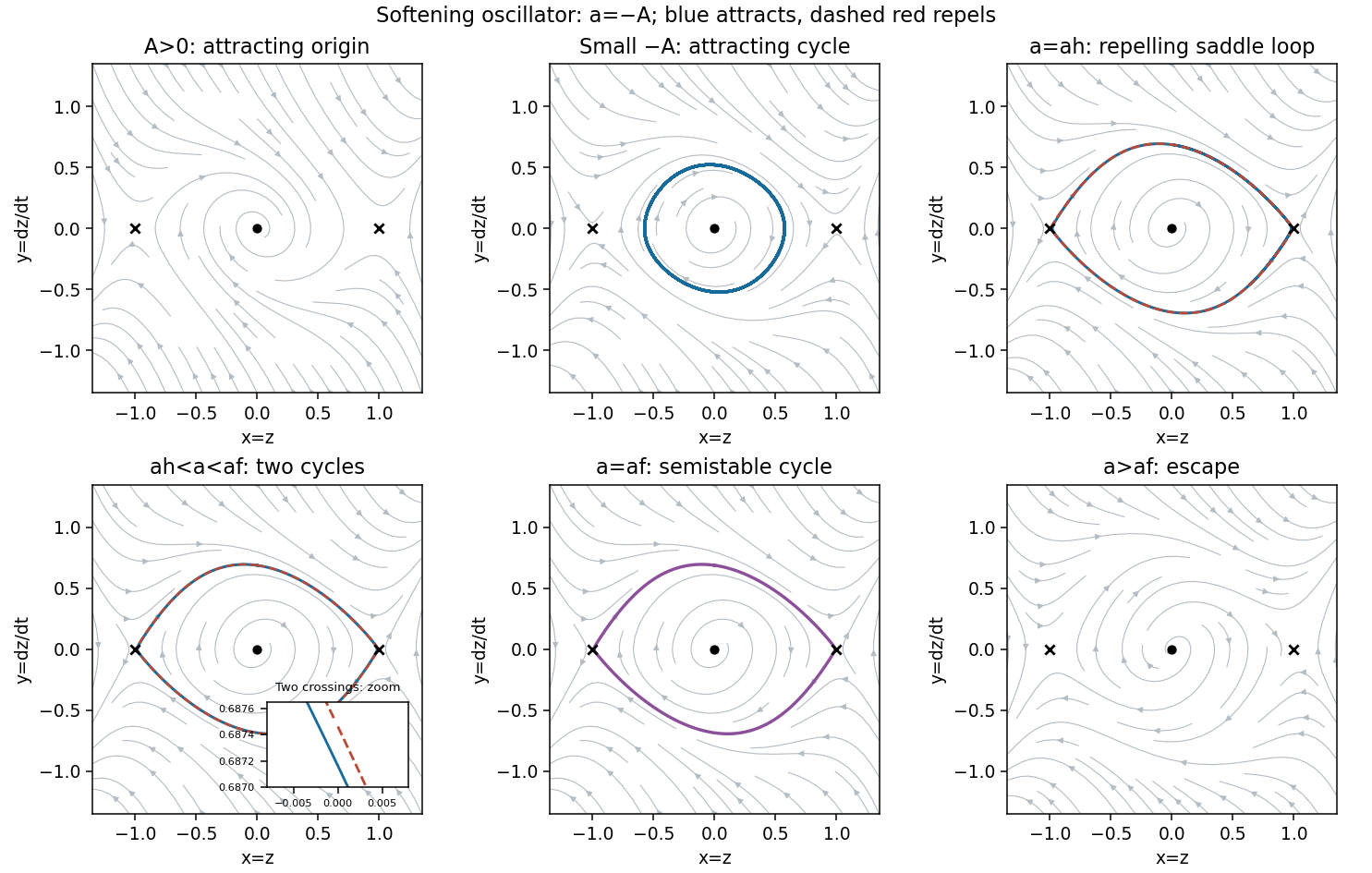
Softening oscillator phase portraits, including the narrow coexistence interval and the fold of cycles
. Details. 
Articles by others on the same topic
There are currently no matching articles.