Hydrostatic pressure varies with height as when the far flat bath is the zero-height reference. Surface tension balances that pressure jump by curvature; with the curvature sign chosen in the equation this becomes . Here is liquid mass density, gravitational acceleration, surface tension and the signed planar curvature. The capillary length balances these effects. Scale both physical and by to obtainFor the wall-rising meniscus decreases as rises. At the distant bath, , and , because the free surface becomes horizontal when expressed as . In the first integral this gives .
At zero wall contact angle the interface is tangent to the vertical wall. In the representation this means and , so . The rising contact point is . Put . Then . Integration from the contact point givesThe sign of is negative on the approach from below, while is positive, as required by the geometry. This local quadratic shape is the zero-contact-angle wall meniscus matching law.
Put , with physical transverse thickness . Matching the preceding quadratic meniscus gives when the inner amplitude is normalized as . After multiplying the transformed film equation by , its two capillary/gravity coefficients are and . Setting the curvature coefficient to one therefore givesThus the inner equation is exactly the stated . The leading matching conditions are as and a bounded film, with vanishing derivatives, as . They connect the static bath-side meniscus to a uniform entrained film.
For positive wall speed varying on the outer time scale, neglect the order- terms at leading order and setThe parabolic matching coefficient is unchanged because . Both remaining differential terms scale as , reducing the equation to . The supplied universal solution therefore yields the quasisteady drag-out matching lawAbove the turn-around region, and its outer derivatives are order one, while and . Hence the leading outer equation and inflow condition areThe boundary value comes from matching, not from setting the film to zero at the wall contact point.
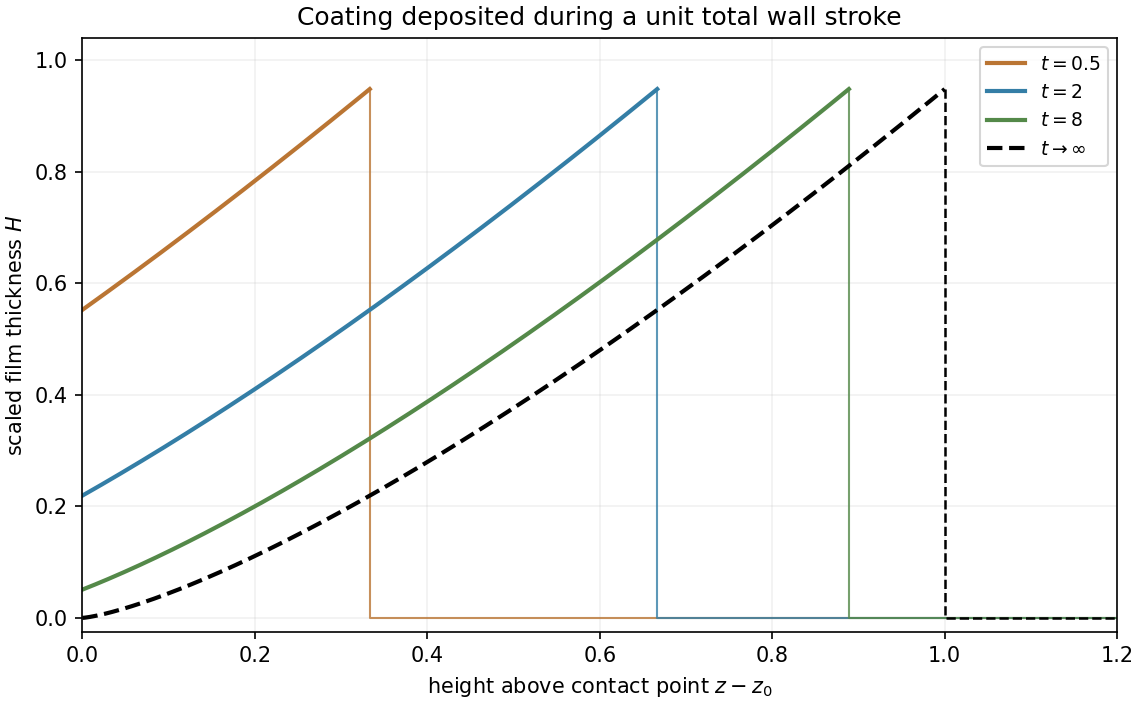
Along a characteristic, and . Integration gives , so . A characteristic entering through at time has and carries . Thus the boundary-fed and initially dry portions giveValues at are never sampled in the finite-time physical region and need not be prescribed. The moving coating front is . Explicitly,The incompatible initial corner creates a jump at the leading coating front; a trace convention at the jump does not affect the transported volume. The wall's total stroke is , so within this leading transport model the final profile isEarlier-deposited fluid is thicker and sits farther up the finite coated interval. Its total scaled volume is , agreeing with . This is a finite-stroke coating profile for the leading matched model.

Articles by others on the same topic
There are currently no matching articles.