Original solutions to the paper released at the source request. The complete editable transcription is retained in the private examination archive.
Hydrostatic pressure varies with height as when the far flat bath is the zero-height reference. Surface tension balances that pressure jump by curvature; with the curvature sign chosen in the equation this becomes . Here is liquid mass density, gravitational acceleration, surface tension and the signed planar curvature. The capillary length balances these effects. Scale both physical and by to obtainFor the wall-rising meniscus decreases as rises. At the distant bath, , and , because the free surface becomes horizontal when expressed as . In the first integral this gives .
At zero wall contact angle the interface is tangent to the vertical wall. In the representation this means and , so . The rising contact point is . Put . Then . Integration from the contact point givesThe sign of is negative on the approach from below, while is positive, as required by the geometry. This local quadratic shape is the zero-contact-angle wall meniscus matching law.
Put , with physical transverse thickness . Matching the preceding quadratic meniscus gives when the inner amplitude is normalized as . After multiplying the transformed film equation by , its two capillary/gravity coefficients are and . Setting the curvature coefficient to one therefore givesThus the inner equation is exactly the stated . The leading matching conditions are as and a bounded film, with vanishing derivatives, as . They connect the static bath-side meniscus to a uniform entrained film.
For positive wall speed varying on the outer time scale, neglect the order- terms at leading order and setThe parabolic matching coefficient is unchanged because . Both remaining differential terms scale as , reducing the equation to . The supplied universal solution therefore yields the quasisteady drag-out matching lawAbove the turn-around region, and its outer derivatives are order one, while and . Hence the leading outer equation and inflow condition areThe boundary value comes from matching, not from setting the film to zero at the wall contact point.
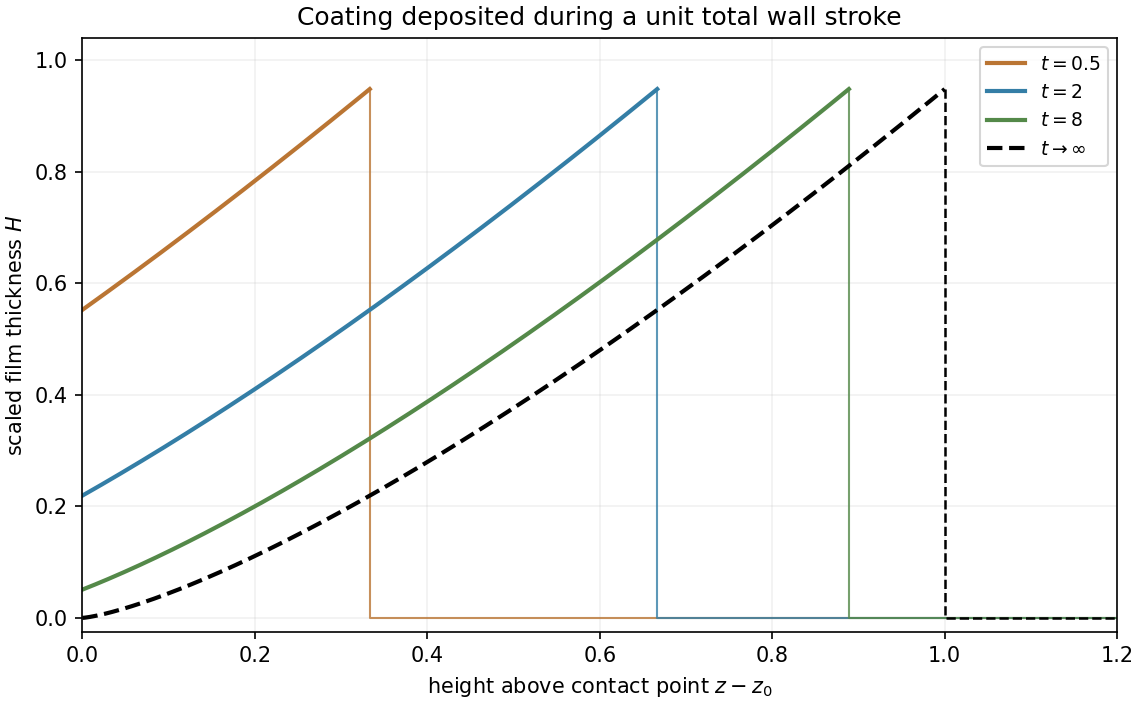
Along a characteristic, and . Integration gives , so . A characteristic entering through at time has and carries . Thus the boundary-fed and initially dry portions giveValues at are never sampled in the finite-time physical region and need not be prescribed. The moving coating front is . Explicitly,The incompatible initial corner creates a jump at the leading coating front; a trace convention at the jump does not affect the transported volume. The wall's total stroke is , so within this leading transport model the final profile isEarlier-deposited fluid is thicker and sits farther up the finite coated interval. Its total scaled volume is , agreeing with . This is a finite-stroke coating profile for the leading matched model.

Let equal one in phase one and zero in phase two; its interface value is immaterial for area integrals. In the absence of phase change or interfacial mass transfer, the distributional phase mass conservation is . For a cross-section of area , defineHere the symbol in the integral denotes the axial velocity component, not a derivative. Integrating through an arbitrary axial slice and using zero normal flux at the rigid pipe wall givesThe velocity is mass weighted, so the averaged mass flux factors exactly; an unweighted phase mean would not in general have this property. This is the cross-section averaged phase mass balance.
For phase two use , volume fraction , andThen . Mean quantities in a phase that is absent are unnecessary; the products giving conserved masses and fluxes remain the meaningful variables.
A spherical bubble displaces liquid volume . Neglect its own weight compared with the liquid buoyancy, as required by the stated gas/liquid approximation. Equating with the quadratic drag givesRetaining a nonnegligible gas density would add the factor . Let , so the upward slip is .
With constant phase densities, adding the two volume balances gives . The closed lower end fixes the total volume flux to zero. Solving it together with the slip relation yieldsIndividual bubbles move upward for , while small phase-fraction disturbances move at the characteristic speed . The latter is negative when : wave speed and bubble speed are different quantities.
A cleared region starts at the closed bottom, with and . Its Rankine-Hugoniot condition speed is . The intended clearing solution is thereforeIt is an entropy shock for the concave conservation law flux, since . Its speed also equals the bubble speed on its uncleared side, so it follows the last layer of bubbles. Under this continuation the last bubble reaches the outlet whenafter which throughout the pipe.
There is a boundary qualification for this dense initial mixture. The characteristics in the uncleared state point into the pipe from the top. To continue the displayed solution all the way to the stated clearance time, its incoming top trace must remain until clearing. Initial characteristics alone cover the shock only until , when its backward right-state characteristic first meets the top boundary. Atmospheric pressure by itself is not a boundary condition for this scalar phase-fraction equation. Thus the displayed formula and printed clearance time give the intended maintained-trace branch; a different top phase-fraction closure could change the later evolution. This is the incoming boundary condition in dense bubble clearing, and is separate from the local derivation of the conservation law.
Existing answer advertised. Oxford’s Topics in Fluid Mechanics archive lists “fhs 2009 q3 answer”, linked to the exact Question 3 answer resource. All three source subparts of this question are skipped under the existing-answer policy. The advertisement was readable; the resource fetch failed, so its contents were not inspected.
Articles by others on the same topic
There are currently no matching articles.