Take a unit-width control volume spanning the stationary hydraulic jump. Mass conservation makes the discharge constant. The horizontal momentum flux is , and the integrated hydrostatic pressure force on a vertical cross-section is . Momentum conservation therefore givesThese are the Rankine-Hugoniot conditions for the shallow water equations in the stationary shock frame. With depths on the two sides, eliminating the velocity gives
Orient the flow so , and let subscripts 1 and 2 denote upstream and downstream. The mechanical energy flux is , where . Inserting the relation for in i gives the hydraulic jump head loss,An admissible jump dissipates mechanical energy, so . The denominator is positive, henceThe zero depth-change case is continuous flow. A depth-decreasing discontinuity would require an energy input at the jump; it is not the dissipative hydraulic jump selected by this model.
Put . The squared Froude numbers follow directly from the discharge relation:Thus the jump connects supercritical flow to subcritical flow. Long surface gravity waves have speed relative to the fluid, so the characteristic speeds in the stationary frame are . Upstream both point with the flow; downstream one points against it. The jump changes whether long-wave information can propagate upstream through the local flow.
Let be the depth behind the bore. The wall's kinematic boundary condition makes the velocity there ; ahead of the bore the depth and velocity are and zero. Across a rightward hydraulic bore moving at , the Rankine-Hugoniot conditions areThe first gives . Substituting into the second gives , where and . Hence the piston-driven shallow-water bore obeysThe positive depth increase is consistent with the energy-loss condition in ii, now viewed in the bore's own shock frame.
For fixed , the left side is a strictly increasing function on , with limit at and unbounded growth. The right side is a strictly decreasing function, sinceIt tends to infinity as and to one as . Their continuity and the intermediate value theorem give a crossing, and strict opposite monotonicity makes it unique. There is exactly one admissible bore speed for every .
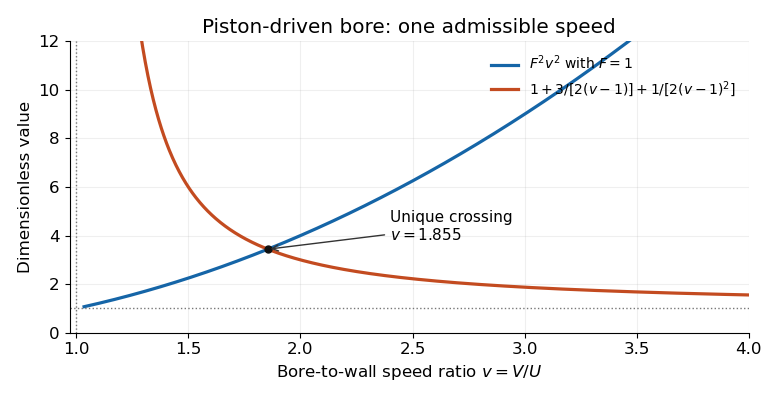
Unique intersection determining the piston-driven hydraulic-bore speed, illustrated for Froude parameter one
. Details. 
The illustrated case is ; changing moves the increasing curve without changing the existence or uniqueness argument. The vertical asymptote at expresses the growing depth ratio .
Articles by others on the same topic
There are currently no matching articles.