This numbered item specifies the model used below. A convenient sample space is the collection of ordered pairs , each with probability . The corresponding random variables are determined by the sum and difference. Inverting the two equations givesThus a candidate pair is possible exactly when and are both integers between and . In particular, and must have the same parity. This inverse description will determine the joint probability mass function.
Part (a) with gives and . By linearity of expectation,Independence of random variables and give the same variance for the sum and difference:
The identity gives , since the two rolls have the same probability distribution. Also . ThereforeThe two random variables are uncorrelated random variables, but that alone does not establish independence of random variables.
Count the ordered roll pairs producing each value. The probability mass functions areand are zero outside these ranges. Both counts have a unique peak:However, forces equal rolls, whose sum is even. Hence , whereas the product of the two marginal probabilities is . This disproves independence of random variables:
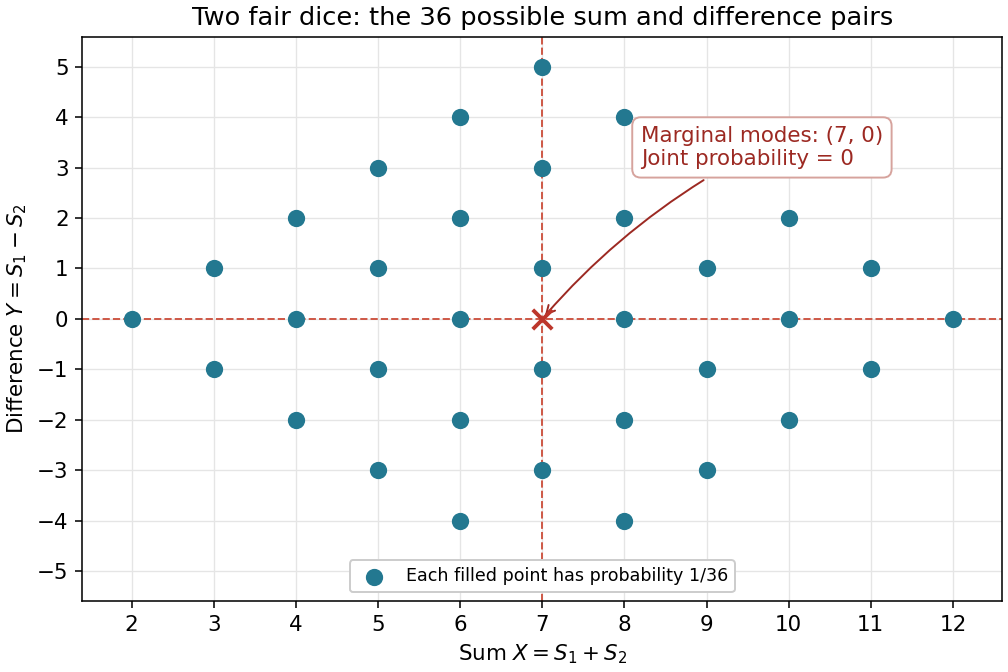

First restrict to integers in the marginal supports: and . Their marginal probabilities are positive. By part (i), a feasible joint pair identifies a unique ordered pair of rolls, so its joint probability is ; an infeasible pair has joint probability zero.
Put and . If the two events were independent, a feasible pair would requireSince , equality forces , hence . But that pair is infeasible. An infeasible pair cannot give independence either, since its joint probability is zero while the product of its positive marginal probabilities is positive. ThusIf all real values of are allowed literally, an impossible event is independent of every event. The complete answer without a support restriction is therefore
Articles by others on the same topic
There are currently no matching articles.