Under the product order, every point of the open unit disc has both coordinates below one, so is an upper bound. Any upper bound must have and , since the two coordinate projections of the open unit disc are . Therefore , proving .
Under the lexicographic order, every point , with arbitrary real , is an upper bound, because every point of has first coordinate strictly below one. Conversely, an upper bound cannot have first coordinate : a point with would exceed it. If an upper bound has , the upper bound is strictly smaller. If it is , the upper bound is strictly smaller. Hence there is no least upper bound under the lexicographic order. This illustrates the supremum of an open disc under product and lexicographic orders.
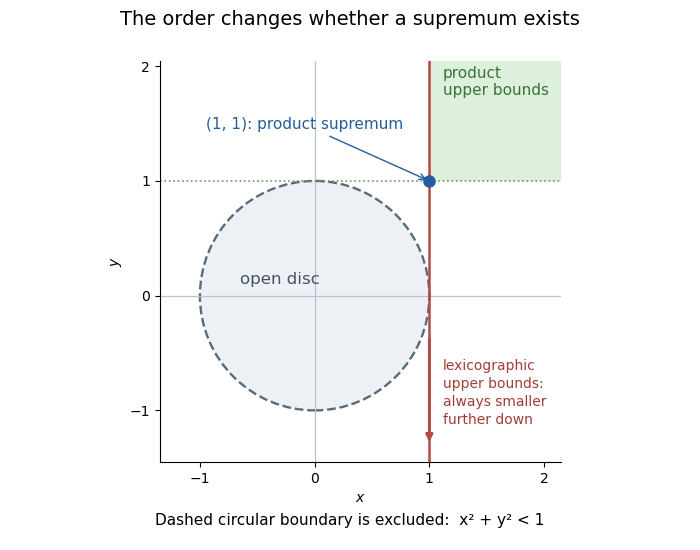
The same open unit disc has a supremum under the product order and none under the lexicographic order
. The green corner consists of product-order upper bounds. Every point on the red vertical line is a lexicographic upper bound; moving down that line always finds a smaller one. Details.
Articles by others on the same topic
There are currently no matching articles.