For these real-valued functions, means that there exist constants and such thatThe absolute values matter because neither function is assumed nonnegative. The constants are independent of ; finitely many earlier values do not affect Big O notation.
False. Set . The ratio of successive terms isConsequently for , which is unbounded. No constant can bound by that constant times for all sufficiently large . The factorial therefore fails the proposed Big O notation bound, without needing Stirling's formula.
True. Every term has when . Adding these inequalities givesThe constants and suffice in the definition of Big O notation.
False. The sum of squares of the first n positive integers givesThis ratio is unbounded, so it cannot satisfy the constant bound required by Big O notation. In fact the sum has order , as its leading term also shows.
An element is a least upper bound of if it is an upper bound, meaning for every , and for every upper bound of . The candidate need not belong to . Because a partial order is an antisymmetric relation, two least upper bounds must be equal. A least upper bound is also called the supremum.
An element is a maximum of if and for every . Thus it is an upper bound that is itself a member. Every maximum is the least upper bound: any upper bound must lie above because . A supremum outside need not be a maximum.
Under the product order, every point of the open unit disc has both coordinates below one, so is an upper bound. Any upper bound must have and , since the two coordinate projections of the open unit disc are . Therefore , proving .
Under the lexicographic order, every point , with arbitrary real , is an upper bound, because every point of has first coordinate strictly below one. Conversely, an upper bound cannot have first coordinate : a point with would exceed it. If an upper bound has , the upper bound is strictly smaller. If it is , the upper bound is strictly smaller. Hence there is no least upper bound under the lexicographic order. This illustrates the supremum of an open disc under product and lexicographic orders.
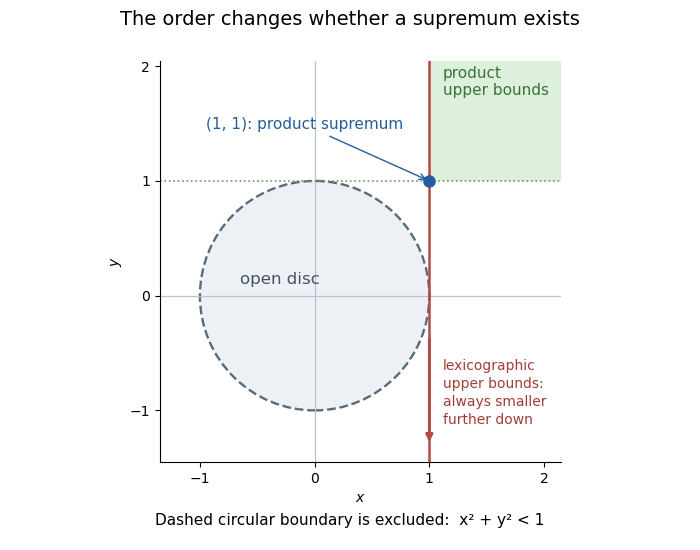
The same open unit disc has a supremum under the product order and none under the lexicographic order
. The green corner consists of product-order upper bounds. Every point on the red vertical line is a lexicographic upper bound; moving down that line always finds a smaller one. Details.
Articles by others on the same topic
There are currently no matching articles.