A normal fault is the plausible interpretation. The photograph shows a steep, exposed planar rock face with lower ground on its open side; this geometry is consistent with an exhumed footwall and a down-dropped hanging wall. A steep dip alone is not a unique indicator of shear sense, and the photograph does not supply a displaced marker proving the sense independently. Under an Andersonian faulting regime, a plausible maximum compression is approximately vertical, with horizontal in the extension direction and approximately along strike.
A numerical answer needs an assumption about fault orientation. For a cohesionless fault optimally oriented for Mohr-Coulomb failure criterion, with vertical , write for the internal friction angle and for the fault dip. The angle between the plane and is , so the optimal normal-fault dip relation givesHence under that model.
For the Mohr circle, plot effective compression horizontally and shear stress vertically. Draw a circle with diameter tangent to . Its centre and radius obey . One illustrative normalization is , , with tangency at the resolved stresses on the plane. Pore fluid pressure shifts the total-stress circle horizontally; the friction law uses effective stress.
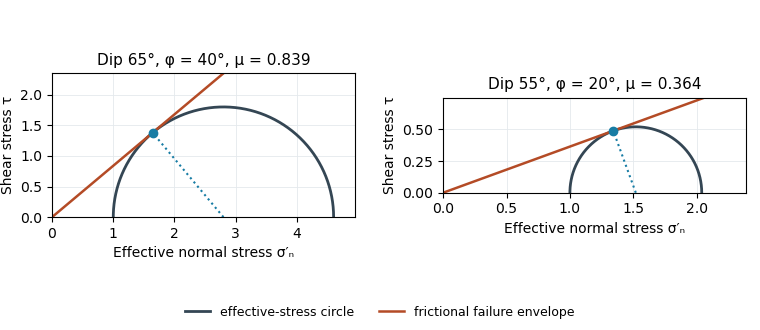
Original normalized Mohr circles for optimally oriented normal faults: different dips imply different tangent slopes only under the stated failure model
. Details. 
The dip does not determine the actual sliding coefficient of friction without the optimal-orientation assumption. A reactivated inherited plane may be nonoptimal, cohesion may matter, and the stress ratio and pore fluid pressure are not measured. For an arbitrary compression-positive stress state,at cohesionless sliding. Thus the requested single value is a conditional inference, not a friction measurement.
The visible surface can be an exhumed fault surface, rather than an unrelated hillslope that happens to intersect a buried plane. Downward motion of the hanging wall exposes the footwall face; repeated displacement and removal of loose material can reveal a substantial length of the same fault plane. Where exposure is renewed faster than weathering, erosion and collapse erase it, that planar surface remains part of the hillside. The less weathered lower face and rougher, vegetated upper ground are consistent with differential exposure, though the photograph alone does not date individual events.
At greater distance or over longer times, erosion modifies the slope and the hillside will cross or obscure the fault plane. The correspondence is therefore a transient competition between fault slip, exhumation and surface processes, not a requirement that all hillslopes follow faults.
Assuming pure dip-slip faulting, use an east–west striking, north-dipping normal fault, with the northern hanging wall moving down dip. In a right-hand-rule strike convention this is strike , dip , rake . The auxiliary nodal plane strikes east–west and dips south. The focal mechanism has a predominantly vertical P axis and a predominantly north–south horizontal T axis; the steep central direction is dilatational.
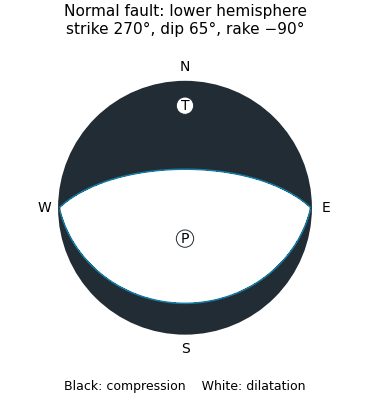
Original lower-hemisphere normal-fault focal mechanism: black compression, white dilatation, and two alternative nodal planes
. Details. 
The sketch is a double-couple seismic moment tensor calculation, not a claim that first motions uniquely identify which nodal plane slipped. The mapped north-dipping surface supplies that additional geological choice.
The along-strike rupture time is , where is rupture velocity. Taking a representative crustal gives about s for a km unilateral finite-source rupture. A different assumed rupture velocity changes this estimate. The local slip rise time at one patch is not specified and need not equal the whole-fault rupture time.
For comparable distance and ground conditions, the eastern observer lies in the forward rupture directivity direction. Radiation from successive patches arrives closer together, producing a shorter, more concentrated and generally larger-amplitude ground-velocity pulse. The western observer receives the contributions spread over a longer interval, generally with less concentrated shaking. This concerns pulse duration and amplitude; it does not imply an equally large permanent displacement at the eastern site.[ref]
What is Directivity by United States Geological Survey. Explanation of constructive interference and the relation of rupture speed to S-wave speed
For distant observers approximately along strike, an elementary seismic travel time construction giveswhere is the shear-wave velocity. With and , these propagation contributions are about and s, respectively; finite local rise time broadens them. Double-couple radiation pattern, receiver geometry and local site response can change the observed amplitudes, so location east or west alone is not an unconditional intensity prediction.
Articles by others on the same topic
There are currently no matching articles.