Write . For , direct partial differentiation givesHence exactly when , proving the claimed diffusion equation solution. At , , so . The infinite spatial domain needs no end-boundary conditions. For positive thermal diffusivity the amplitude decreases, as described by the thermal diffusion rate of a Fourier mode.
Choose to make the sketch explicit. The three profiles areThey have the same wavelength, zero crossings and phase, with amplitudes , and . Diffusion reduces the temperature gradient and amplitude; it does not advect or change this individual mode’s wavelength.
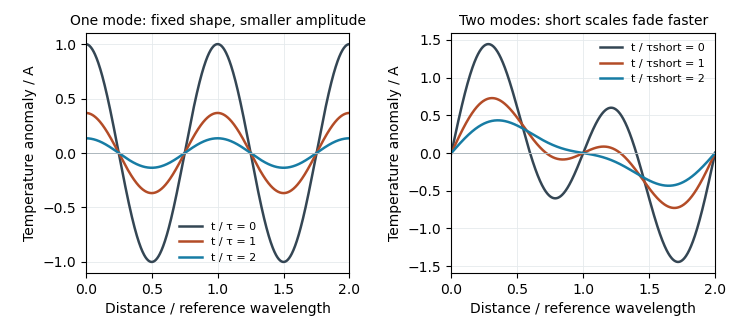
Original diffusion solutions: one Fourier mode loses amplitude, and a two-mode profile loses its short-wavelength structure faster
. Details. 
The diffusion equation is linear, so superposition givesEach term separately satisfies the equation, and their sum recovers the stated initial data at . Its e-folding times are , so implies . The shorter-wavelength oscillation loses a given fraction of its amplitude first. It approaches zero exponentially rather than disappearing at a finite instant. This preferential damping explains smoothing of fine-scale temperature structure.
For an integrable initial profile , use its Fourier transform with the conventionThe transformed diffusion equation is , soEquivalently the heat-kernel convolution isThis also accommodates bounded piecewise-continuous initial profiles; it recovers at continuity points as . For periodic initial data use a Fourier series and multiply each mode by ; the constant mean mode remains unchanged. “Any function” needs the usual existence/integrability or growth conditions: an arbitrarily fast-growing initial function need not give a finite heat-kernel integral.
Articles by others on the same topic
There are currently no matching articles.