With thermal diffusivity , a Fourier mode of angular wavenumber decays at rate . To avoid confusing this with thermal conductivity, use and angular wavenumber below: the same rate is , with units .
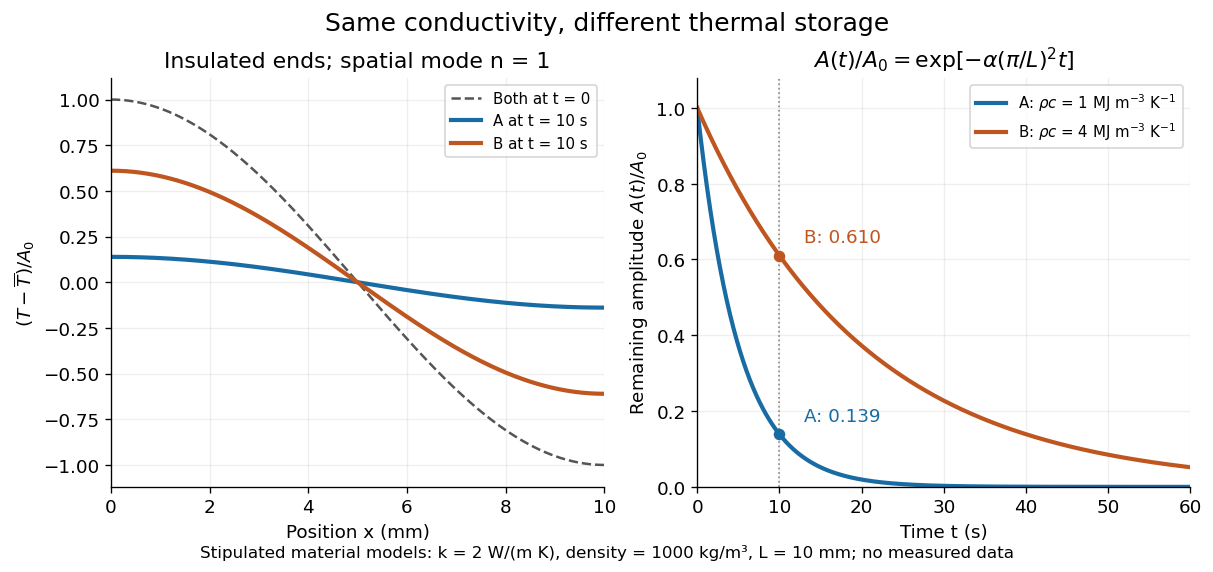
Consider an insulated bar with constant thermal diffusivity, no sources and no heat flux through either end or the sides. An original initial temperature profile and its exact evolution areThe cosine has zero temperature gradient at both ends, satisfying the insulated Neumann boundary conditions. Its spatial mean is zero, so conservation of energy leaves the mean temperature unchanged while the nonuniform part disappears. A short derivation substitutes into the heat equation: the second spatial derivative supplies , hence . The exponential decay time is ; doubling angular wavenumber quarters this time. If cycles-per-length spatial frequency is used instead, and the rate is .

Articles by others on the same topic
There are currently no matching articles.