For nonzero a, the correct data outcome has probability∣β∣2. To obtain exact identification for all a, this preparation must have α=0, so it is ∣1⟩up to global phase. This is a condition on the prescribed preparation circuit: any alternative quantum state preparation that supplies ∣−⟩ at the function oracle is equivalent.
Charlie cannot send a bit to Alice with the stated preparation, fixed interaction and final local measurements. Write V=CNOTB→A and W=CNOTB→C, so the complete gate is U=WV with the rightmost gate actingfirst. Alice has finished interacting before the gate involving Charlie acts.
This is an exact operator identity, including its global phase, and applies to arbitrary inputs. One can also check it directly from the orthogonal projectorsPb=∣b⟩⟨b∣: conjugating C1→2=P0⊗I+P1⊗X by H⊗H gives
These are the simplified quantum circuits in the figure: for a=00 there are no gates; for a=01 there is Cy→2; for a=10 there is Cy→1; and for a=11 there are both. The ancilla qubit becomes their common control. On every computational-basis state, the entire simplified circuit acts as
Starting the data qubits at ∣00⟩, the prescribed computational basis preparation of the ancilla qubit must therefore be ∣1⟩: it activates the required flips and gives ∣a⟩∣1⟩. Starting it at ∣0⟩ instead gives ∣00⟩∣0⟩ for every a, so no information is obtained.
Aconstant function has f(0)=f(1), whereas a balanced one has one zero and one one, so f(0)=f(1). The four oracles require only the following circuits:
The output is certainly zero for constant and one for balanced. In circuit terms the target X contributes only a global sign, and a controlled X with target ∣−⟩ acts as Z on the control; HZH=X then turns that phase into a measured bit. These identities prove the network for all four explicit oracles. The unused sign contains f(0) only asaglobal phase, consistent with the full-identification lower bound.
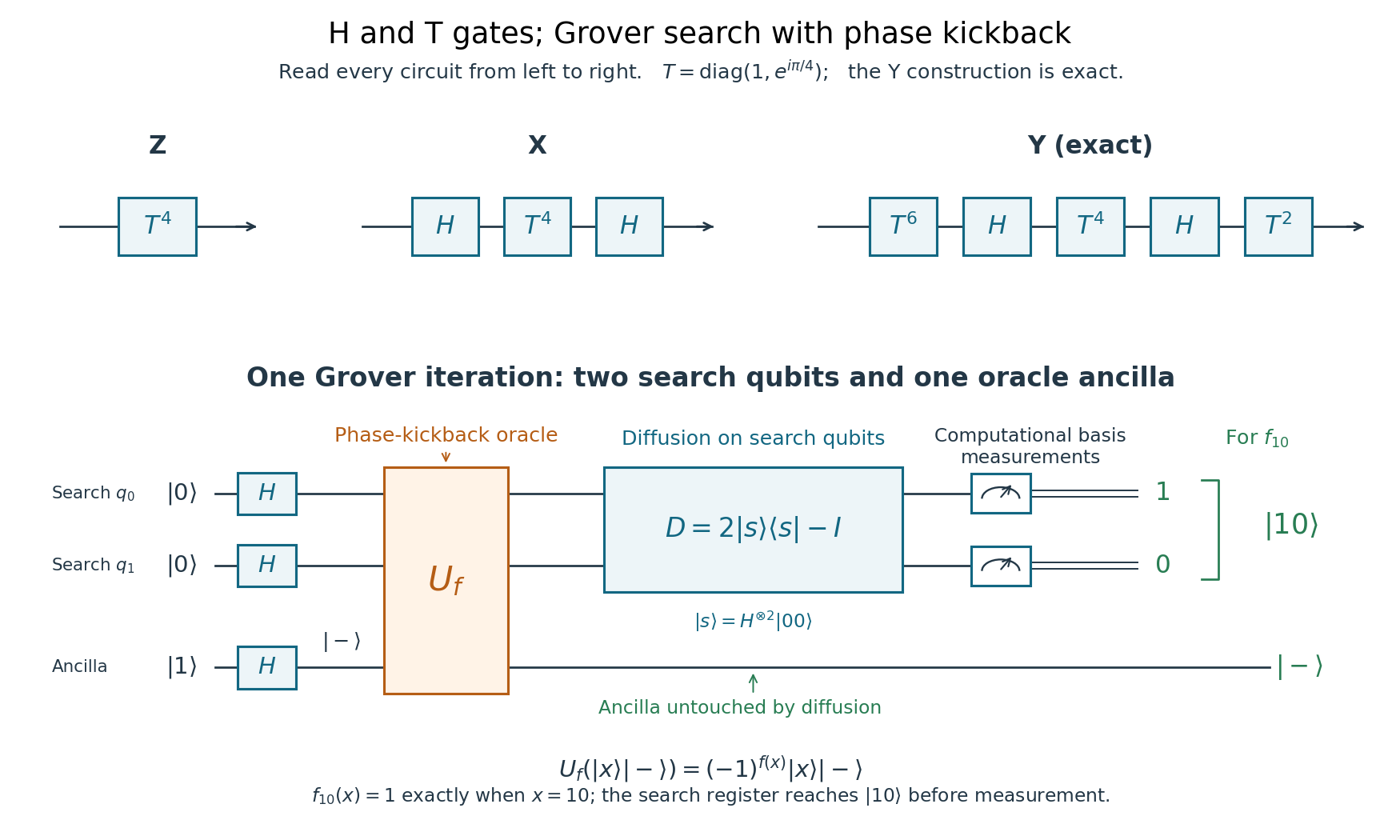
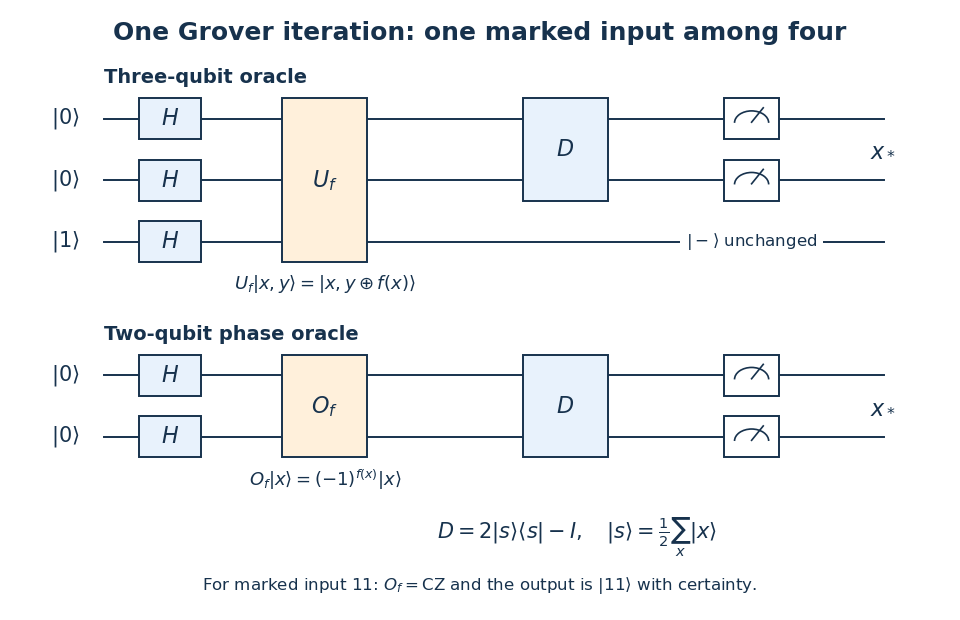
Initialize the search register in ∣00⟩ and the output qubit in ∣1⟩, then apply H to all three. The search state becomes ∣s⟩=(∣00⟩+∣01⟩+∣10⟩+∣11⟩)/2, and the output becomes ∣−⟩. The oracle obeys
A promise restricts which Boolean functions may be supplied. For the exact one-iteration four-entry search here, promise exactly one marked input. The four functions are fjk(x)=1 precisely when x=jk, for jk∈{00,01,10,11}. Other known numbers of marked entries require a correspondingly chosen iteration count; uniqueness is the promise for this particular exact circuit.
In basis order 00,01,10,11, the requested explicit calculation is
where J is in hertz and Iz=Z1/2, Sz=Z2/2. Resonant pulses and refocusing separate local rotations from the scalarcoupling. For positive J, evolution for t=1/(2J) supplies e−iπZ1Z2/4. Combining it with local Z phases gives the phase oracle
Here ∣−⟩=(∣0⟩−∣1⟩)/2. Since X∣−⟩=−∣−⟩, phase kickback gives Uf(∣x⟩∣−⟩)=(−1)f(x)∣x⟩∣−⟩. The third qubit remains separable and unchanged. A direct marked-state phase oracleOf∣x⟩=(−1)f(x)∣x⟩ therefore replaces the three-qubit query using only two qubits:
Tracing over B removes cross terms with unequal control labels. Tracing over Aleaves Tr(UbρAUb†)=1, proving the formula and its independence of ρA. Exchanging A and C proves the corresponding reverse independence. Thus the two targets cannot signal to each other through this fixed common-control interaction, despite phase kickback allowing a target to affect its control.
Two controlled-NOT gates with a common control and distinct targets are an example. They commute; their chronological order can be exchanged, giving an equivalent causal proof. Intervening control rotations or additional interactions can change the conclusion.