Choose the following original phenomenological mathematical model solely to calculate a paired-pulse readout. It is not experimental data, a fit to the teaching experiment, or a simulation of the Hodgkin-Huxley model. The conditioning action potential defines time zero. Test pulses have fixed width ; denotes their inward electric current amplitude. Impose an absolute neuronal refractory period . No finite test amplitude generates an event for . After that hold, stipulate a required amplitudewith , dimensionless and recovery time constant . Emit a test event exactly when , including equality. For this ideal event readout, assign events to pulse onset and assume the conditioning event is successfully evoked. There is no calculated membrane potential, spike waveform, response latency or stochastic success probability.
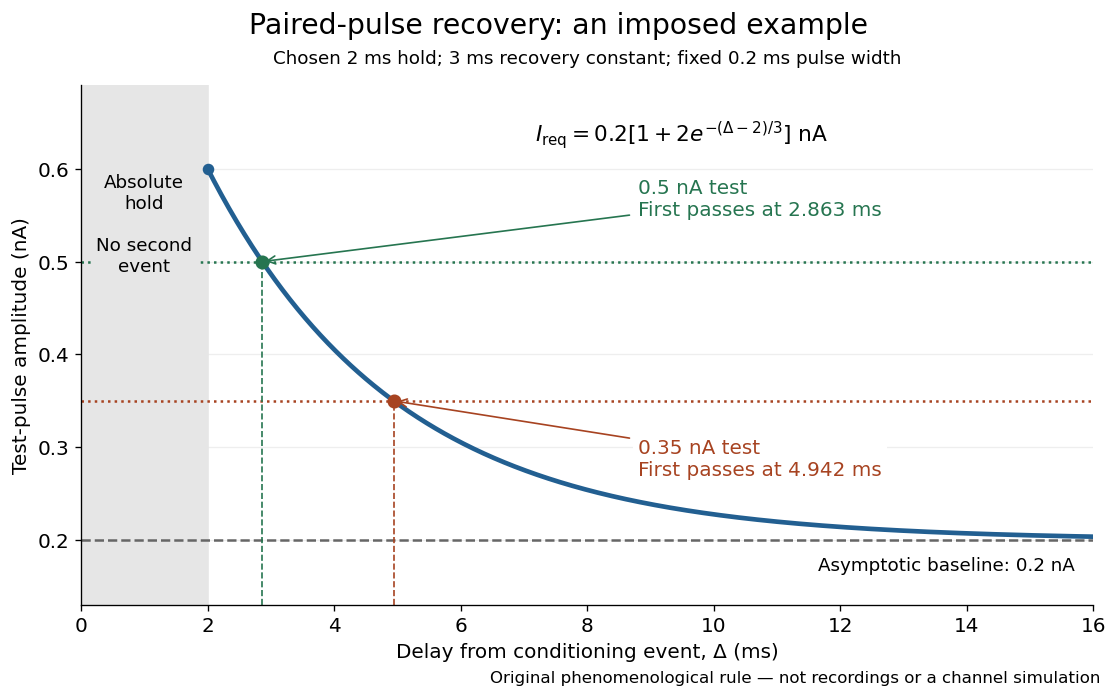

The exponential decay represents a combined recovery deficit; it is neither the Hodgkin-Huxley model's nor a measured potassium electrical conductance. One such curve cannot separately identify sodium recovery and persistent potassium electrical conductance. A constant pulse-width amplitude criterion also does not establish an equivalent rule for other pulse widths or voltage trajectories.
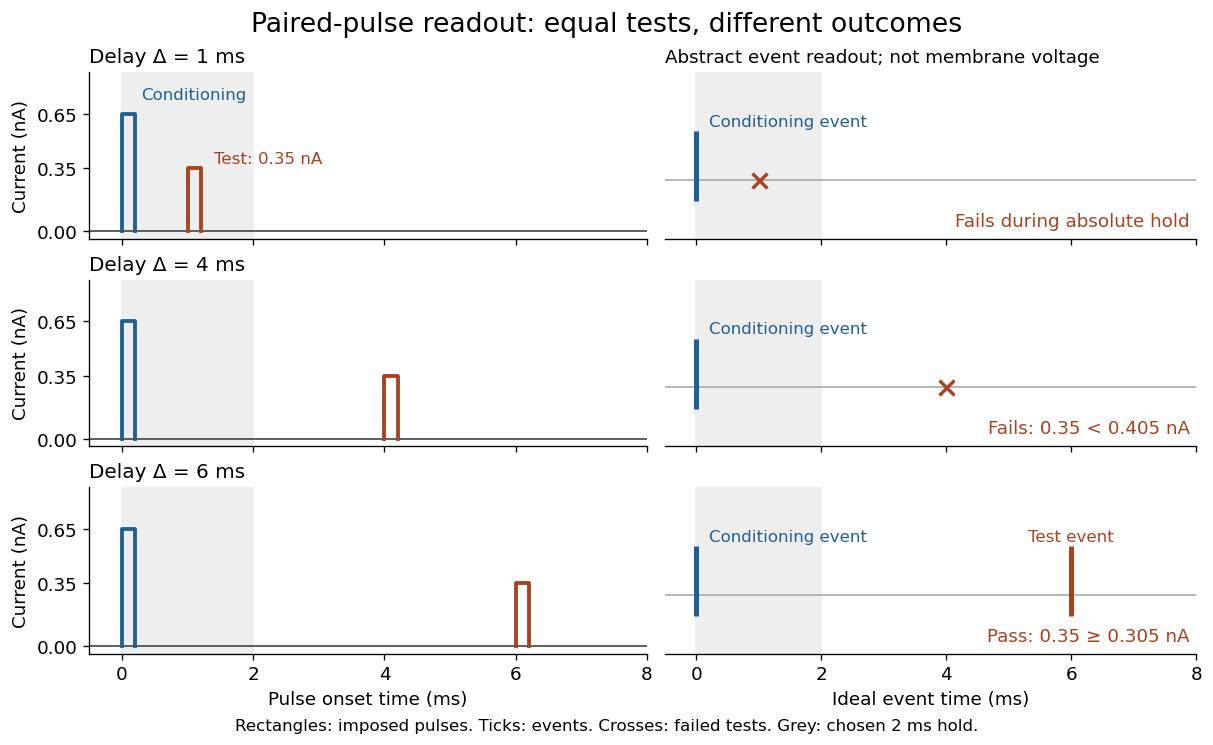
At the hold boundary, . At ,at ,Thus a test fails at because of the imposed hold, fails at because recovery is insufficient for that amplitude, and succeeds at . At , a pulse would instead succeed: failure of the weaker pulse was relative refractoriness.

For , solve using the logarithm. The earliest allowed delay isFor this is ; for it is . If , the imposed hold is the only delay restriction. If , no finite delay passes the rule: the required amplitude stays strictly above its asymptotic baseline. A finite experimental “fully recovered” time therefore also needs a tolerance and a readout definition.
Articles by others on the same topic
There are currently no matching articles.