A plasmid feature map records the positions of specified DNA features. Construct an original circular example of total length base pairs. Coordinates run clockwise from a chosen zero, and and label the same boundary. Positions here denote boundaries between base pairs, so the interval from 1000 to 2500 contains base pairs. This convention avoids counting both endpoints as additional material.
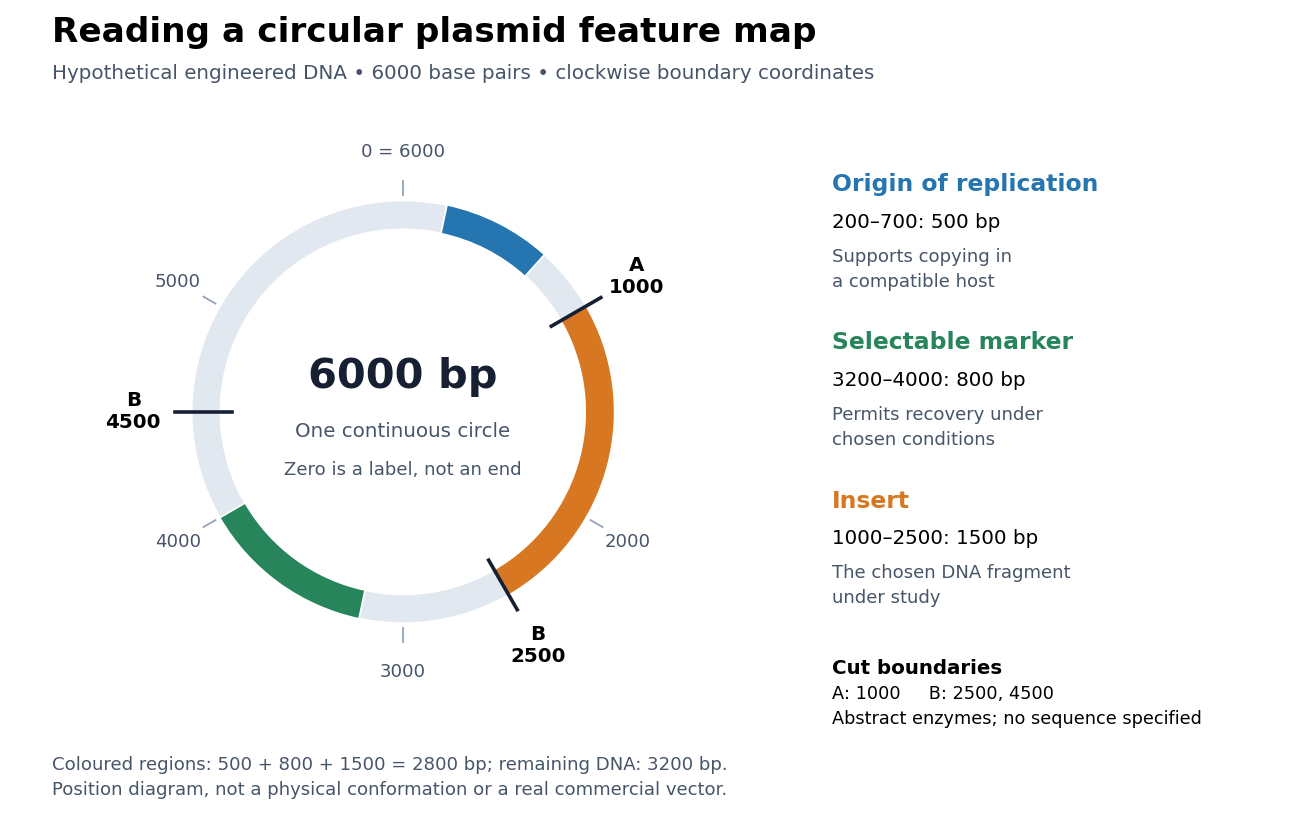
An original 6000-base pair plasmid feature map: copying, selection and a chosen plasmid insert occupy distinct regions
. Hypothetical engineered circular DNA, with clockwise boundary coordinates. Blue marks an origin of replication at 200–700; green marks a selectable marker at 3200–4000; orange marks the plasmid insert at 1000–2500. Abstract restriction enzymes A and B cut at the labelled boundaries: A at 1000; B at 2500 and 4500. Their recognition nucleotide sequences are unspecified. Neither the feature intervals nor the total length describe a real commercial construct. The ring records position, not the physical shape or three-dimensional conformation of DNA. Details.
The origin of replication is assigned to 200–700, the selectable marker to 3200–4000 and the plasmid insert to 1000–2500. Other positions are unspecified DNA, not empty gaps. Their lengths account for the entire circle:The first three terms are the marked regions; the last is all remaining material. Choosing a coordinate zero does not add a physical break. Rotating every coordinate by the same amount changes the drawing's labels without changing any distance around the plasmid.
A gene promoter must function in the recipient for the intended gene expression; copying a plasmid alone does not establish gene expression.[ref]
Molecular Biology Reference by Addgene. Plasmid Elements, Promoter Region row: recipient-dependent transcriptional machinery
The map therefore supports three separate questions: can the carrier persist, can carriers be recovered, and can the selected DNA perform the proposed task? The galactose induction comparison illustrates the third question in an actual yeast experiment. Articles by others on the same topic
There are currently no matching articles.