For a polygonal schema with all its sides paired and two same-direction occurrences of an edge label , the words , , and describe homeomorphic quotient spaces. Here inversion of a string reverses its order and inverts each letter. Cut from the start of the first side to the start of the second, using a diagonal . The pieces have boundary words and . Gluing the old sides gives outside word ; reversing the whole boundary and choosing a new starting point gives . Alternatively cut from the end of the first side to the end of the second. The pieces are and , and gluing their old sides gives , cyclically . Renaming the new paired side gives both asserted forms. These are actual cutting and gluing homeomorphisms, so they preserve all the other side identifications as well as the Euler characteristic.
Start with a polygonal disk and pair all its sides, specifying for each pair a homeomorphism matching endpoints. Arrow labels encode whether each occurrence is traversed with or against its assigned direction. Form the quotient topology using those identifications and no extra identifications in the interior. Matched edge interior points have disk neighbourhoods formed from two half-disks; the corner sectors around each identified vertex form a circular link. The quotient is therefore a closed surface. A boundary word records each edge label exactly twice. Its endpoint identifications determine the vertex count, while its signs determine orientability. This encoding is distinct from treating a side-paired polygon as an abstract simplicial complex; a compatible subdivision is needed for a simplicial triangulation.
Read a boundary word counterclockwise, giving every paired edge a label. A positive exponent means the edge arrow agrees with the boundary traversal, and an inverse means it disagrees. Identify equally labelled edges in their arrow directions. The sphere has a square word ; the vertex count is three, giving Euler characteristic . A closed orientable surface of genus has wordA nonorientable surface which is the connected sum of surfaces of real projective planes has word . For , this is a digon; the square word , identifying antipodal boundary points, is another model of the real projective plane. The Klein bottle has square word , representing the nonorientable case . The classification theorem for closed combinatorial surfaces says that these orientable and nonorientable families exhaust the connected closed cases.
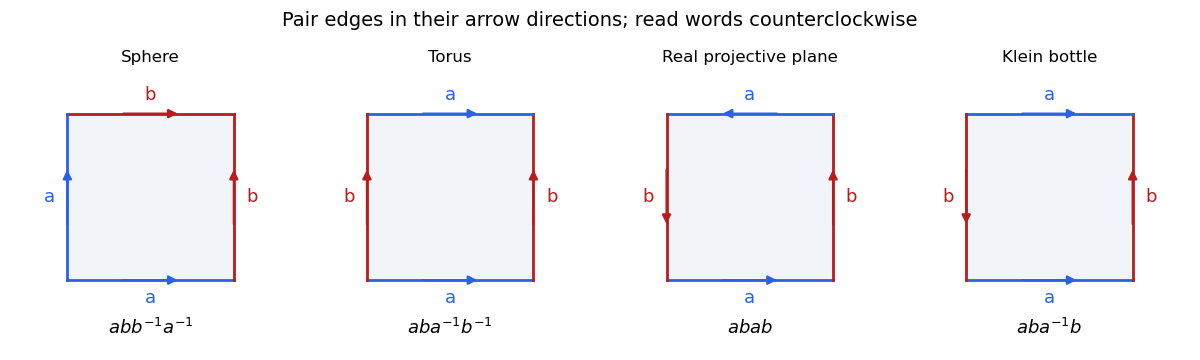

Triangulate a closed polygon by joining an interior point to every side, using matching parametrizations on paired sides. Orient every radial edge away from the interior point and choose consistent orientations on paired boundary edges. Each triangle then has a local vertex ordering with the centre first and its boundary edge in the chosen direction. These local orderings agree along shared edges. The quotient triangles and their affine face identifications form a finite delta-complex, even if some triangle vertices become identified. The second barycentric subdivision of a delta-complex removes these identifications at the simplicial level without changing the underlying quotient space. Thus every polygonal schema with a complete pairing has a finite triangulation. A single subdivision need not suffice to give an abstract complex.
Replace each corner of a polygonal schema by a small closed interval cutting across that corner. The endpoint identifications induced by paired polygon edges glue these intervals into a graph at each vertex equivalence class. This is its vertex link. A circle link gives a disc neighbourhood; a closed interval link gives a half-disc neighbourhood in a surface with boundary.
For a complete pairing of the sides of a single polygon, every link endpoint is paired exactly once. In each vertex equivalence class the link graph is connected, since the corner endpoint identifications generate precisely that class, and all its vertices have degree two. It is therefore a circle. For partial pairings, a connected link can instead be a closed interval when it has two unpaired endpoints. Counting free polygon edges alone does not count boundary components of a surface; their endpoints must first be identified.
Start with a polygonal schema whose outer boundary has sides, and remove a triangular disc strictly inside its polygon. Cut the resulting annulus along an arc from an outer vertex to an inner vertex. The cut space is a closed disc with marked sides: the original outer sides, two banks of the cut, and three inner sides. Parametrize it by a convex polygon with that many sides. A boundary homeomorphism carrying the marked vertices in cyclic order extends over the disc by radial extension after identifying both discs with a standard closed disc.
Transport the original side identifications to this polygon and identify the two cut banks, leaving the three inner sides unpaired. The quotient space is the original surface with an open triangular disc removed. In boundary-word notation, if is the original word, the new word is , with unpaired. The torus has ; a square model of the real projective plane has , pairing antipodal points of the square's boundary.
Identifying the sides of one polygon in pairs gives a cell structure with one face, edges and some number of vertex classes. For a closed orientable surface of genus ,Since , every such schema satisfies .
Articles by others on the same topic
There are currently no matching articles.