Polymer blend miscibility is the ability of different polymers to form one thermodynamically stable phase at specified temperature, pressure and composition. A specimen that merely looks uniform is not sufficient evidence. IUPAC distinguishes a homogeneous blend from a miscible one: the latter must satisfy thermodynamic miscibility criteria.[ref]
IUPAC Compendium of Chemical Terminology, fifth edition (Gold Book). Homogeneous polymer blend, entry HT07582, notes on the definition of miscible polymer blend
The thermodynamic comparison is between the homogeneous state and all allowed phase-separated states at the same overall composition. For a binary incompressible lattice model with equal segment volumes, let be the first component's volume fraction, the segment counts per chain and the interaction parameter. Flory–Huggins solution theory gives a dimensionless mixing Gibbs free energy per lattice site,The mixing entropy per segment is reduced for long connected chains. The originating statistical treatment of polymer solutions makes molecular-size disparity explicit, rather than replacing the chains by equal-sized independent small molecules.[ref]
Thermodynamics of High Polymer Solutions by Paul J. Flory. Opening summary, p. 51, chain-size-dependent mixing entropy and volume fractions
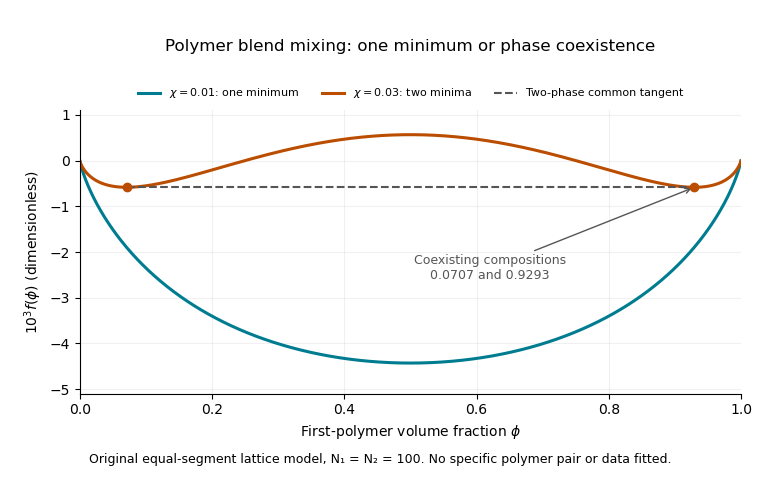
At composition-independent , direct differentiation givesNegative curvature means that small composition fluctuations can lower the free energy: the homogeneous state is locally unstable. For an original symmetric example with at , . Values and therefore give positive and negative curvature, respectively. In this model the symmetric critical value is .
Positive local curvature alone does not establish global stability. In a common-tangent construction for phase coexistence, a line touching the free-energy curve at two compositions can lie below the intervening homogeneous states, indicating favorable two-phase coexistence. The spinodal marks local loss of stability; the binodal bounds coexistence. These are different questions about the same free-energy landscape.

Experiments must also address kinetics and observation scale. A blend can retain an apparently uniform state because phase separation is slow. Microscopy or light scattering can reveal domains or composition fluctuations, but absence of a resolved signal only establishes the resolution and timescale of the observation. A stated thermal history and measurements after changing temperature help distinguish a persistent preparation from evidence about equilibrium. No particular polymer pair is assigned a phase diagram by the illustrative lattice parameters.
Articles by others on the same topic
There are currently no matching articles.