After the quantum quench, hold fixed and evolve without an intervening energy measurement. The unitary time evolution isProjection onto the original gives probability amplitude . Squaring its modulus yields the two-level quantum return probabilityTheir sum is one. For , the first minimum of is at , and the return is complete at . At or there is no oscillation, because the initial quantum state is already a final energy eigenstate.
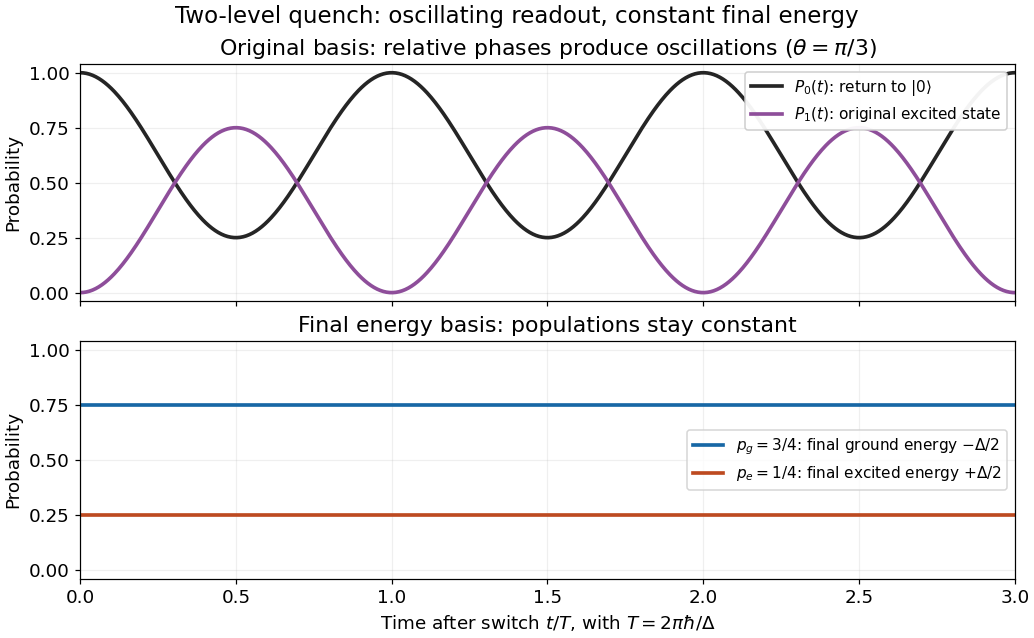

Changing measurement basis reveals the evolving relative quantum phase. Measuring the final energy first instead destroys this quantum coherence between final energy eigenstates in the unconditioned ensemble: its later original-basis return probability is , equal to for this example. That constant differs from the oscillation of the unmeasured pure state. The work protocol and the oscillation protocol therefore use separate preparations.
Articles by others on the same topic
There are currently no matching articles.