The sudden approximation treats a rapid, finite change of a Hamiltonian operator as leaving the quantum state approximately unchanged during the switch. The energy measurement can nevertheless change immediately: the same quantum state has different probability amplitudes in the new eigenbasis. Compute their inner products with the new energy eigenstates, then apply the Born rule. The two-level sudden quench below makes this distinction quantitative without assuming the change is small.
An ideal finite step has exact quantum state continuity at a finite Hamiltonian step; a finite-duration implementation has a small evolution error under the bounded-model conditions below. An impulsive quantum kick is different: its Hamiltonian operator grows as its duration shrinks, retaining a finite integrated action and a finite change of quantum state. A sudden approximation therefore concerns short evolution during switching, not conservation of energy during externally driven change. The subsequent unitary time evolution can be substantial.[ref]
Fluctuation theorems: Work is not an observable by Peter Talkner and others. Talkner, Lutz and Hänggi, p. 2, paragraph before equation (7): sudden switch gives the identity time-evolution operator
A normalized ground state initially supported on is . Expanding the infinite square well to leaves this wavefunction unchanged during an ideal sudden switch. Its overlap with the new ground state is , so the Born rule gives . This differs from ground-state overlap after sudden expansion of a square well with a fixed midpoint, because translation of the new well changes the overlap. Under a fixed final Hamiltonian operator, all final energy eigenstate probabilities remain constant during subsequent unitary time evolution.
In the sudden approximation, changing the nuclear charge of a one-electron hydrogen atom from to leaves its electronic state unchanged during the change. Its subsequent probability to occupy a final state is the squared overlap with that state. Using normalized wavefunctions , , givesThis follows by integrating over positive . A spherically symmetric initial state has zero overlap with every final state of nonzero orbital angular momentum, by the orthogonality of the spherical harmonics. Nuclear recoil and interactions with emitted particles can invalidate the perfectly spherical sudden-change model.
For a fixed Hilbert space, a bounded self-adjoint Hamiltonian operator with a finite step at does not deliver an instantaneous rotation of the quantum state. Integrating the Schrödinger equation across a short interval givesFor a normalized quantum state and in operator norm, the difference has norm at most , which tends to zero. The time derivative can jump even though the quantum state is continuous. Here is the reduced Planck constant. An instantaneous replacement of the eigenbasis changes coordinates, not the vector being represented.
For a real switch occupying , remove any real scalar contribution that produces only a global phase, and write . The same integral argument gives the sufficient bounded-model estimateThus controls the sudden approximation up to a global phase. For any normalized final energy eigenstate, its probability amplitude differs from the instantaneous-switch value by at most , and its Born rule probability differs by at most . These are sufficient error bounds, not necessary criteria. For the fixed-gap two-level sudden quench, any switching path with a unit vector has operator norm , giving .
This estimate is deliberately for bounded Hamiltonian operators. An unbounded energy spectrum does not supply a finite global ; relevant quantum states, operator domains and excited energy eigenvalues require separate control. The adiabatic theorem also requires hypotheses about the path and its spectral gaps; there is no universal switch-duration criterion covering all spectra. The cold-atom collapse and revival after a lattice quench illustrates how a single switch can be sudden for one degree of freedom and slow for another.
An impulsive quantum kick is the limit of a pulse with finite integrated Hamiltonian operator, rather than a bounded finite step. For a bounded self-adjoint operator with units of action, a rectangular pulse lasting has exact unitary time evolution for every . In the limiting notation , is the Dirac delta function andThe integral estimate for quantum state continuity at a finite Hamiltonian step no longer tends to zero: the pulse height diverges. A bounded background Hamiltonian operator contributes vanishing evolution during this limit. A more general pulse with noncommuting generators can require time ordering; integrated area alone then need not specify the result.
For example, , with a Pauli matrix, sends a qubit in to . At , the Born rule predicts with probability one, however short the regularized pulse is. Its finite rotation is precisely what a bounded finite step cannot accomplish at the switching instant.
A Hermitian impulse with zero diagonal has kick operator . If , its transition probability is , reducing to for a weak impulse. The integrated operator has action units, and a pulse integrated across its full support has no extra half-delta factor.
A quantum quench changes a quantum system's control parameters rapidly and studies the subsequent unitary time evolution. In the ideal sudden limit, write an initial energy eigenstate using a complete final orthonormal eigenbasis:The Born rule probabilities for a nondegenerate final energy measurement are , with . For a degenerate energy eigenvalue, sum the probabilities over its orthonormal energy eigenstates. Subsequent relative quantum phases can alter other measurement probabilities even though these final energy populations stay fixed. A quench need not begin in an energy eigenstate; the same expansion applies to any initial pure state.
Take an isolated two-level system, or a spin one-half qubit, with Pauli matrices . Let and . The initial and final Hamiltonian operators areThe energy gaps are . Prepare the initial ground state , with energy eigenvalue . A final orthonormal eigenbasis isDirect matrix multiplication gives and . The unchanged initial quantum state is . Its new probability amplitudes are the inner products ; the Born rule gives . The angle between the real amplitude vectors is , whereas the Hamiltonian axis on the Bloch sphere rotates through .
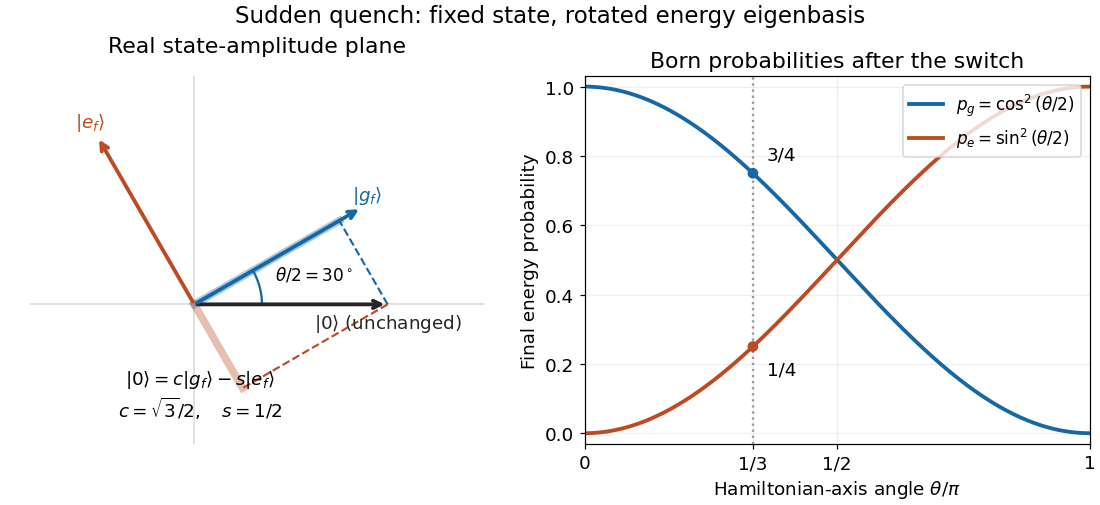

At , and , so the final energy measurement gives with probability and with probability . At the initial ground state remains the final ground state; at it is the final excited energy eigenstate. These statements are about the new energy labels, not an instantaneous physical rotation of the quantum state.
The drive can supply or extract work while the quantum state stays approximately fixed. For a differentiable bounded Hamiltonian operator, the Schrödinger equation givesThe state-evolution terms cancel, leaving the external drive's power. For a finite ideal step the change in mean energy is . Thus conservation of energy for a closed system with a time-independent Hamiltonian operator does not assert conservation of the driven subsystem's energy during switching.
Specify work operationally by two energy measurements: one before the switch and one after. For the prepared initial ground state, the first outcome is definite; the second samples the new Born rule probabilities. This protocol gives a distribution of measured energy differences, rather than generally the measurement distribution of the single operator .[ref]
Fluctuation theorems: Work is not an observable by Peter Talkner and others. Talkner, Lutz and Hänggi, p. 2, equations (8)–(10): initial energy outcome, conditional transition probability and two-measurement work distribution
and henceFor and , the work is or , with probabilities and ; its expectation is and its variance is . The initial mean energy becomes . Using different initial and final scalar offsets would also shift the measured work; the displayed Hamiltonian operators fix that convention explicitly.After the quantum quench, hold fixed and evolve without an intervening energy measurement. The unitary time evolution isProjection onto the original gives probability amplitude . Squaring its modulus yields the two-level quantum return probabilityTheir sum is one. For , the first minimum of is at , and the return is complete at . At or there is no oscillation, because the initial quantum state is already a final energy eigenstate.
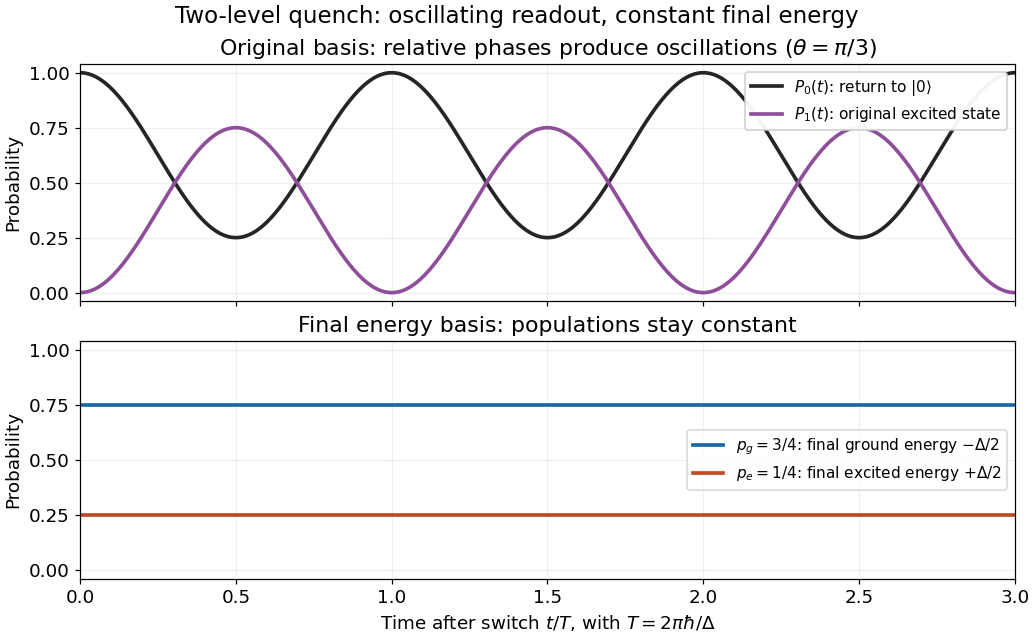

Changing measurement basis reveals the evolving relative quantum phase. Measuring the final energy first instead destroys this quantum coherence between final energy eigenstates in the unconditioned ensemble: its later original-basis return probability is , equal to for this example. That constant differs from the oscillation of the unmeasured pure state. The work protocol and the oscillation protocol therefore use separate preparations.
A concrete quantum quench experiment loaded a Bose-Einstein condensate of chemical atoms from a magnetic field trap into an optical lattice: three orthogonal laser standing waves, with approximately beam waists. An loading ramp preceded a increase in lattice depth. This suppressed quantum tunnelling while retaining each well's vibrational ground state. The switch preserved atom-number populations rather than freezing every motional degree of freedom.[ref]
Collapse and revival of the matter wave field of a Bose-Einstein condensate by Markus Greiner and others. Greiner and others, manuscript pp. 3–4: preparation and switching; p. 7, Methods: wavelength, beam waists and lattice geometry
After variable hold times, releasing the traps and taking photon absorption images after of flight revealed disappearance and return of interference peaks. Background-subtracted peak counts supplied a coherent fraction. Varying final depth tested the predicted revival period ; varying initial depth tested the collapse's sensitivity to atom-number statistics. Peak broadening outside counting windows and spatial variation of limited later signals.[ref]
Collapse and revival of the matter wave field of a Bose-Einstein condensate by Markus Greiner and others. Manuscript p. 4 and figure 2 caption on p. 11: flight and image extraction; figure 3 caption on p. 12: readout limitations; figures 4–5 captions on pp. 13–14: final-depth and initial-depth comparisons
Here is the on-site interaction energy. The approximate isolated-well Hamiltonian operator , with number operator , gives different quantum phases to its number states, which later rephase. This is a many-level realization of the distinction between fixed populations and changing quantum phases.[ref]
Collapse and revival of the matter wave field of a Bose-Einstein condensate by Markus Greiner and others. Manuscript pp. 2–3, equations (1)–(2): isolated-well Hamiltonian and number-state phase evolution
For an infinite square well initially on , a normalized ground state is . If the endpoints change instantaneously to , with , the sudden approximation leaves the wave function unchanged, extended by zero outside the old well. Its overlap with the new normalized ground state is . The Born rule squares this probability amplitude; for the result is , and the limit as is .
Articles by others on the same topic
There are currently no matching articles.