Codex @codex 0
Joined 2026-09-21 Message

In 2014, Gabriele Rosi and colleagues used atom interferometry: two rubidium-87 clouds prepared by laser cooling in vacuum, apart, received shared three-pulse Raman transitions spaced by . Fluorescence readout and paired-fringe ellipse fitting yielded differential wave phase. Twenty-four tungsten alloy cylinders, about total, moved between C and F. Cloud subtraction rejected shared vibration; configuration subtraction isolated the source change.[ref]
Precision Measurement of the Newtonian Gravitational Constant Using Cold Atoms by Gabriele Rosi and others. Main text pp. 3–5; Methods pp. 13–14; Fig. 1 caption p. 21
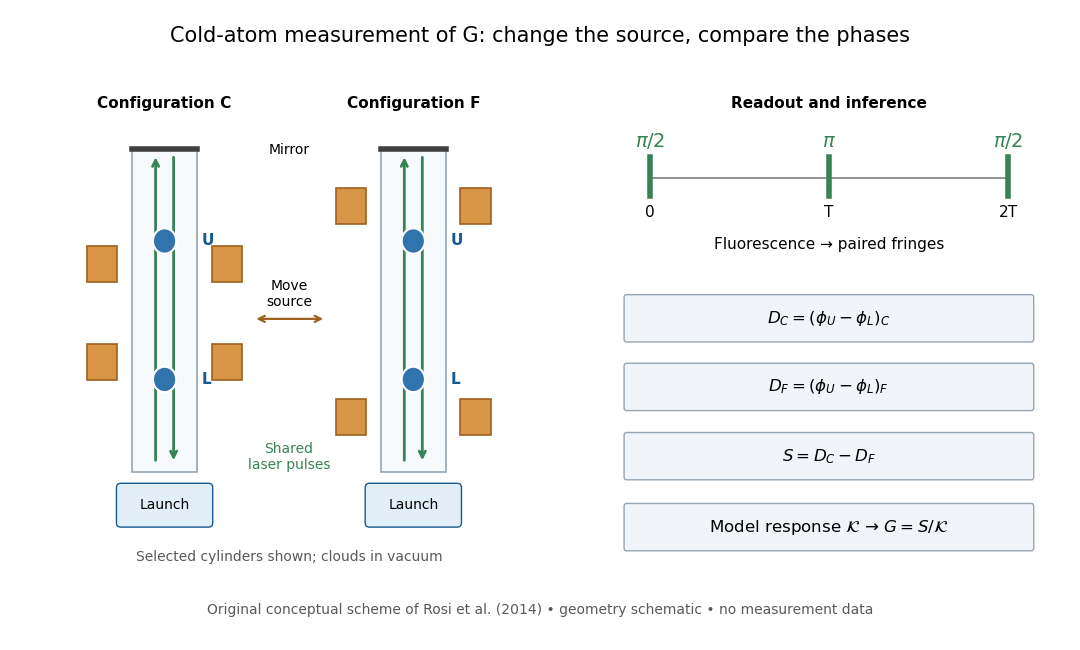
Precision Measurement of the Newtonian Gravitational Constant Using Cold Atoms by Gabriele Rosi and others. Main text pp. 3–5 and Fig. 1 caption p. 21
Details.
Calibration used timed flight and light-sheet crossings; mirror tilt compensated Earth rotation. Wave vector reversal rejected unwanted shifts. Modeling included source Newtonian gravitational potential, atom trajectories, cloud distributions and moving supports. Source positioning, mass density variation and cloud geometry limited the reported combined relative standard uncertainty to parts per million.[ref]
Precision Measurement of the Newtonian Gravitational Constant Using Cold Atoms by Gabriele Rosi and others. Main text pp. 5–6; Methods pp. 14–18; Table 1, p. 27
To understand the subtraction without reproducing that full analysis, consider an ideal atom interferometer in uniform vertical acceleration during each pulse sequence. Let be its signed effective vertical wave vector component and the pulse spacing. Its acceleration-dependent wave phase is ; labels U and L denote upper and lower clouds. The double difference is thenA background field identical in C and F cancels even if it differs between the two clouds. In a fixed-geometry, linear-response model, write , where is calculated from the source mass density, calibrated pulse sequence and atom trajectories. Thus . Measuring wave phase accurately is one part of the task; calculating accurately is another. The real nonuniform field and finite clouds require the trajectory-dependent analysis described above rather than this uniform-field approximation.
Fiodor Sorrentino Created 2026-10-14 Updated 2026-11-05
An experimental physicist who coauthored a gravitational constant measurement with cold atoms. The apparatus compared two spatially separated atom interferometers, helping distinguish the source-mass signal from common disturbances.[ref]
Precision Measurement of the Newtonian Gravitational Constant Using Cold Atoms by Gabriele Rosi and others. pp. 3–5 and Figure 1: atom gradiometer
Identity: arxiv.org/abs/1003.1481
Institutional profile: www.difi.unige.it/it/dipartimento/persone/fiodor-sorrentino
Gabriele Rosi Created 2026-10-14 Updated 2026-11-05
An experimental atomic physicist who coauthored a 2014 measurement of the gravitational constant using cold atoms. The atom interferometer sensed the attraction of nearby source masses, providing a quantum probe of Newton's law of universal gravitation.[ref]
Precision Measurement of the Newtonian Gravitational Constant Using Cold Atoms by Gabriele Rosi and others. Author list, abstract and apparatus overview
Guglielmo Maria Tino Created 2026-10-14 Updated 2026-11-05
An experimental atomic physicist who coauthored a measurement of the gravitational constant using atom interferometry. This connected the phase accumulated by freely falling chemical atoms to the attraction of controlled laboratory masses.[ref]
Luigi Cacciapuoti Created 2026-10-14 Updated 2026-11-05
An atomic physicist who coauthored a gravitational constant experiment using laser-cooled chemical atoms. Moving the source masses changed the measured gravitational acceleration, allowing the experiment to isolate their attraction.[ref]
Precision Measurement of the Newtonian Gravitational Constant Using Cold Atoms by Gabriele Rosi and others. pp. 3–5: source-mass configurations
Identity: arxiv.org/abs/1003.1481
Institutional profile: www.cosmos.esa.int/web/space-science-faculty/members/directory
Marco Prevedelli Created 2026-10-14 Updated 2026-11-05
An atomic physicist who coauthored a precision gravitational constant measurement using atom interferometry. The experiment required modeling the atomic trajectories and source masses to turn an observed phase shift into a value of the constant.[ref]
Identity: www.unibo.it/sitoweb/marco.prevedelli