Quadratic energy loss from centred Gaussian gate timing error is the leading decrease in collected energy when a symmetric gate is displaced slightly from the centre of a Gaussian pulse. At the optimum the first-order change vanishes, but the second-order change is negative. The Gaussian pulse time-gate energy fraction gives the exact displaced-gate integral; here the local loss and its effect on jitter are derived explicitly.
Let be the centred energy-normalized pulse profile, let , and setThe Leibniz integral rule gives . Since is even and ,The Taylor expansion therefore yieldsThis is an absolute fraction of the full pulse energy. The relative loss compared with the centred gate is instead .
For a gate as wide as the power FWHM , and . An offset gives leading loss , or about percent of the centred gate's collected energy. Neither the full pulse energy nor the gate width has changed.
A zero mean offset does not eliminate this loss. For a sufficiently narrow random offset with mean and variance , the leading expectation isIf has a centred normal distribution, the quadratic model also gives . At , the leading mean loss is and this standard deviation is . These formulas neglect fourth-order effects; they are local approximations, not bounds for large timing excursions.
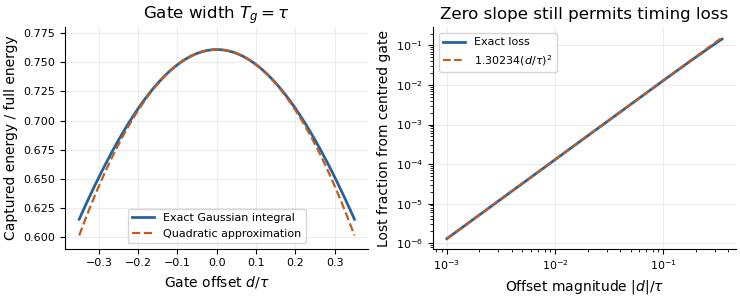
Exact Gaussian gate capture and its local quadratic loss: a zero first derivative does not remove timing sensitivity.
Details. 
An apparatus check scans the gate delay about its optimum and compares the measured decrease with the model, while monitoring gate width and the pulse. A gate on the detector's electrical output need not act directly on optical power: the detector impulse response and readout convolution must be included. NIST's impulse-response measurements illustrate that distinction.[ref]
Articles by others on the same topic
There are currently no matching articles.