The Gaussian pulse time-gate energy fraction is the share of an isolated pulse's laser pulse energy admitted by a finite time window. The result below acts on incident optical radiant power. Let be the power full width at half maximum, and first place the pulse centre and the detection time gate centre at zero.
A detection time gate need not collect the whole pulse. Integrating the same profile only over gives the Gaussian pulse time-gate energy fractionwhere is the error function. A gate as wide as the power full width at half maximum collects only , or 76.10% of the pulse energy. The pulse has nonzero Gaussian tails outside that interval. A real readout's impulse response can extend the required integration window further.
Alignment adds a parameter. Let the pulse centre be , the gate centre be , and write the Gaussian gate centring error as . Put . Integrating the normalized Gaussian pulse profile over the gate givesAt the two error function terms reduce to the centred formula above. With and , the captured fraction drops to . The pulse centre then lies on a gate edge. Merely keeping the gate width fixed does not keep its collected energy fixed.
The gate works best when centred. With the centred energy-normalized pulse profile and , differentiation of givesA Gaussian function is an even function about its centre and decreases with distance from that centre. Thus for , and symmetry gives the opposite sign for . The same argument proves that a centred interval maximizes mass for an even unimodal density; unimodality supplies the required monotonicity.
A centred gate of width captures of the energy. Solving gives for 99% capture in this ideal model. The requirement changes if the centring error is nonzero.
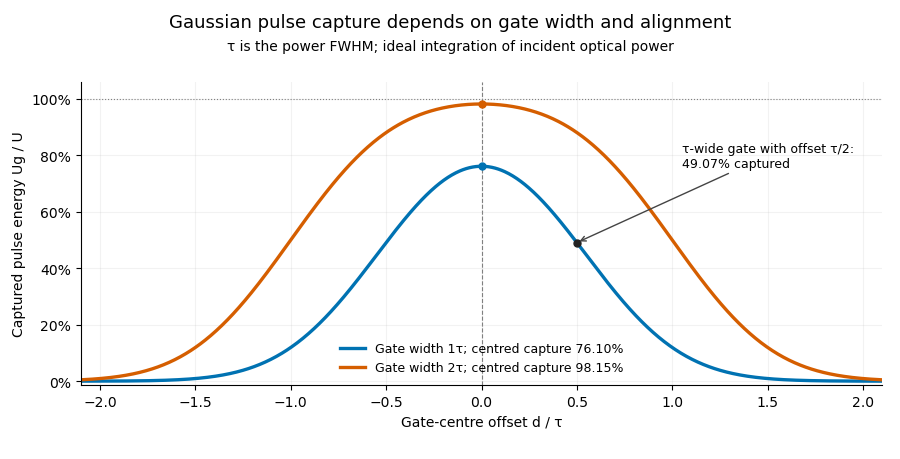

Pulse timing jitter can therefore create variation in gated energy even when every full pulse has the same . A wider gate reduces this loss but also changes admitted background and the chance of including neighbouring pulses. Measure the timing and detector response associated with the chosen gate.
For a detector modeled as a linear time-invariant system, its recorded waveform is a convolution of the optical input with its impulse response. NIST tested avalanche photodiode radiometers with roughly optical pulses, recorded their responses with an oscilloscope, and convolved measured responses with longer Gaussian inputs to estimate corrections. The detector and amplifier were characterized together.[ref]
Calibration Service for Low-level Pulsed-Laser Radiometers at 1.06 µm: Pulse Energy and Peak Power by Rodney W. Leonhardt. §§6.1–6.2, printed pp. 13–15: short-pulse excitation, sampling readout and numerical convolution
A gate applied to that electrical waveform must use the readout model rather than assuming the optical fraction is unchanged.The Gaussian gate centring error is , the time displacement between a gate centre and a Gaussian pulse centre. The Gaussian pulse time-gate energy fraction gives the full displaced-gate formula. Equal positive and negative errors collect equal energy in that symmetric model, so an energy deficit alone does not reveal the direction of the misalignment.
A focused expansion explains sensitivity close to the optimum. Let be the centred energy-normalized pulse profile, let , and define . For the Gaussian standard deviation ,Thus the leading quadratic energy loss from centred Gaussian gate timing error is second order, rather than linear in .
For an original example, take a gate as wide as the power FWHM . Its centred fraction is . An error gives from the full formula; the quadratic approximation gives . For this is a displacement, with gate width and total pulse energy unchanged.
A delay scan of a gated readout can locate the maximum, provided the source and gate widths remain stable. Pulse timing jitter produces a distribution of offsets rather than a single deterministic . Also distinguish a gate on optical power from one on a detector's electrical waveform: NIST measured detector impulse responses and used convolution to assess pulse reproduction.[ref]
Calibration Service for Low-level Pulsed-Laser Radiometers at 1.06 µm: Pulse Energy and Peak Power by Rodney W. Leonhardt. §§6.1–6.2, short-pulse response measurement and numerical convolution
Quadratic energy loss from centred Gaussian gate timing error is the leading decrease in collected energy when a symmetric gate is displaced slightly from the centre of a Gaussian pulse. At the optimum the first-order change vanishes, but the second-order change is negative. The Gaussian pulse time-gate energy fraction gives the exact displaced-gate integral; here the local loss and its effect on jitter are derived explicitly.
Let be the centred energy-normalized pulse profile, let , and setThe Leibniz integral rule gives . Since is even and ,The Taylor expansion therefore yieldsThis is an absolute fraction of the full pulse energy. The relative loss compared with the centred gate is instead .
For a gate as wide as the power FWHM , and . An offset gives leading loss , or about percent of the centred gate's collected energy. Neither the full pulse energy nor the gate width has changed.
A zero mean offset does not eliminate this loss. For a sufficiently narrow random offset with mean and variance , the leading expectation isIf has a centred normal distribution, the quadratic model also gives . At , the leading mean loss is and this standard deviation is . These formulas neglect fourth-order effects; they are local approximations, not bounds for large timing excursions.
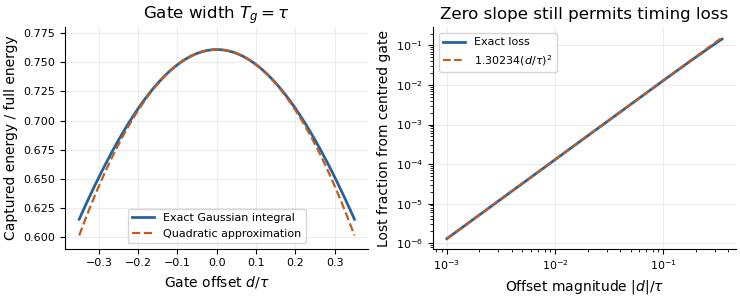
Exact Gaussian gate capture and its local quadratic loss: a zero first derivative does not remove timing sensitivity.
Details. 
An apparatus check scans the gate delay about its optimum and compares the measured decrease with the model, while monitoring gate width and the pulse. A gate on the detector's electrical output need not act directly on optical power: the detector impulse response and readout convolution must be included. NIST's impulse-response measurements illustrate that distinction.[ref]
Articles by others on the same topic
There are currently no matching articles.