Let a test particle start at rest at radius outside a fixed spherically symmetric source. The spherical shell theorem gives the exterior Newtonian gravitational potential , where is the source's standard gravitational parameter. Zero initial transverse velocity makes the motion radial. Conservation of mechanical energy per unit mass givesThe minus sign selects inward motion; the positive square root is its speed. For a fall from to the surface , that speed is . In the limit of release from rest infinitely far away, the familiar free-fall speed is , equal in magnitude to the local escape velocity. A finite starting radius gives a smaller speed.
The arrival time follows from the same first integral. Set . ThenFor arrival at this is finite, and the field formula is used only outside the source. For , givesKeeping the smaller initial gravitational magnitude constant would predict , about longer. The actual acceleration increases during the fall.
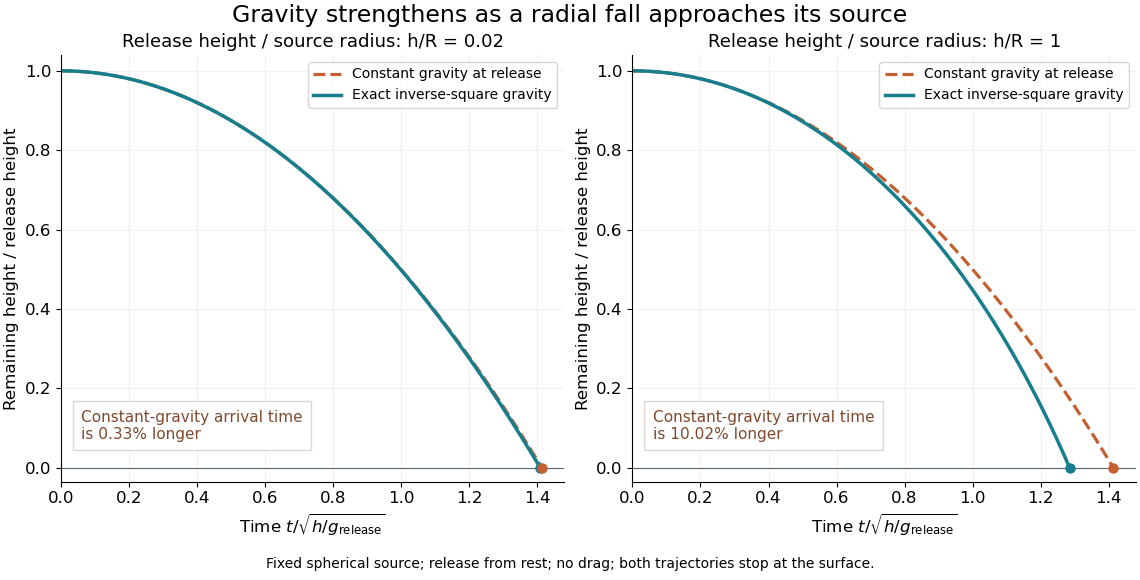

The curves compare a shallow fall, , with a fall from , so . Each comparison holds the release height and initial gravitational magnitude fixed. The constant-gravity model is close for the shallow fall and increasingly inaccurate for the larger one. This is also a practical use of nondimensionalization: the normalized trajectories depend on , while supplies the dimensional time scale.
Articles by others on the same topic
There are currently no matching articles.