Henyey track 2026-10-14
A pre-main-sequence star with a developing radiative core can contract along a relatively horizontal path toward higher effective temperature in the Hertzsprung-Russell diagram. This differs from the nearly vertical fully convective Hayashi track.
For fully ionized hydrogen and helium with mass fractions and , the inverse mean molecular weight counts nuclei plus free electrons:
Thus for , for , and . Keep the same and dimensionless structure constants when comparing these toy sequences. From part (a),
Eliminating gives the composition shift of a convective pre-main-sequence track:
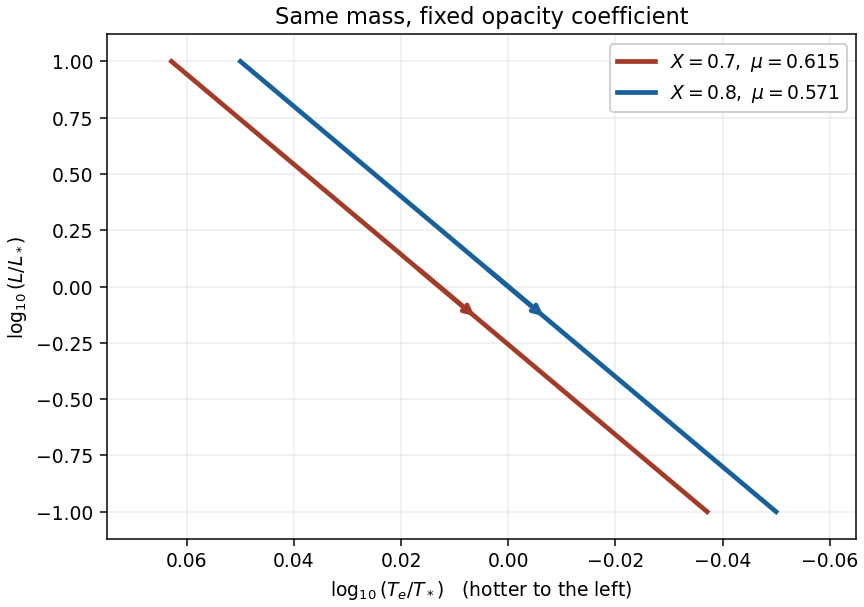
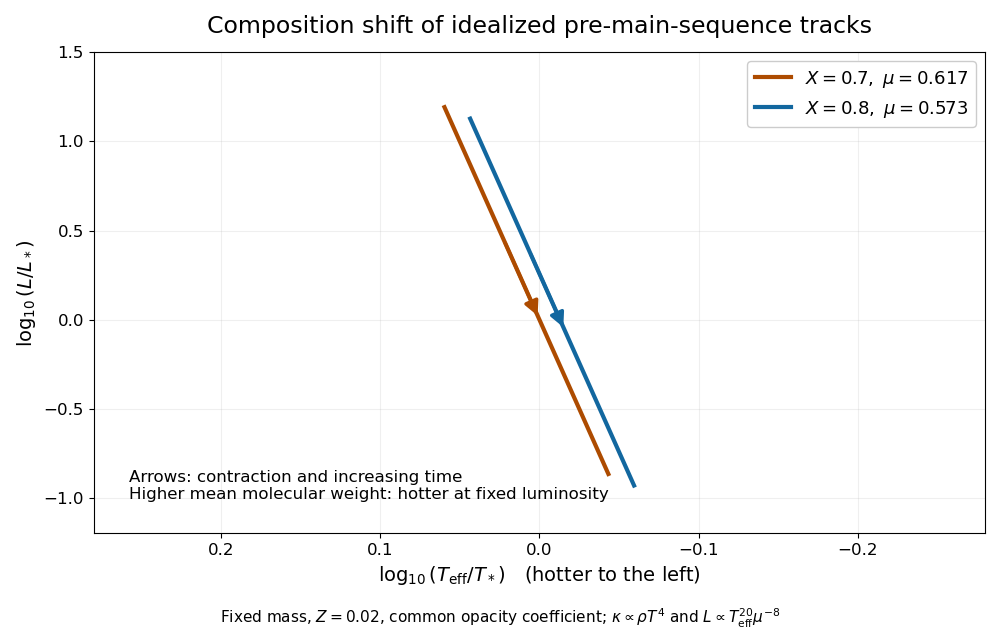
Consequently the tracks in a Hertzsprung-Russell diagram are almost vertical, with . At equal luminosity, : the track lies to the hotter, left-hand side of the track. Since contraction decreases , both and decrease in this particular opacity model. Both arrows therefore point downward and slightly rightward on the conventional hot-left diagram.
Figure 1.
Convective contraction tracks at equal mass, with evolution downward and rightward
. Details.
The plotted reference scales are arbitrary; the horizontal separation is the predicted . They are schematic Hayashi tracks under the specified atmospheric opacity law, rather than calibrated stellar models.
A protostar leaves this contraction sequence when its assumptions fail. Increasing central stellar temperature makes stellar nuclear fusion significant: burning of deuterium can temporarily slow contraction, and sustained hydrogen burning brings the star to the main sequence. In a sufficiently massive pre-main-sequence star, a radiative core develops, the interior ceases to share one adiabat, and evolution can proceed along a hotter Henyey track. Changing atmospheric opacity, partial ionization, or substantial continuing accretion also changes the predicted path. For sufficiently low mass, electron degeneracy pressure instead limits the increase of central temperature, as in part (c).
The helium mass fraction is . For the two compositions, and . The mean molecular weight is therefore
At fixed mass and with the same prescribed opacity coefficient, part (a) gives and . Eliminating radius gives
This is the composition shift of a convective pre-main-sequence track. The higher-helium mass fraction case is hotter at a given luminosity, lying to the left of the case in a Hertzsprung-Russell diagram. Its fixed-luminosity temperature ratio is .
Both stars contract, so both and decrease in this particular opacity model. Their nearly vertical Hayashi tracks therefore run downward and slightly to the right, with arrows in that direction:

Figure 1.
Composition-dependent pre-main-sequence tracks with contraction arrows
. Details.
The plotted luminosity and effective temperature are normalized to arbitrary common references; no opacity normalization or absolute age was specified. The comparison holds the given opacity coefficient fixed.
These paths cease to apply when their assumptions fail. Deuterium-burning energy-generation rate can temporarily slow contraction; sustained hydrogen burning ends the purely gravitational phase. Formation of a radiative core breaks the fully convective adiabat and can lead to a Henyey track toward hotter effective temperature. Partial ionization, a changing atmospheric opacity, and electron degeneracy pressure alter the equation of state or boundary relation. Accretion luminosity, changing mass, and magnetic inhibition of convection can also modify a young star's path.