For an invertible matrix , the rank-one matrix update is a singular matrix exactly when . This follows directly from the matrix determinant lemma. At that value, and the nonzero vector satisfiesEvery vector in the kernel is a multiple of , since implies . The matrix rank therefore drops by exactly one.
For with and , the update becomes a singular matrix at , and . At , this direction is compressed by a factor and the inverse amplifies it by a factor 100. The actual spectral norm of the matrix inverse, which maximizes amplification over every direction, is about .
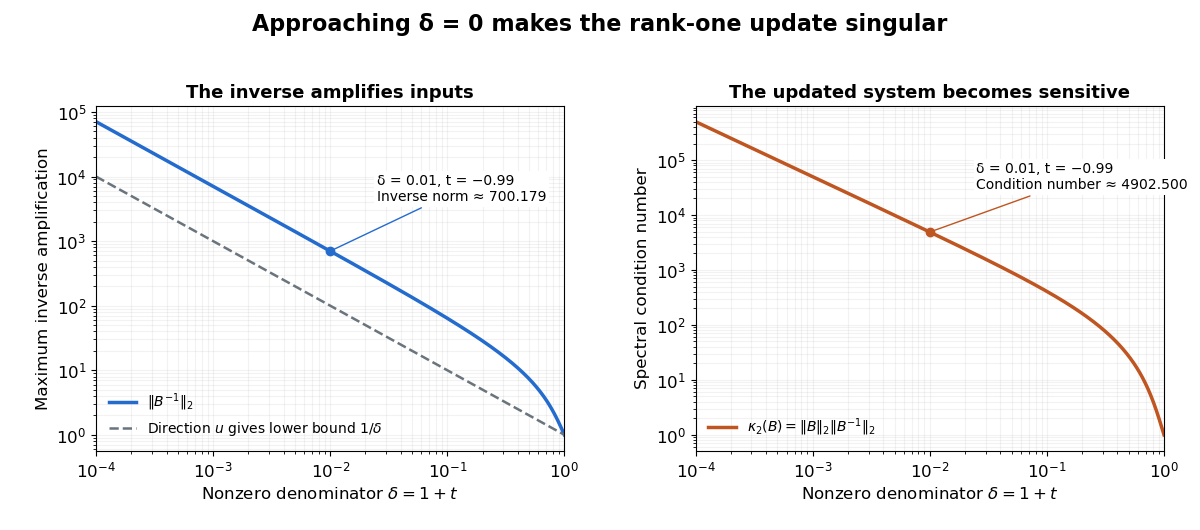
An inverse grows large as the rank-one update approaches its singular denominator
. Here and uses the same example vectors. The left panel shows and its lower bound , obtained from the direction . The right panel shows the condition number . Both are computed from singular values; the missing point has no matrix inverse. Details.
The exact formula can expose a large condition number in the updated linear system even when the original one had a small condition number. It does not guarantee numerical stability merely because its evaluation uses fewer arithmetic operations. The denominator condition certifies existence; the condition number and floating-point behavior address different questions about using the resulting answer.
Let , with . The equation is the linear system , a rank-one matrix update of the identity matrix. Every solution has . Substitution reduces the entire problem toIf , there is one solution, . If and , every works and the solution set is the straight line . If and , there is no solution.
The first reduction follows directly from the original equation in any dimension. In three dimensions it can also be obtained by taking the cross product with , giving . The singular denominator therefore represents two different possibilities, inconsistency or a family of solutions, and must not simply be discarded as an undefined formula.
Articles by others on the same topic
There are currently no matching articles.