The Sherman–Morrison formula computes the matrix inverse after a rank-one matrix update. If is an invertible matrix and , thenThe inverse correction is itself an outer product, divided by the scalar . The matrix determinant lemma shows that the nonzero-denominator condition is exactly the condition that the updated matrix remains an invertible matrix.
For , , and , we have . Thus the computed inverse isMultiplication in either order gives the identity matrix. The result reuses the original inverse and the same correction vectors, rather than solving independently for all four inverse entries.
Often only the solution of an updated linear system is needed. If and , thenprovided . The two solves use the same LU decomposition of . This expresses the computational benefit without requiring an explicitly stored matrix inverse. Strang's Lecture 14, transcript pp. 9–10 explains this reuse of the original factorization.
To see why the inverse correction works, first consider and put . The rank-one matrix satisfies . Expandingalso works in the reverse order. The general case follows by factoring out and replacing by . A matrix identity has reduced to cancellation of scalar coefficients.
Historically, Jack Sherman and Winifred J. Morrison studied updating an inverse when a single matrix entry changes in their [ref]
https://doi.org/10.1214/aoms/1177729893. 1950 paper, Adjustment of an Inverse Matrix Corresponding to a Change in One Element of a Given Matrix
. Such an entry change is the special rank-one matrix update , with standard basis vectors . The reference and the earlier 1949 abstract on row or column changes are recorded in Henderson and Searle, On Deriving the Inverse of a Sum of Matrices (1981), references 40–41. This distinguishes the specific original setting from the more general formula used here.For an invertible matrix , the rank-one matrix update is a singular matrix exactly when . This follows directly from the matrix determinant lemma. At that value, and the nonzero vector satisfiesEvery vector in the kernel is a multiple of , since implies . The matrix rank therefore drops by exactly one.
For with and , the update becomes a singular matrix at , and . At , this direction is compressed by a factor and the inverse amplifies it by a factor 100. The actual spectral norm of the matrix inverse, which maximizes amplification over every direction, is about .
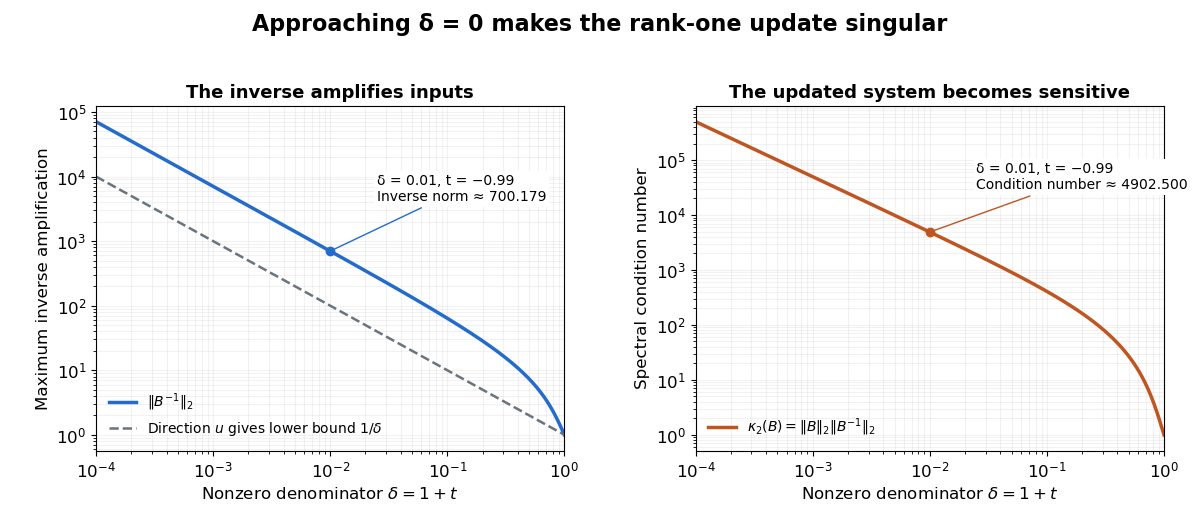
An inverse grows large as the rank-one update approaches its singular denominator
. Here and uses the same example vectors. The left panel shows and its lower bound , obtained from the direction . The right panel shows the condition number . Both are computed from singular values; the missing point has no matrix inverse. Details.The exact formula can expose a large condition number in the updated linear system even when the original one had a small condition number. It does not guarantee numerical stability merely because its evaluation uses fewer arithmetic operations. The denominator condition certifies existence; the condition number and floating-point behavior address different questions about using the resulting answer.
Articles by others on the same topic


The Sherman-Morrison formula is a statement in linear algebra that provides a way to compute the inverse of a matrix when that matrix is modified by the addition of a rank-one update.