For equal exterior potential energies and constant mass, the exact transmission probability isBelow the barrier, the hyperbolic sine is positive for , so . At , the interior wavefunction is linear in ; either neighbouring formula has the displayed finite limit, since and tend to one. Above the barrier, the interior wavefunction oscillates: the quantum reflection probability generally remains nonzero, but for a positive integer gives perfect transmission probability through constructive wave interference. These are scattering resonances, not below-barrier quantum tunnelling.
At half height, , we have and , consistent with finite square barrier transmission at half barrier height after replacing this width by that example's width . In the illustration, the width is four times and , giving . The plotted wavefunction comes from solving the four interface equations; the transmission probability curve uses the closed formula.
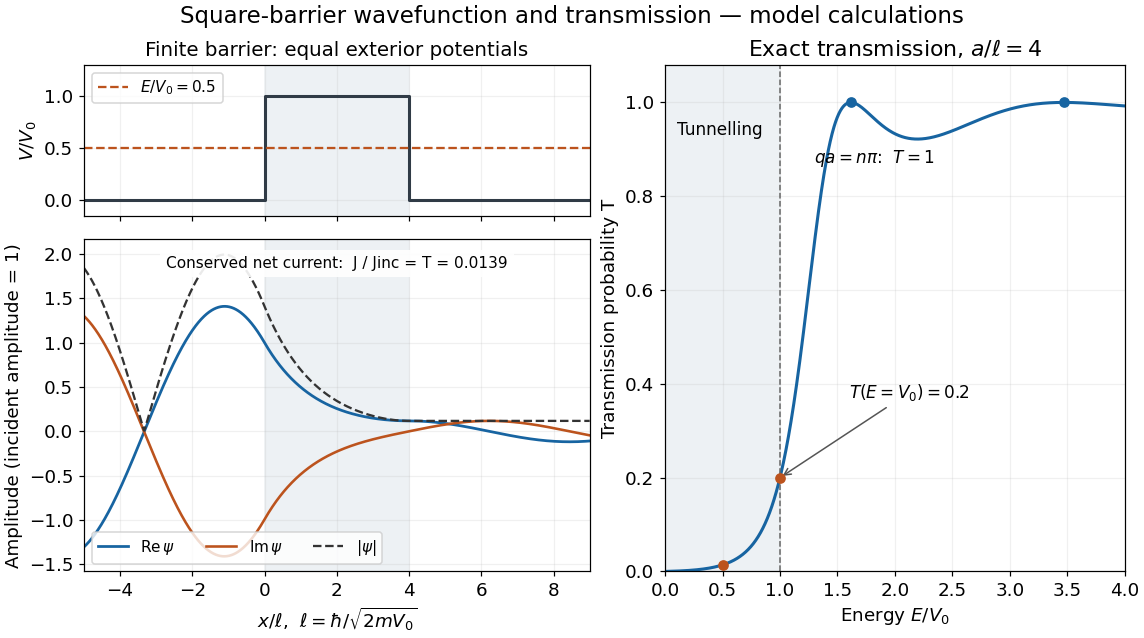
Matched square-barrier wavefunction and transmission below and above the barrier
. Original model calculations with equal exterior potential energies, constant mass and incident probability amplitude one. The real part and imaginary part of the wavefunction, its modulus and the exact transmission probability are shown; these curves are not measurements. The conserved net probability current is small but nonzero throughout the barrier. Details.
For fixed and , the exact rectangular barrier transmission probability givesThis is the leading term of an asymptotic expansion: the wavefunction amplitude scale is , and the transmission probability scale is , with an interface prefactor. Increasing width by multiplies this approximation by . At fixed incident energy, increasing barrier height increases the tunnelling decay constant as ; heavier nonrelativistic particles also have stronger suppression. For the numerical example in rectangular barrier transmission probability, the approximation gives , compared with the exact .
The regime condition matters. Near at fixed width, tends to zero and the opaque barrier approximation fails; use the exact threshold value. For , expansion of the hyperbolic sine givesThis tends to one as at fixed , but the condition alone does not imply nearly perfect transmission if the remaining factor is large. At , use the oscillatory formula and its scattering resonances, rather than an exponential decay law.
Articles by others on the same topic
There are currently no matching articles.