For a two-component mixture, let be component A's mole fraction in the liquid and its mole fraction in the coexisting vapor. At interior compositions, define the relative volatility of A with respect to B by the ratio of composition odds:Thus means A is enriched in the vapor, while means . Solving this definition givesHere a constant relative volatility is a stipulated model of vapor-liquid equilibrium, not a measured property of a named chemical solution. Real relative volatility can vary with composition, temperature, and pressure. The relation specifies no absolute temperature scale: even fixing does not determine a boiling-temperature curve or a heat requirement.
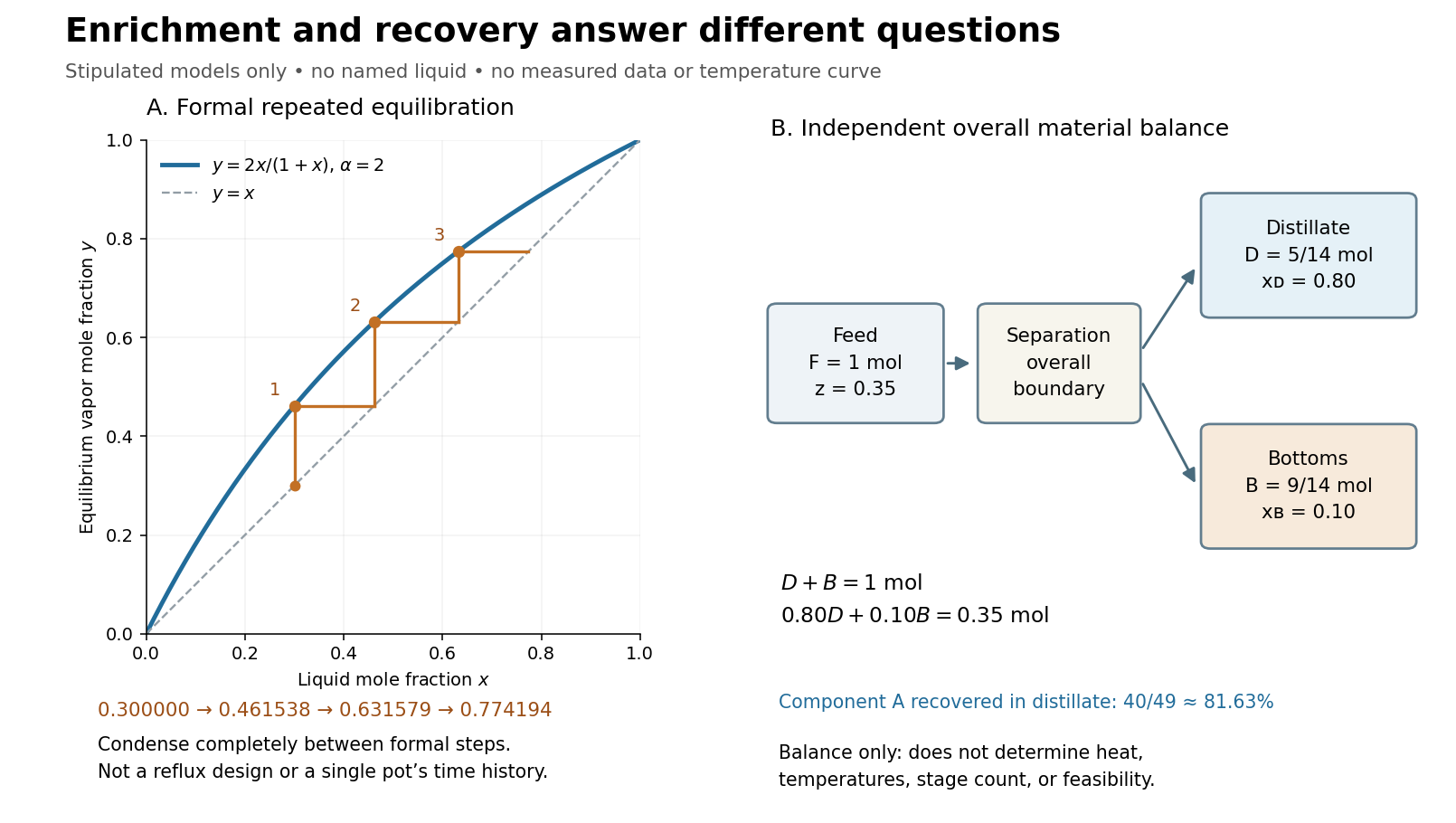
Stipulate a constant relative volatility . The vapor-liquid equilibrium model then becomesAn initial liquid mole fraction gives an equilibrium vapor mole fraction . Now imagine completely condensing a small sample of that vapor and using this condensate as a fresh liquid for another equilibration. Repeating this formal operation givesThese are original model calculations of ideal-stage enrichment. They are not measured compositions, a reflux design, or successive compositions of one pot undergoing simple distillation. That pot loses the more volatile component and becomes depleted; each step here instead starts from the previous enriched condensate. The displayed sequence specifies compositions, not the recoverable amount at each step.
Articles by others on the same topic


Relative volatility is a measure used in the field of chemical engineering, particularly in distillation and separation processes, to quantify the ease with which one component in a mixture can be separated from another component. It is defined as the ratio of the vapor pressures of two components in a liquid mixture.