Distillation separates a mixture by producing vapor from a liquid and collecting the condensed liquid, called the distillate. The more volatile component can have a higher mole fraction in the vapor. Simple distillation collects this condensate directly; fractional distillation adds repeated contact in a fractionating column.[ref]
Distillation introduction. Chem2O06 Laboratory Manual by McMaster University; General Principles; A Mixture of Ideal Liquids; Fractional Distillation
Two questions must be kept separate. Vapor-liquid equilibrium describes which compositions can coexist. A distillation material balance accounts for how much of each component leaves in each product. A product can be enriched without containing all the original component, and even a feasible distillation material balance does not establish that an apparatus can make those products.
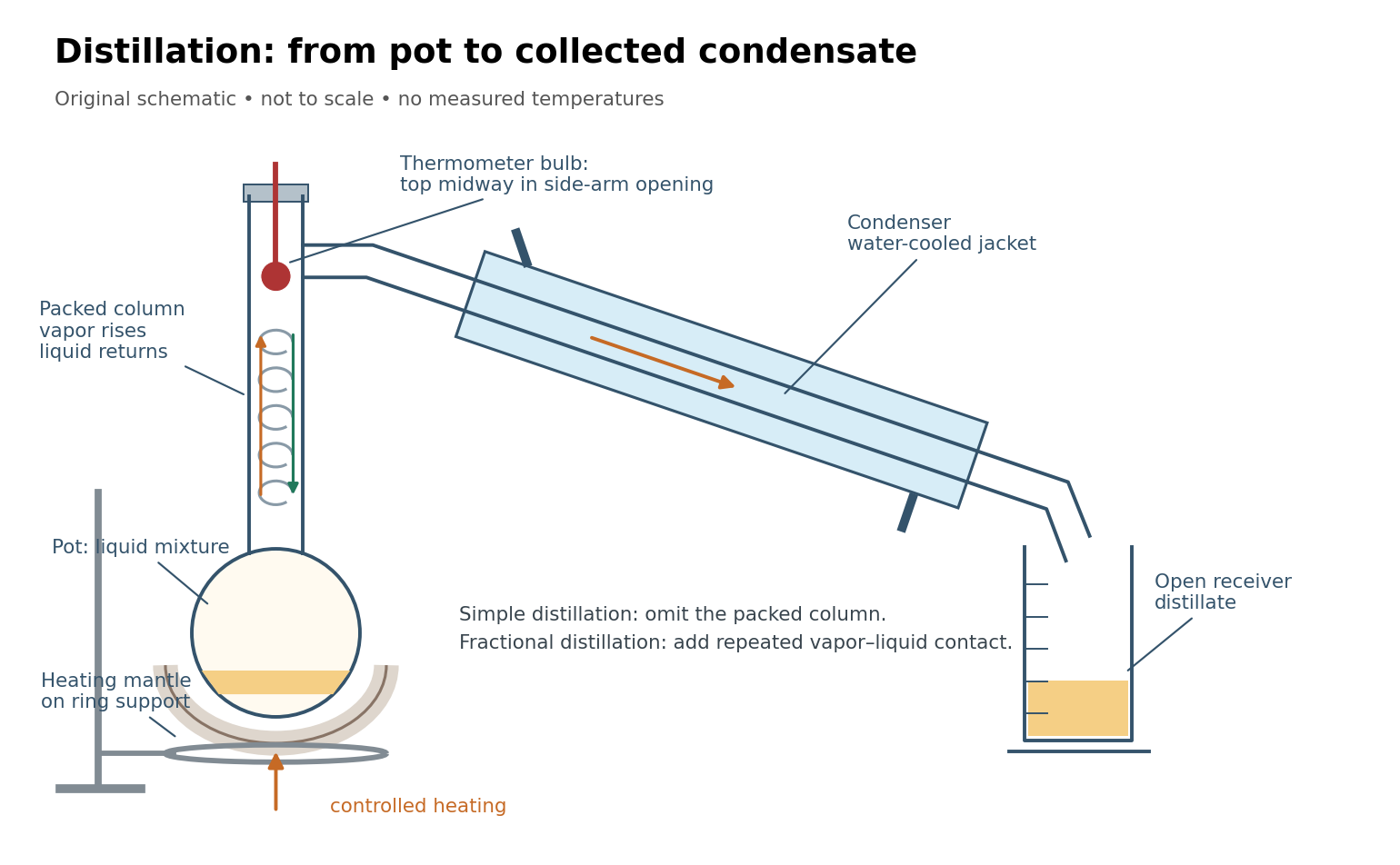
Distillation connects a heated pot, a fractionating column, a thermometer, a laboratory condenser, and a receiver
. Original schematic, not a scale drawing. Bulb position and mantle support follow the paired simple and fractional distillation experiment; blue marks the cooling jacket. Details.
A laboratory condenser removes heat from vapor so that it becomes liquid. In distillation, the downstream laboratory condenser makes collectable distillate. Complete condensation, without loss or reaction, preserves the entering vapor's overall component mole fractions; cooling alone does not give another enrichment step. Partial condensation can instead leave two streams of different composition, requiring both vapor-liquid equilibrium and a distillation material balance.
In simple distillation, pot vapor passes directly to the laboratory condenser. An initial small condensate sample can approximate vapor-liquid equilibrium with the current pot liquid. Removing enriched distillate depletes the pot's more volatile component. A collected fraction averages the changing condensate composition, rather than preserving the first-drop mole fraction.[ref]
Distillation introduction. Chem2O06 Laboratory Manual by McMaster University; A Mixture of Ideal Liquids, discussion of first and later fractions
Fractional distillation brings rising vapor into contact with descending liquid in a fractionating column. Packing supplies contact area; it does not act as a sieve for individual molecules. Repeated exchange can enrich the rising vapor in the more volatile component. Some condensed liquid returns downward as reflux, rather than all being withdrawn as distillate.[ref]
Distillation by Hong Kong University of Science and Technology. Introduction, paragraphs on reflux and plates, trays or packing
An equilibrium stage is an idealization of this contact. A real fractionating column has finite contact time and imperfect wetting and mixing; its length is not automatically a count of equilibrium stages. Product withdrawal and reflux affect the separation together. Thus the repeated ideal-stage enrichment example illustrates the composition advantage of repeated equilibration, but supplies neither a column design nor a specified reflux requirement.[ref]
Distillation efficiency. Hyper-TVT by ETH Zurich; §5.6 Efficiency, equilibrium versus actual plates and flow-dependent efficiency
A fractionating column provides contact between rising vapor and returning liquid during fractional distillation. Packing or trays provide contact area; the resulting separation depends on both vapor-liquid equilibrium and the actual flow and exchange between the thermodynamic phases.[ref]
An equilibrium stage models a contact whose outgoing liquid and vapor satisfy vapor-liquid equilibrium at the stage's temperature and pressure. It is a composition model, not a claim that each piece of packing reaches thermodynamic equilibrium.[ref]
Distillation efficiency. Hyper-TVT by ETH Zurich; §5.6 Efficiency, opening equilibrium-plate assumption
Reflux is condensed liquid returned toward the heated part of a distillation apparatus. In a fractionating column, descending reflux contacts rising vapor. Returning more condensate also changes the amount available for collection, so enrichment and product recovery must be considered together.[ref]
Distillation by Hong Kong University of Science and Technology. Introduction, reflux paragraph; Intended Learning Outcomes, reflux-ratio dependence
For a two-component mixture, let be component A's mole fraction in the liquid and its mole fraction in the coexisting vapor. At interior compositions, define the relative volatility of A with respect to B by the ratio of composition odds:Thus means A is enriched in the vapor, while means . Solving this definition givesHere a constant relative volatility is a stipulated model of vapor-liquid equilibrium, not a measured property of a named chemical solution. Real relative volatility can vary with composition, temperature, and pressure. The relation specifies no absolute temperature scale: even fixing does not determine a boiling-temperature curve or a heat requirement.
Stipulate a constant relative volatility . The vapor-liquid equilibrium model then becomesAn initial liquid mole fraction gives an equilibrium vapor mole fraction . Now imagine completely condensing a small sample of that vapor and using this condensate as a fresh liquid for another equilibration. Repeating this formal operation givesThese are original model calculations of ideal-stage enrichment. They are not measured compositions, a reflux design, or successive compositions of one pot undergoing simple distillation. That pot loses the more volatile component and becomes depleted; each step here instead starts from the previous enriched condensate. The displayed sequence specifies compositions, not the recoverable amount at each step.
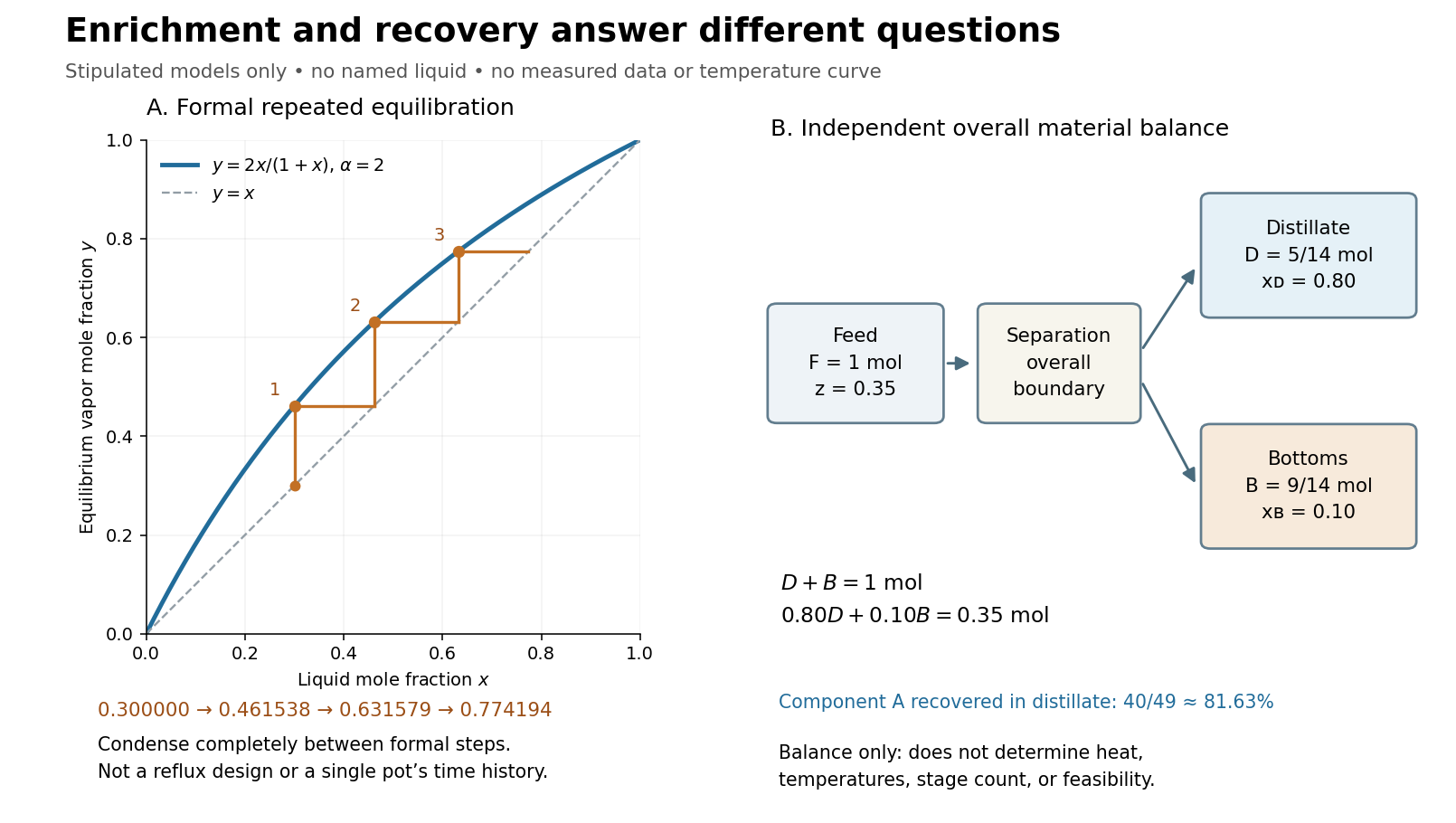

The algebra makes the enrichment especially transparent. With composition odds , every formal step doubles the odds, soFor every finite , , although as . This explains why repeated ideal equilibration can improve composition without making finite-step perfect separation a consequence of the model.
Consider a nonreacting two-component mixture processed into just two products, with no losses or unaccounted inventory. Let be feed, distillate, and bottoms amount of substance values in moles, and let be their component-A mole fractions. These are whole-stream compositions; is not automatically the instantaneous equilibrium vapor composition above the pot. Total and component balances giveThe component-B balance follows by subtracting the second equation from the first. Eliminating gives, for ,Nonnegative product amounts require between and . For an original stipulated feed , , , and ,Check the component inventories:The distillate contains a fraction of the original component A, despite its higher mole fraction . This distinction between composition and recovery is useful when deciding how much enriched product to collect. These balances determine neither temperatures, heat input, nor the number of equilibrium stages; they do not prove that the specified products are attainable in a particular fractionating column.
McMaster University's 1997/98 laboratory manual compares simple distillation and fractional distillation using charges of each of cyclohexane and p-xylene. Part B uses a round-bottom flask and a fractionating column. The protocol specifies a boiling chip, a heating mantle on a ring support, and the top of the thermometer bulb midway in the opening toward the laboratory condenser. Heating is adjusted for roughly one drop per second. Students record head temperature every collected, up to , and plot both runs against collected volume on the same axes.[ref]
Experiment 3 procedures. Chem2O06 Laboratory Manual by McMaster University; Parts A–B, Figure 3.5 position instruction, and Recording of Results
Charge, atmospheric operation, and collection rate provide comparison conditions; the fractionating column is changed. A sharper separation of temperature regions would support improved fractionation. It would not directly measure product mole fractions or prove purity. The manual distinguishes collected volume from composition and states that this pair forms no azeotrope. No student dataset is supplied here, and the constant-relative volatility example is not assigned to these liquids.[ref]
Experiment 3 procedures. Chem2O06 Laboratory Manual by McMaster University; Recording of Results, distinction between temperature–volume and temperature–composition plots; comparison questions
An azeotrope has equal coexisting liquid and vapor compositions: . Ordinary fractional distillation cannot cross this composition boundary at fixed pressure; more packing does not remove it. A constant head temperature therefore does not establish a pure chemical substance.[ref]
Distillation introduction. Chem2O06 Laboratory Manual by McMaster University; Liquids that Form Azeotropes, constant-temperature mixtures and limits on separation
The stipulated model has throughout , so it has no interior azeotrope and cannot represent this limit. Articles by others on the same topic
There are currently no matching articles.