For a one-dimensional free particle with and , take the positive total energy from the relativistic energy-momentum relation:A fixed plane wave quantum phase obeys . Its phase velocity is thereforeFor a narrow wave packet centered at , expand its dispersion relation as . In the Fourier inversion integral building the wave packet, the envelope then depends on . Thus its group velocity isThe superluminal phase velocity follows a repeating phase marker; it does not describe a localized signal or superluminal transport of energy. Higher derivatives of the dispersion relation produce wave packet spreading, so the translated-envelope argument is a narrow-band approximation. For , the Lorentz factor is , and : the group velocity is while the phase velocity is .
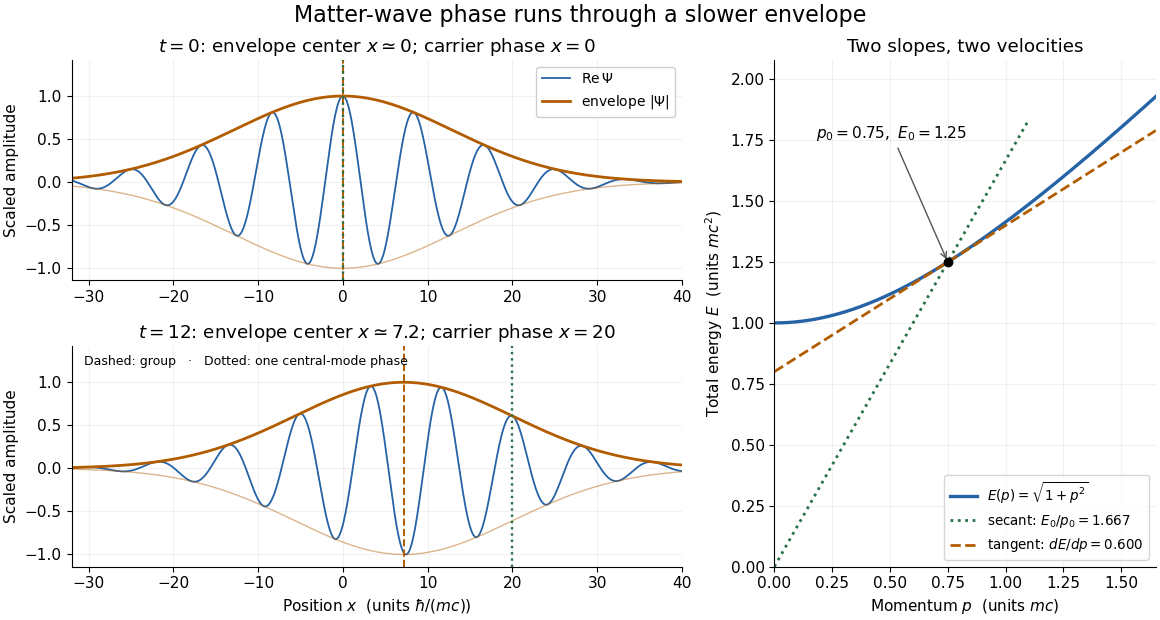

The total-energy convention matters. Define to remove the common rest energy from a wavefunction with total-energy time dependence. ThenThis is exactly the free-particle momentum convention used by the Schrödinger equation here. Removing a common time-dependent global phase changes the reported phase velocity, while leaving the de Broglie wavelength, relative spatial quantum phases and group velocity unchanged. Adding again to a total energy would count the rest energy twice.
Articles by others on the same topic
There are currently no matching articles.