A matter wave is the quantum wave associated with a material particle. Its phase can interfere after coherent paths recombine.
In the position representation, a matter wave is described by a wavefunction: a complex number probability amplitude, with detection probabilities given by the Born rule. A localized wave packet combines different momenta; its envelope can move while its individual quantum phase crests move at another speed. Neither curve is a literal mechanical oscillation of material along a particle's path. The de Broglie phase harmony explains the historical route to ; the relativistic matter-wave velocities distinguish the two speeds. The Davisson–Germer experiment and the Thomson electron transmission diffraction experiment connect that spatial quantum phase to measured electron diffraction.
In the 1923 note Waves and Quanta, Louis de Broglie proposed a periodic process associated with rest energy, remaining in phase with a wave along the moving particle's path. He distinguished the internal frequency slowed by time dilation from the wave frequency based on total energy.[ref] The proposal developed into his 1924 thesis.[ref]
Louis de Broglie - Biographical. Nobel Lectures, Physics 1922–1941; Louis de Broglie, Biographical, printed p. 257: 1924 thesis and doctoral degree
In the 1929 lecture The wave nature of the electron, he reconstructed the argument using a Lorentz transformation.[ref]The Wave Nature of the Electron by Louis de Broglie. Nobel Lectures, Physics 1922–1941; 12 December 1929, printed pp. 247–249: rest-frame periodicity, Lorentz transformation and momentum
Here is that quantum phase argument in modern notation. Set in the rest frame. A Lorentz transformation to a frame where the particle has velocity givesAlong , proper time is , soThis is the harmony: evaluating the spatial wave at the moving particle gives the slower clock phase. At fixed , its angular frequency is instead . Since , the de Broglie wavelength follows as . The proposed clock was a theoretical construction, not an observed mechanical vibration.
For a one-dimensional free particle with and , take the positive total energy from the relativistic energy-momentum relation:A fixed plane wave quantum phase obeys . Its phase velocity is thereforeFor a narrow wave packet centered at , expand its dispersion relation as . In the Fourier inversion integral building the wave packet, the envelope then depends on . Thus its group velocity isThe superluminal phase velocity follows a repeating phase marker; it does not describe a localized signal or superluminal transport of energy. Higher derivatives of the dispersion relation produce wave packet spreading, so the translated-envelope argument is a narrow-band approximation. For , the Lorentz factor is , and : the group velocity is while the phase velocity is .
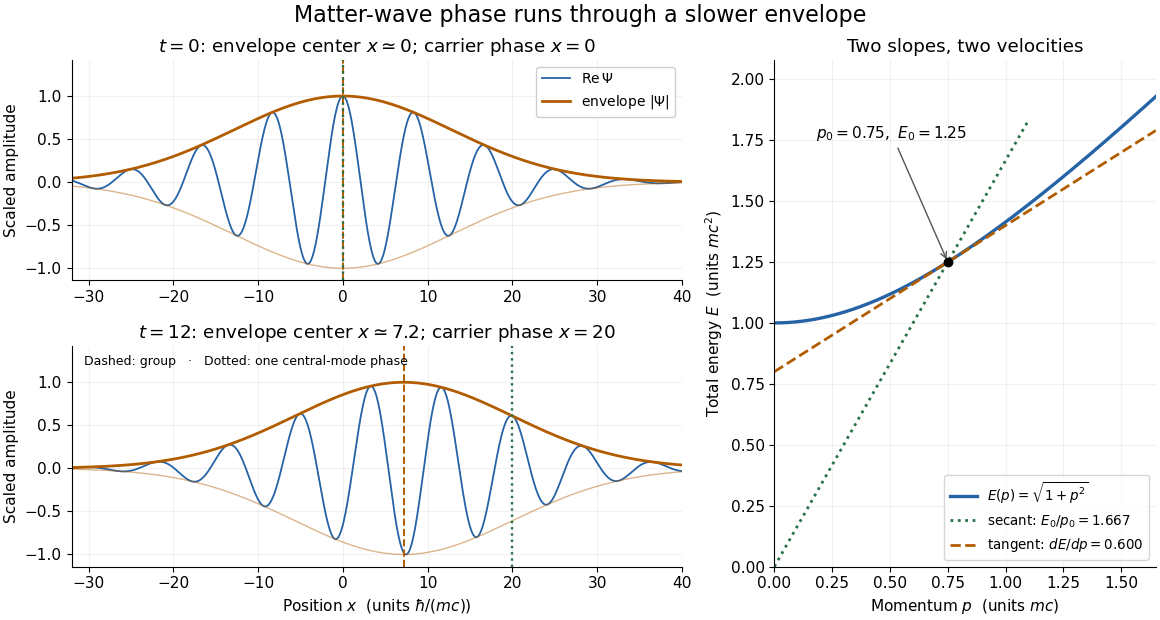
The total-energy convention matters. Define to remove the common rest energy from a wavefunction with total-energy time dependence. ThenThis is exactly the free-particle momentum convention used by the Schrödinger equation here. Removing a common time-dependent global phase changes the reported phase velocity, while leaving the de Broglie wavelength, relative spatial quantum phases and group velocity unchanged. Adding again to a total energy would count the rest energy twice.
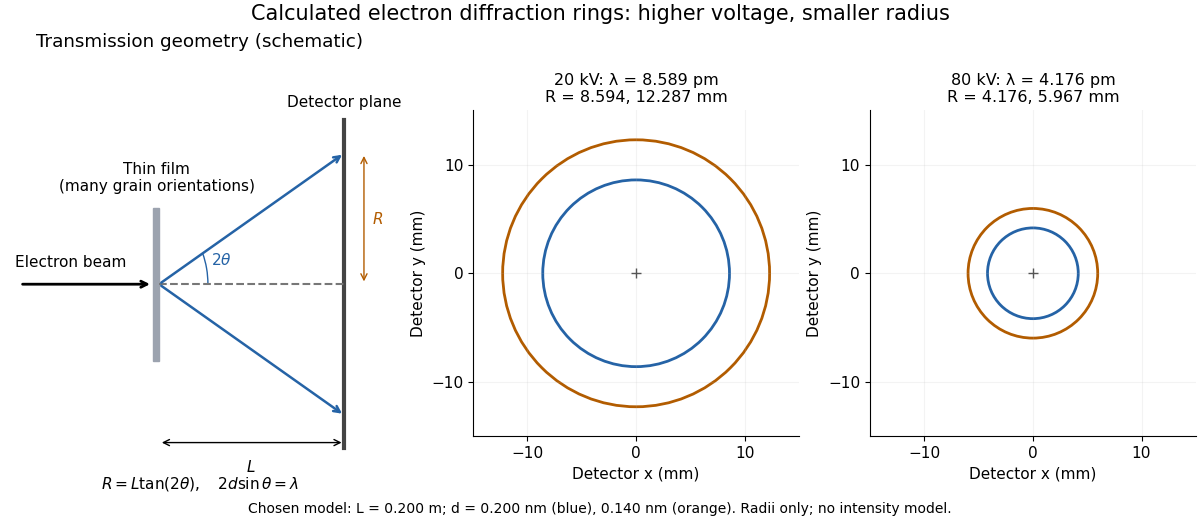
Alongside the 1927 Davisson–Germer experiment, George Paget Thomson developed an independent transmission test. Alexander Reid first used celluloid; Thomson used thin metal films. A narrow Electron beam crossed a film about thick, reaching a photographic plate perpendicular to the beam. Rings appeared. Accelerating voltages of – set the de Broglie wavelengths; metal structures known from X-ray diffraction allowed quantitative comparison. A downstream magnetic field deflected ring-forming Electrons like those passing through holes, identifying the carriers as Electrons rather than X-rays. Celluloid's uncertain structure limited its quantitative interpretation.[ref]
The Davisson–Germer experiment uses crystal reflection and angular electric current scans; this transmission camera records a spatial pattern behind the specimen. Both probe interference in electron diffraction, with different specimen preparations and readouts. A developed photographic plate records accumulated detections, not a direct image of the wavefunction.
Why rings? In an ideal film containing many small crystals with uniformly distributed orientations, a family of lattice planes with spacing can satisfy Bragg's law at every azimuth about the incident beam. First-order elastic scattering then forms a cone of opening half-angle , where . A flat detector a distance downstream cuts this cone in a circle:The last expression requires small scattering angles. It explains a useful control: hold the specimen and camera distance fixed, increase accelerating voltage, and the ring radii should shrink with the electron accelerating-voltage wavelength. It predicts positions, not intensities: preferred crystal orientations, film thickness and repeated quantum scattering can alter a real pattern.
For a chosen example, take and . The exact relativistic electron accelerating-voltage wavelength gives at and at . The corresponding exact ring radii are and . These are calculated examples with chosen spacings and camera distance, not Thomson's measurements. The higher voltage lies outside the range quoted from his lecture, deliberately illustrating a prediction rather than reconstructing his data.
Matter-wave interference occurs when coherent spatial branches of a particle's wavefunction recombine and their relative quantum phase changes the detection probabilities.
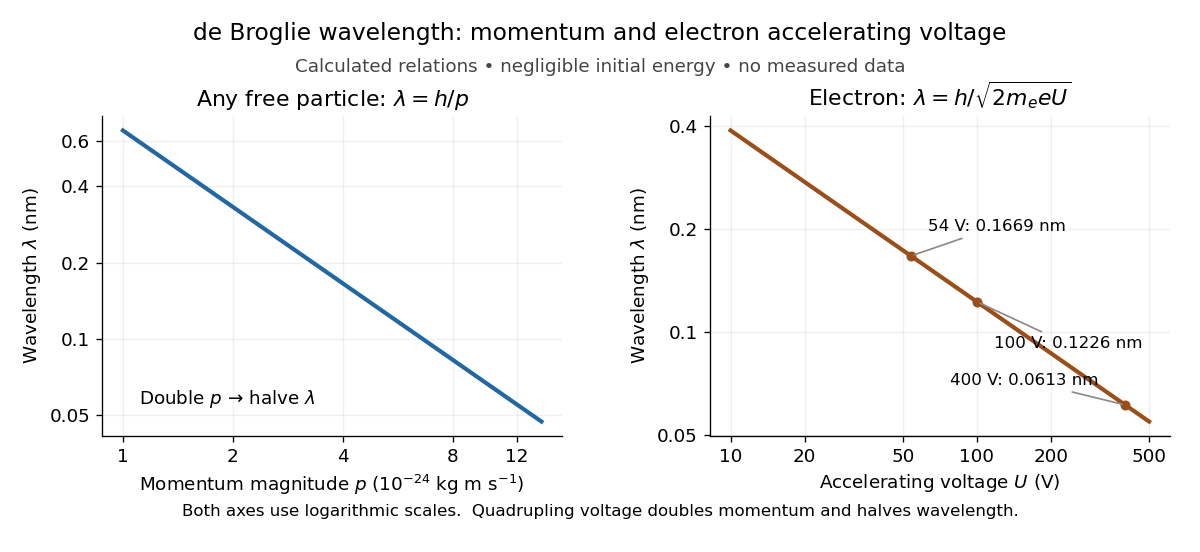
The de Broglie wavelength is the distance over which a matter wave accumulates one full spatial quantum phase cycle in its propagation direction:Here is the Planck constant, is the momentum, and is the angular wavevector. The scalar in means the positive momentum magnitude, not a signed component. Reversing a momentum reverses the wavevector without making the wavelength negative. At zero momentum there is no finite spatial phase period: the limiting wavelength diverges.
This relation makes microscopic diffraction accessible with particles: increasing the momentum shortens the wavelength until it is comparable with the spacings in a crystal scattering problem. The electron accelerating-voltage wavelength gives a practical way to tune this scale, while the Davisson–Germer experiment tests it by comparing electron diffraction directions with independently known crystal geometry. The same relation applies to neutral particles in a neutron interferometer; electric charge is not a requirement for a matter wave.
The wavelength belongs to the wavefunction, not to a sinusoidal path of a particle. A free-particle momentum convention makes the distinction especially clear: a plane wave has a rotating complex quantum phase but a constant probability density. A localized wave packet contains a range of momenta and therefore generally has a range of wavelengths, rather than one exact spatial period.
For a free particle of mass in nonrelativistic quantum mechanics, choose the potential energy zero and writeApplying the momentum operator returns ; this fixes the sign convention. The angular frequency is measured relative to this chosen energy zero. Adding a constant energy changes only a time-dependent global phase, leaving the spatial de Broglie wavelength unchanged. No rest-energy term is included in this nonrelativistic quantum mechanics convention.
The plane wave has and probability current . Its real part can be drawn as a sine or cosine, but that graph is a component of a probability amplitude, not a transverse displacement. On infinite space this is a generalized momentum eigenstate, not a state satisfying wavefunction normalization. A narrow wave packet instead moves with group velocity ; the phase velocity is not its transport speed.
The equality of canonical momentum and kinetic momentum here assumes a field-free region with the magnetic vector potential chosen zero. For a charged particle in a magnetic field, the kinetic momentum is . An arbitrary canonical phase gradient must not then be substituted into ; the free particle formula needs its stated assumptions.
Let an Electron start with negligible kinetic energy and move through an increase in electric potential. Its electric charge is , where is the elementary charge, so the decrease in potential energy is . In a field-free region after acceleration,This is an Electron formula, not a universal conversion from voltage to wavelength. It assumes negligible initial kinetic energy, negligible losses, and , where is the speed of light. It describes the de Broglie wavelength outside the crystal; the potential energy inside a material can change the local kinetic momentum.
For , take , , and . The rounded Electron mass is consistent with the 2022 recommended constants.[ref]
CODATA Value: electron mass by National Institute of Standards and Technology. CODATA electron mass: numerical value and 2022 adjustment label
The electronvolt is an energy unit: must be converted to joules before combining it with in SI units. Dimensional analysis checks both steps:The resulting velocity is about , or , so the nonrelativistic assumption is consistent. For a larger accelerating voltage, the relativistic energy-momentum relation gives , with , while still holds. At the relativistic wavelength is shorter by about .Explicitly, the exact special relativity formula and its nonrelativistic quantum mechanics limit areHere is the gained kinetic energy; the total energy is . At , the nonrelativistic quantum mechanics expression gives , about larger than the exact . This difference matters when using electron diffraction ring positions to infer lattice plane spacings.
A neutron interferometer coherently splits and recombines neutron matter waves, allowing path-dependent phases to be measured through the output intensity.
The Colella–Overhauser–Werner experiment observed the relative phase acquired by neutron paths at different heights in the Earth's gravitational field.
Articles by others on the same topic

A matter wave refers to the wave-like behavior exhibited by particles of matter, based on the principles of quantum mechanics. This concept stems from the de Broglie hypothesis, proposed by Louis de Broglie in 1924, which posits that all matter possesses wave-like properties. According to de Broglie's theory, every particle has an associated wavelength, known as the de Broglie wavelength, which is inversely proportional to its momentum.



