Suppose a calibrated measurement bounds the fractional loss of a nonzero superconducting persistent current by , with , over a duration . Take by choosing the circulation direction. Under the constant-, constant-, undriven RL circuit model,The inequality follows because the logarithm is increasing. The final approximation requires and slightly understates the exact upper bound. If is uncertain, an independently established upper bound on gives the conservative electrical resistance bound. The uncertainty in the initial reading, the final reading, background subtraction and drift must all be included in ; a display resolution alone does not provide it.
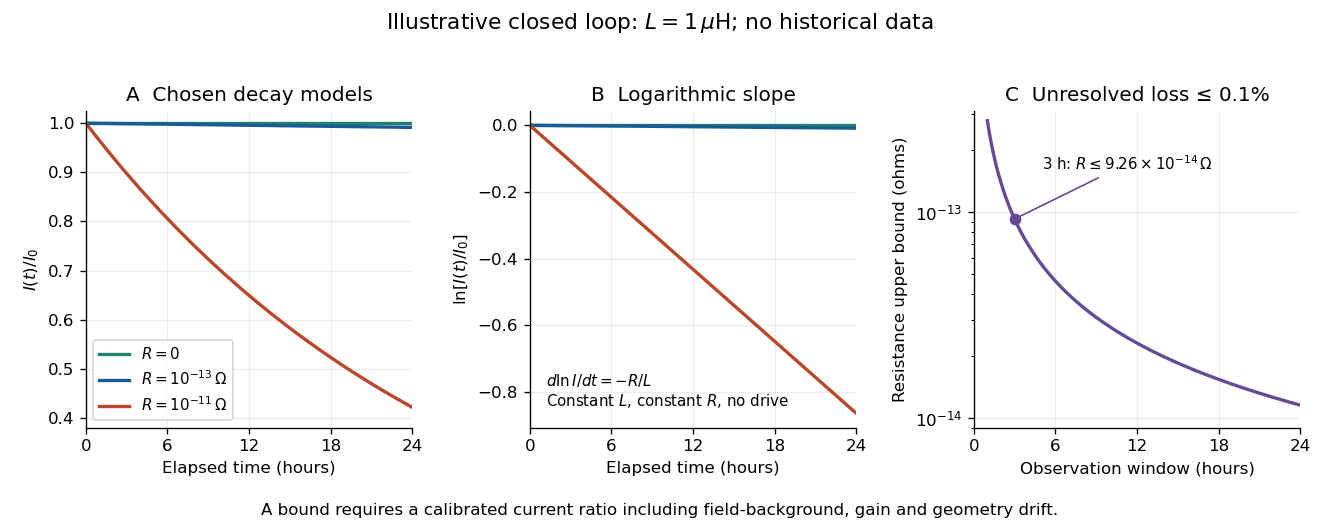
An illustrative exponential decay, its logarithmic slope and the resulting resistance bound
. Chosen numerical model, not historical data: fixed self-inductance and no external drive. The final panel assumes a calibrated fractional-loss bound of at each chosen observation duration. Longer observation tightens the bound only while that fractional uncertainty remains controlled. Details.
For an original illustrative example, let and suppose the corrected electric current ratio after is at least . ThenThese are conditional bounds for stipulated parameters, not values attributed to the 1914 apparatus. With the same but , the model instead gives and : a readily visible loss on the chosen scale.
A resolved decay can be checked using its logarithm:A straight line supports this constant-parameter model; curvature or jumps demand a different account. If an effective electrical resistance varies with time while remains fixed and the loop remains undriven, only its time average is constrained:This does not bound every instantaneous value of . Changing self-inductance or external linked magnetic flux adds terms to the circuit equation, so an uncorrected magnetic signal cannot simply be substituted for . Nonobservation of decay leaves arbitrarily small positive constant electrical resistance compatible with a finite observation: it is not a logical proof that .
Articles by others on the same topic
There are currently no matching articles.