An RL circuit combines electrical resistance and self-inductance . In the series model, the same electric current flows through both components. An ideal battery maintains terminal electric potential difference ; the drops in the direction of positive electric current obey Ohm's law and the inductor relation:This is Kirchhoff's voltage law with the inductor's terminal drop, rather than its oppositely signed induced electromotive force. For constant , , and , the first-order linear differential equation has solutionThe time constant measures exponential decay of the difference from the final electric current. [ref].
For a stipulated example, take electrical resistance , self-inductance , terminal electric potential difference , and initial electric current . ThenWith measured numerically in seconds, this is in amperes. At one time constant,and the terminal electric potential difference drops areTheir sum is exactly . At , the inductor takes the entire terminal electric potential difference while the electric current is still zero. At steady electric current, the inductor's terminal drop is zero and the entire drop is across the electrical resistance.
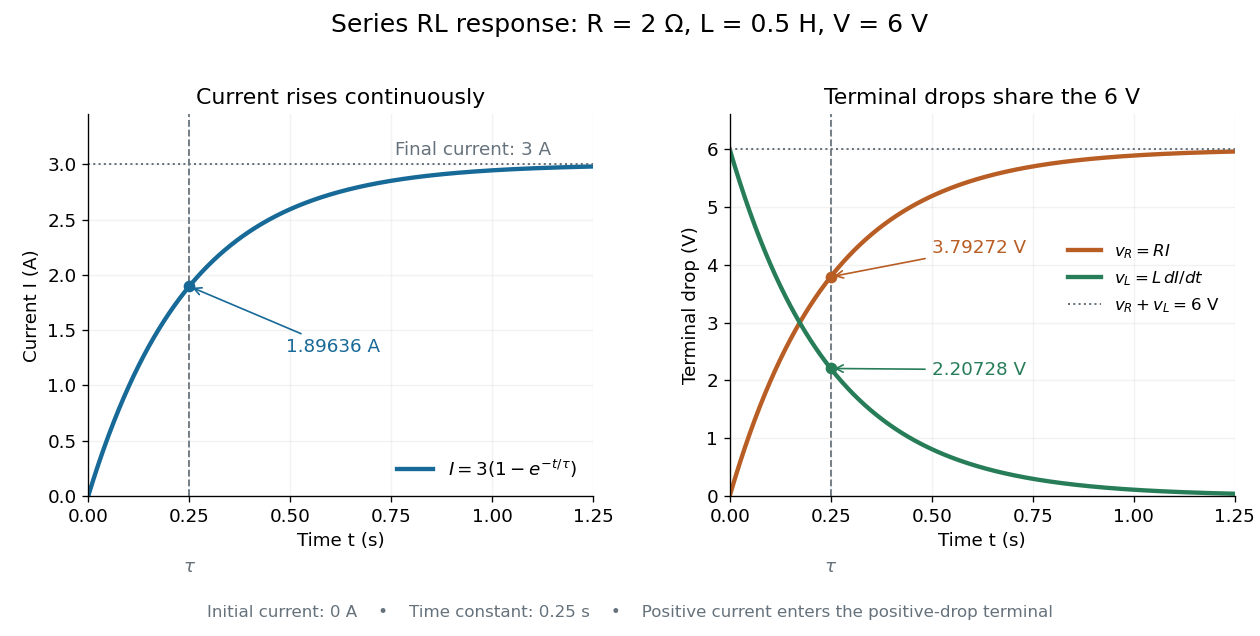

The final magnetic energy stored by the inductor is . At one time constant, the electric current has reached about of its final value, but its magnetic energy has reached only about :This difference follows from the square of electric current in the inductor's magnetic energy.
For release, take at the start of a separate experiment with initial electric current . Remove the battery from the model while maintaining a closed path through the same electrical resistance and inductor. ThenNow : the induced electromotive force supports the continuing positive electric current as its magnitude decreases. This closed-loop model describes exponential decay, not opening the sole path and imposing an instantaneous jump to zero electric current. The inductor's magnetic energy and the power of Joule heating areTheir time constant is . The total energy dissipated by Joule heating is exactly the initial magnetic energy:The second diagram in inductor shows this energy transfer. A finite closed path lets us predict both how long the electric current persists and how much energy becomes heat. [ref]
https://openstax.org/books/university-physics-volume-2/pages/14-4-rl-circuits. OpenStax University Physics 2, §14.4: decay in a closed RL loop
. Articles by others on the same topic
There are currently no matching articles.