The ring of integers of a number field isIt is the integral closure of in . Its additive group is a free abelian group of rank , so an integral basis writes every element uniquely as with . Its field of fractions is .[ref]
https://www.jmilne.org/math/CourseNotes/ANT.pdf. Milne, Algebraic Number Theory, Chapter 2, rings of integers and integral bases
For , this gives ; for , it gives . The Gaussian integers give the corresponding example inside . The ring of integers is determined by the field, and need not equal for a chosen algebraic integer generator: in , the larger ring contains with index two.
This is the setting for divisibility, global units, and prime ideal factorization. A ring of integers is a Dedekind domain, so every nonzero proper ideal factors uniquely into nonzero prime ideals, even when unique factorization of elements fails.[ref]
https://www.numdam.org/item/BSMA_1877_2_1_1_207_1.pdf. Dedekind, Sur la théorie des nombres entiers algébriques, 1877, §25
A global unit and its inverse are algebraic integers in the number field. Equivalently its valuation is zero at every nonarchimedean prime. Global units embed in local unit groups; their p-adic closures can be smaller than the full local groups. This discrepancy is measured by the class-field unit sequence.
An order in a number field is a subring containing and having full rank as an additive abelian group. Its finite index in the ring of integers of a number field is related to its discriminant by the discriminant-index formula for an integral lattice.
Every nonzero ideal of the ring of integers of a number field factors uniquely as a finite product of nonzero prime ideals. Thus each has integer valuations , almost all zero, determined by the factorization of its principal ideal.
If is a prime ideal of above a rational prime , its ramification index is the exponent of in the factorization of . Equivalently, for the normalized ideal valuation, .
Let be the integral closure of a Dedekind domain in a finite separable extension of degree . For a nonzero prime ideal of , writeand let . Then
For a prime number and , the polynomial is Eisenstein at , andThe discriminant-index formula for an integral lattice reduces the proof to the prime . At the unique prime ideal above , one has and , which rules out an integral element with .
Let be a square-free integer, and let be the associated quadratic field. ThenThe pair is an integral basis. The field discriminant is in the first case and in the second. This statement requires to be a square-free integer: for example, but omits .[ref]
https://kconrad.math.uconn.edu/blurbs/gradnumthy/quadraticgrad.pdf. Conrad, Factoring in Quadratic Fields, Theorem 3.4
For , the integral basis is , and the field discriminant is . For , it is with , and the field discriminant is . The identity makes closed under multiplication. Since , the smaller order in a number field consists precisely of with even . This computes its index two and shows concretely why adjoining a square root does not always supply every algebraic integer.
In this second integral basis, the field norm isIn particular, and : the extra algebraic integer is also a unit. The units of the quadratic field Q square root of five describe all its powers.
Since , the ring of integers of iswith integral basis and field discriminant eight. Multiplication is ordinary polynomial multiplication followed by :For example, and . The integer coefficients stay integral, as required for a ring.
Under the two field embeddings, the element becomes the point . The integral basis vectors become and , giving a Minkowski embedding of a real quadratic field. Their determinant has absolute value , consistent with the field discriminant.
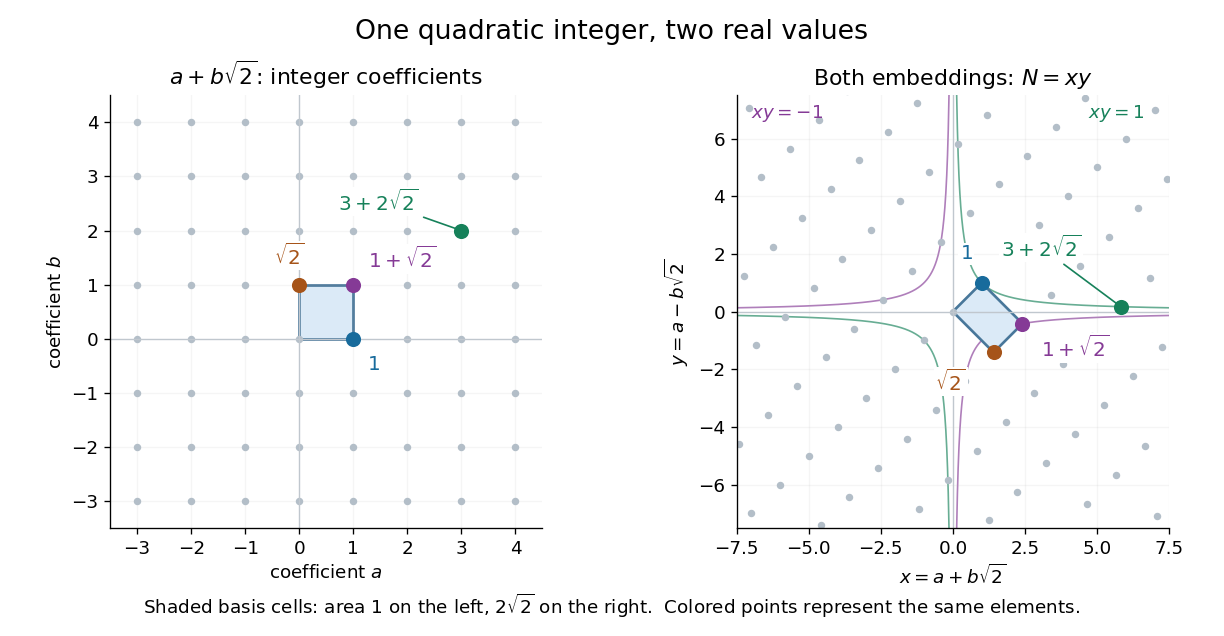
The ring is a Euclidean domain for the absolute field norm. Approximate both rational coefficients of a quotient by nearest integers. If the errors are , then , giving a remainder of strictly smaller absolute norm. In particular this ring is a principal ideal domain and has trivial ideal class group.
Articles by others on the same topic


The ring of integers, commonly denoted as \(\mathbb{Z}\), is the set of all whole numbers that includes positive integers, negative integers, and zero.