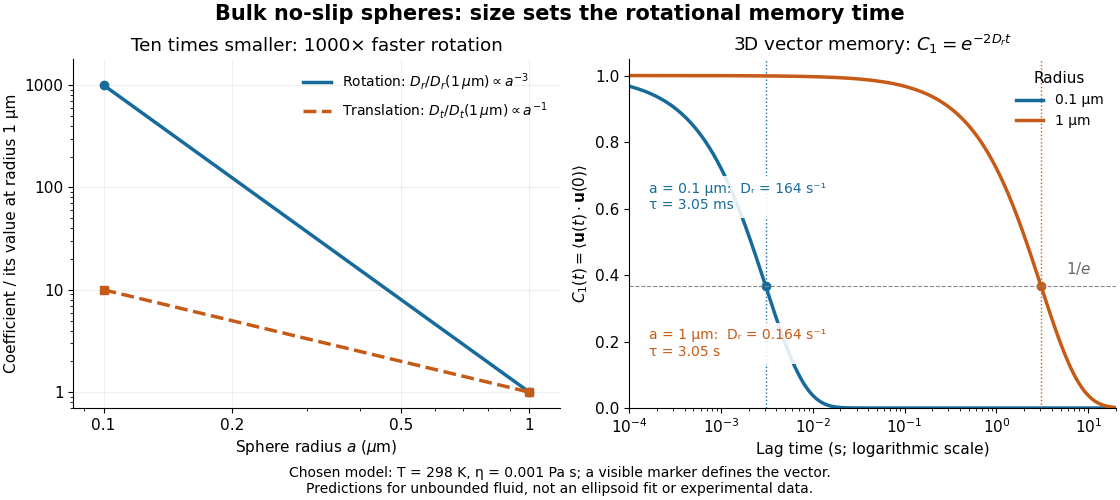
For a sphere of radius in an otherwise stationary, unbounded Newtonian fluid with dynamic viscosity , impose the no-slip boundary condition and the slow-flow assumptions of Stokes flow. The resisting torque on a rotating sphere in Stokes flow is , where is its angular velocity and . Thermal rotational diffusion at absolute temperature then givesHere is the Boltzmann constant; the translational expression is the Stokes–Einstein relation. The ratio has units of inverse length squared, so comparing the numerical values of and without their units is meaningless. At fixed temperature and dynamic viscosity, decreasing radius tenfold increases a thousandfold but only tenfold. This strong size dependence explains why small particles can lose directional memory extremely quickly.
Choose and as illustrative model inputs. Using gives and the following predictions:These are bulk three-dimensional sphere calculations, explicitly not a fit to the confined ellipsoid experiment below. Walls, nonspherical shape and departure from the no-slip boundary condition can change rotational resistance. A visible surface mark is still necessary to read the sphere's turning in an image, even when its rotational diffusion coefficient is well defined physically.

Articles by others on the same topic
There are currently no matching articles.