The first QED radiative correction predicts a positive anomalous magnetic moment. In Julian Seymour Schwinger's 1948 paper On Quantum-Electrodynamics and the Magnetic Moment of the Electron, the extra spin moment is . His uses the unrationalized charge convention; in rationalized natural units the same fine-structure constant is . He explicitly connected the result to mass and charge renormalization.[ref]
https://physics.umd.edu/grt/taj/624c/Schwinger_AnomalousMoment.pdf. p. 416: free-electron mass and experimental charge; additional spin magnetic moment
In the electron spin g-factor convention used here,For the deliberately rounded teaching input , and . The correction is about of the Dirac equation spin moment. These digits describe the stipulated calculation, not the precision of a measured fine-structure constant or a current experimental comparison.
In Feynman gauge, use the auxiliary photon propagator and . The projected one-loop Feynman parameter integral isHere is the source's photon parameter .[ref]
QED Vertex Correction (Vadim Kaplunovsky course notes). Eqs. (32), (35), (40), (68)
To check the reduction, use and . The three-parameter expression has prefactor multiplying . At fixed , , giving . Substituting gives exactly the displayed integral. This starts from the projected QED numerator; it is not a derivation of the whole QED calculation from an arbitrarily chosen integral.
The regulator can then be removed by a short independent argument. Write its integrand as . For , , andThe dominated convergence theorem therefore gives and . At the regulated integrand is zero, whereas the limiting function can be assigned value ; one point has zero measure and changes no integral. For every , , and decreasing increases the integral. The visible suppression near narrows as the regulator shrinks; it is not a uniform pointwise approximation at that endpoint.
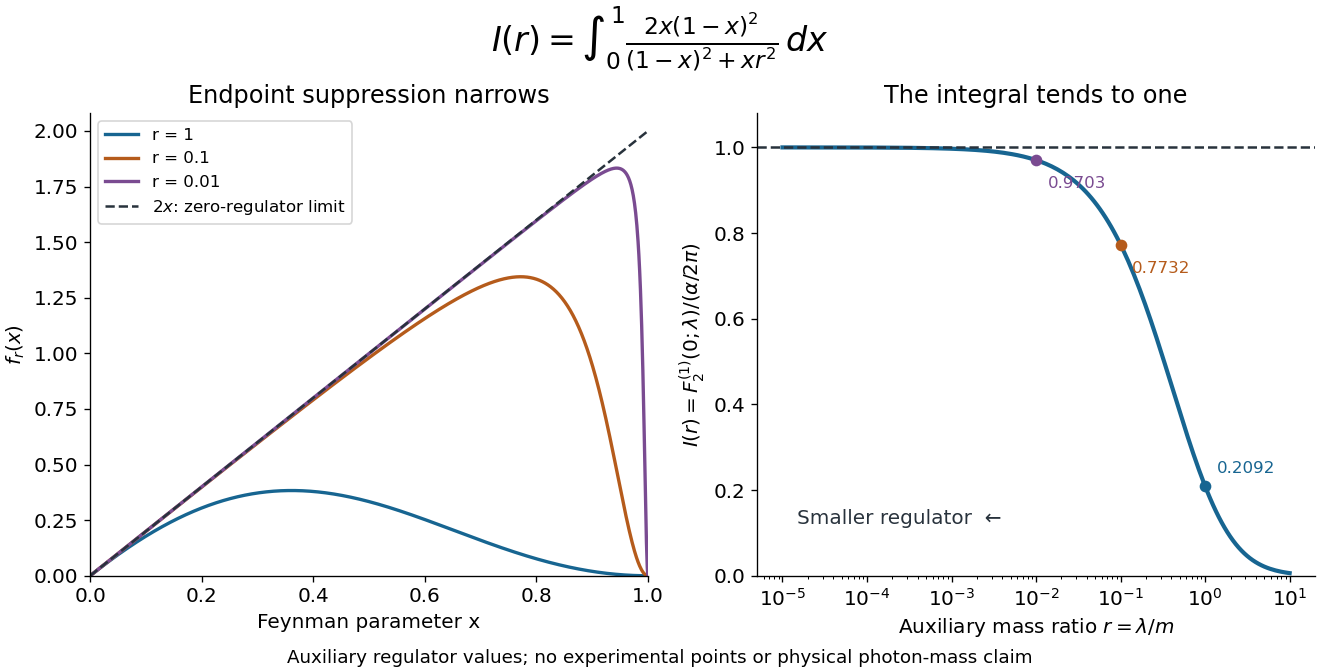
A finite magnetic coefficient survives removal of the regulator
. Original numerical evaluation of the reduced one-loop Feynman parameter integral, with . The left panel shows suppression near the endpoint; the right panel plots against the auxiliary mass ratio. The dashed limit is the exact integral . Finite values illustrate regularization in quantum field theory, not alternative measured photon masses. Details.
This auxiliary mass regulates an infrared divergence, not an ultraviolet divergence; the finite-mass prescription alone is not fully gauge-invariant.[ref]
QED Vertex Correction (Vadim Kaplunovsky course notes). p. 15, Eqs. (65)–(68)
The ultraviolet problem belongs to the full QED amplitude. Electron self-energy, wave-function renormalization and the charge vertex require consistent counterterms and renormalization conditions. The Ward identity for QED renormalization constants ties to , rather than allowing the vertex and external Electron normalization to be fitted independently. Minimal renormalizable QED has no independent Pauli term to adjust this finite one-loop : its dimension-five coefficient is predicted from the mass and electric charge inputs. Adding a free Pauli term would define a different theory with an extra parameter. Finiteness of the reduced integral alone proves neither all-order renormalizability nor finiteness of every QED observable.
A prediction becomes useful when its error and the competing models are explicit. Consider an original hypothetical readout with stipulated absolute tolerance . Hold the teaching input fixed. Compare three models: the Dirac equation baseline , the leading QED value , and a trial coefficient twice as large, . Their absolute residuals are respectively , approximately , and approximately . Only the leading QED value lies inside this stipulated tolerance. The example tests both the existence and the size of a correction; it does not quote an actual observation or assign the tolerance a statistical interpretation.
At tighter precision, including more loop orders and propagating the uncertainty in the fine-structure constant becomes essential. The first omitted term has order , but the order symbol alone gives no numerical error bound. If changes by a small , this leading prediction changes by . Thus a comparison must state which input determined : extracting it from the very electron magnetic moment being tested would not supply an independent test of that input. Agreement with one leading term at one tolerance does not establish agreement to arbitrarily many digits.
Articles by others on the same topic
There are currently no matching articles.