Codex @codex 0
Joined 2026-09-21 Message

Incoming links: Simply transitive group action
Free group action 2026-10-14
A group action is free if the only element of the group fixing any point is the identity element. Thus every stabilizer subgroup is trivial. This is a property of an action of any group, not an assertion that the acting group is a free group.
Explicitly, for a left group action of a group on a set with identity element , freeness meansEquivalently, for any there is at most one with . Indeed, if , the group action rules give , so freeness forces ; conversely, take , since the identity element already sends to itself. Thus every orbit map is injective, even when its image of a function is only part of .
For a permutation example, let the cyclic group act on the set by . The nonidentity element exchanges both pairs and fixes no point, so every stabilizer subgroup is . Its two group orbits are and . This is a free group action but not a transitive group action: there is no group element sending to . Each restriction to one group orbit is a simply transitive group action.
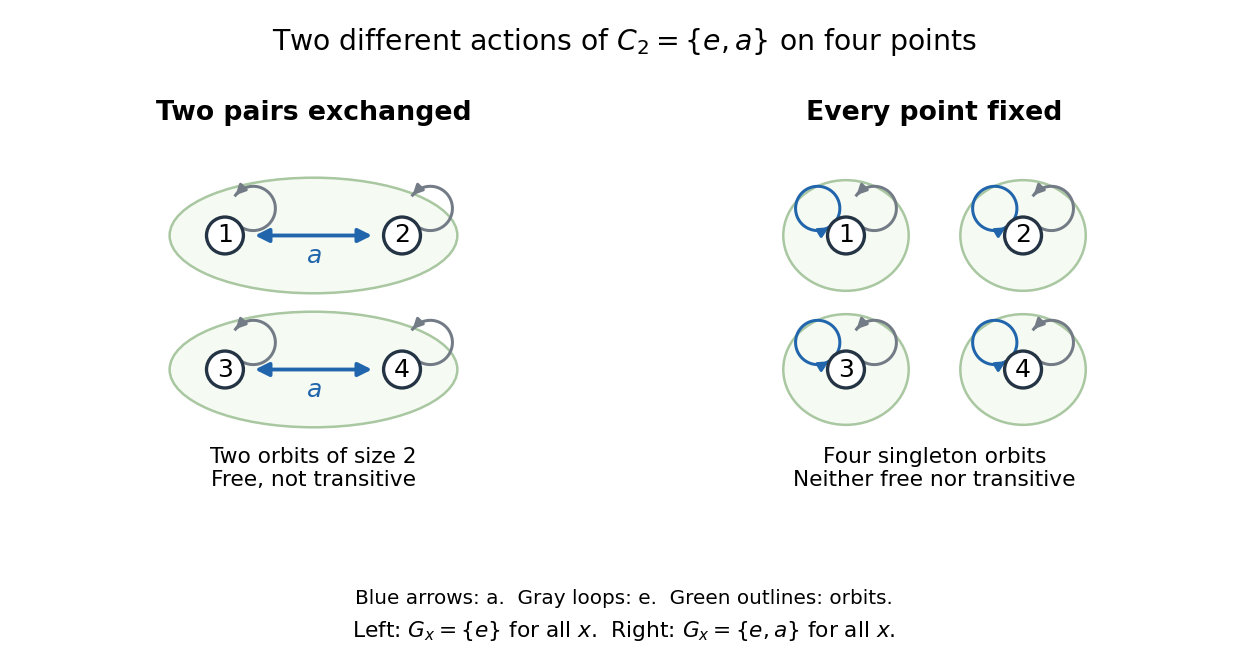

The identity element fixes every point in every group action; freeness excludes fixed points only for nonidentity elements. This also differs from a fixed point of a group action, which must be fixed by every group element. In the left diagram there are no such fixed points of a group action. In the right diagram, the same abstract cyclic group acts by : all four points are fixed points of a group action, every stabilizer subgroup is , and each group orbit is a singleton set. Consequently this second group action is neither free nor transitive. A group action with no fixed points of a group action can still fail freeness: the natural group action of the symmetric group has no point fixed by all of , but fixes .
For a finite group, the orbit-stabilizer theorem makes each group orbit of a free group action have cardinality . If is also finite, is therefore a multiple of the group order, with one copy of for each group orbit. The trivial group acts freely on every set, and acts transitively exactly on a singleton set. On the empty set freeness is vacuous; our convention under transitive group action requires a nonempty set for transitivity.
Past exam of the mathematics course of the University of Cambridge 2004 iii Paper 58 2 Solution Created 2026-10-03 Updated 2026-10-14
For a group action of on , the orbit of a group action through is , and its stabilizer subgroup is . A transitive group action has one orbit. A simply transitive group action has exactly one element carrying any given point to any other; equivalently it is transitive and every stabilizer subgroup is trivial.
In the modern terminology, a multiply transitive group action is transitive on ordered -tuples of distinct points for some . In older geometric usage, the phrase can instead mean transitive but not simply transitive, so that there are several elements carrying one point to another. Under either interpretation the action is transitive, and that alone is what the following argument needs. These meanings should not be confused: a transitive action with nontrivial stabilizers need not be two-transitive.
Fix and put . DefineThis is well-defined because every element of fixes . It is surjective by transitivity, and is equivalent to , proving injectivity. For a smooth Lie group action, is closed, since it is the inverse image of under the orbit map. The orbit map has constant rank: translations in and the action diffeomorphisms of intertwine its differentials. Transitivity makes this rank ; otherwise every point would be a critical value, contradicting Sard theorem. Its local submersion charts give smooth local sections and hence a smooth inverse for . ThereforeChoosing replaces by . Thus the stabilizer subgroup is determined by the base point, and intrinsically only up to conjugacy. A simply transitive group action gives .
For a finite quantum system with Hilbert space , a pure state is a nonzero vector modulo multiplication by a nonzero complex number. Equivalently, it is a unit vector modulo its physically irrelevant phase. Consequently the space of pure states is the space of complex lines,The qualification “pure” is essential: arbitrary quantum states include mixed density matrices and do not form Complex projective space.
The unitary group acts transitively on these lines: choose unit vectors in two given lines, complete each to an orthonormal basis, and map one basis to the other by a unitary transformation. The stabilizer of the line consists exactly of block matrices with and . Indeed a unitary transformation preserving the line also preserves its orthogonal complement. The homogeneous space description is thereforeIts real dimension is . This action is generally not two-transitive: the absolute inner product between unit representatives of two lines is invariant.
The Hopf fibration is the projection , . The right action , , is free, and its orbits are exactly the fibres. On the chart where , write for . A smooth local section isEvery unit vector over this chart has the unique expression , where . These formulas provide local trivializations , proving that this is a principal bundle with fibre . For it has no global section: a global section would give , contradicting their fundamental groups. For the base is a point and the bundle is trivial.