A Lie group is a group that is also a finite-dimensional smooth manifold, with multiplication and inversion both smooth maps. Its tangent space at the identity element carries a natural Lie algebra structure. Smoothness lets us differentiate the group operation; being a group means that every transformation can be composed and undone. The dimension of a manifold counts independent local parameters, rather than the number of elements of the group. See MIT 18.745, Lecture 2, Definition 2.1 and Example 2.5.
For example, the planar special orthogonal group consists of rotation matricesThe sine and cosine entries vary smoothly. Four entries appear, but they are constrained by and : locally, one angle specifies the whole matrix. Multiplication adds angles, with angles differing by representing the same rotation. Thus is an infinite group of dimension one, geometrically a circle group.
The positive-dimensional examples motivate the language of continuous symmetry, but the definition also admits finite groups with the discrete topology as zero-dimensional Lie groups. Conversely, being an infinite group alone says nothing about having a continuous angle parameter. The compatibility between smooth maps and the group operation is what makes differentiation useful.
Choose an injective local exponential chart on a ball of radius in the Lie algebra, and let . The neighborhood contains no nontrivial subgroup. Otherwise it contains an element with . Choose the first integer with . Then , so chart injectivity puts outside , a contradiction. Zero-dimensional Lie groups have the singleton identity as such an open neighborhood.
denotes an exceptional Lie group and its associated Lie algebra, of rank two and dimension fourteen. Its roots form the G2 root system. The compact real form is the automorphism group of the octonion algebra; other real forms and the complex Lie algebra have the same complex root-system type.
Differentiation sends Lie groups to Lie algebras and smooth group homomorphisms to bracket-preserving linear maps. On connected simply connected Lie groups, this is an equivalence with finite-dimensional real Lie algebras: the Lie third theorem gives existence, and integration of a Lie algebra homomorphism gives unique maps. General connected groups require discrete central quotient data, and disconnected groups additionally require component and conjugation data.
Every finite-dimensional real Lie algebra is the Lie algebra of a connected simply connected Lie group. One construction first uses the Ado theorem to embed it into a matrix Lie algebra, integrates the corresponding left-invariant distribution by the Frobenius theorem to a connected immersed Lie subgroup, and then takes a universal covering Lie group. The immersed subgroup need not be closed; taking its ambient closure may change its Lie algebra.
The universal cover of a connected Lie group carries a unique lifted Lie group structure with a chosen identity, making its covering map a Lie group homomorphism. The kernel is a discrete central subgroup: conjugation of any kernel element is a continuous map from a connected group into a discrete set, hence constant. Every connected Lie group is therefore a quotient of its simply connected cover by a discrete central subgroup.
A complex Lie group is a complex manifold whose multiplication and inversion are holomorphic maps between complex manifolds. Its tangent space at the identity is a complex Lie algebra; the Adjoint representation of a Lie group and the Lie exponential map are holomorphic. Compatibility with a complex manifold structure is essential: an arbitrary even-dimensional real Lie group need not have holomorphic multiplication.
Every scalar holomorphic function on a compact connected complex manifold is constant by the maximum modulus principle. Apply this to each entry of the holomorphic Adjoint representation of a Lie group; its value is constantly the identity. Differentiation makes the complex Lie algebra abelian, hence connectedness makes the group abelian. The holomorphic Lie exponential map identifies it with modulo a discrete subgroup. Compactness forces that subgroup to span the underlying real vector space, giving a full-rank Euclidean lattice and a complex torus.
An abelian Lie group has commutative multiplication. Its Lie algebra is an abelian Lie algebra, and its Lie exponential map is a group homomorphism from the additive Lie algebra. Conversely, an additive Lie exponential map forces the identity component of a Lie group to be abelian, but does not force all disconnected components to commute.
For a connected abelian Lie group, the Lie exponential map is an additive group homomorphism and a local diffeomorphism at zero. Its image is an open subgroup, hence the whole connected group. Its kernel is a discrete additive subgroup of a real vector space. A basis of that kernel identifies it with inside , giving the displayed classification. The compact factors record periods of one-parameter subgroups.
The multiplication defines the three-dimensional Sol Lie group. Its left-invariant vector fields have dual coframe . Their sum of squares is a left-invariant metric, .
A real or complex Lie group is semisimple when its Lie algebra is semisimple. For a real group, the Killing form then defines a nondegenerate bi-invariant pseudo-Riemannian metric. Compact semisimple groups have negative-definite Killing form; noncompact examples such as have indefinite Killing form. A disconnected group can also have a semisimple Lie algebra, so connectedness is a separate hypothesis when integrating infinitesimal actions.
Inside the truncated tensor algebra, let be the span of iterated Lie brackets of elements of of lengths at most . Its exponential is the connected simply connected free nilpotent Lie group of step , with tensor multiplication. The bracket is the commutator in the tensor algebra. Its grading defines dilations that multiply degree by .
Write a group element as . The step-two Baker-Campbell-Hausdorff formula gives the displayed multiplication and inverse . The scalar is the antisymmetric second signature coordinate, which equals the signed area for a closed planar path. The Carnot-Carathéodory distance is comparable to near the identity, with the same homogeneous scaling globally.
The loop group of a Lie group is the group of smooth maps from the circle to that group, with pointwise multiplication and the smooth-function topology. Rotation of the source circle acts by group automorphisms. For , every loop has the form , where is its winding number and is a smooth real periodic function determined up to addition of an integer multiple of .
Such a continuous projective unitary representation admits strongly continuous rotations whose self-adjoint generator is bounded below and whose adjoint action rotates the loops. In the basic fermionic construction, integer one-particle modes are filled below zero. The rotation energy counts nonnegative particle energies and positive hole energies. It has finite-dimensional integer eigenspaces and implements circle rotations. Tensor products give higher nonnegative integer levels.
Write a loop as with smooth real periodic and its mean. For the level-one representation with modes filled below zero and , choose implementers , where increases charge by one, , and . Their product differs from by the displayed two-cocycle. Its phase is bilinear, which verifies the cocycle identity; integer makes it independent of the ambiguity in . Rephasing implementers changes it by a group coboundary.
A nondegenerate invariant symmetric bilinear form on a Lie algebra extends by translation to a metric preserved by both left and right translation. It may have indefinite signature. Its Levi-Civita connection is for left-invariant vector fields, and its Ricci tensor is . Choosing the nondegenerate Killing form of a semisimple Lie algebra yields a canonical indefinite Einstein manifold; compact groups instead admit the positive metric .
Let , and , with central. The symmetric tensor is invariant under the Adjoint representation of a Lie algebra: the derivation action of each of cancels in pairs. For , has determinant and inverse metric in the dual coframe. Its three hyperbolic planes give the displayed metric signature. On a connected Lie group this supplies a four-parameter family of bi-invariant pseudo-Riemannian metrics. Disconnected components must preserve the tensor separately; the automorphism reversing while fixing the other generators reverses and prevents this extension.
On a real semisimple Lie group, the nondegenerate invariant Killing form gives a bi-invariant pseudo-Riemannian metric. For left-invariant fields the Koszul formula gives and . Taking the trace gives , proving the Einstein property. On a compact semisimple group, is positive definite and has Einstein constant . The indefinite general construction is not a proof of existence of a positive-definite bi-invariant metric on a noncompact group.
A compact Lie group is a Lie group whose underlying manifold is compact. Averaging any positive inner product over its Haar measure supplies an invariant inner product on each finite-dimensional representation, including the Adjoint representation.
A real torus is the compact Lie group obtained by identifying real vectors differing by integer vectors, with addition induced from Euclidean addition. It is a finite product of circle groups and has normalized Haar measure. Dimension two is the familiar surface torus, but toral dynamics and Fourier characters naturally use arbitrary finite dimension.
Let be a connected compact Lie group, a maximal torus, and its Weyl group. With normalized Haar measures and , every continuous class function satisfies . For a general continuous function, replace by its average . Conjugation from covers the regular elements times, and its real Jacobian determinant is .
For a connected compact Lie group with maximal torus , the map , , has the displayed real Jacobian determinant. Choose an invariant inner product and identify the tangent space of with . Translation of the derivative at to the identity gives . Each pair of opposite roots of a root system corresponds to a real two-plane on which the determinant is . The torus direction has determinant one. Normalized quotient and Haar measures have matching volume constants because the Riemannian submersion gives . The map covers regular elements times, giving the Weyl integration formula with conjugacy averaging for general functions.
For the unitary group, the diagonal maximal torus has coordinates and Weyl group . The Weyl integration formula weights independent uniform angles by . The Vandermonde determinant has squared torus integral , by Fourier orthogonality. Multiplying an irreducible character of highest weight by this determinant gives an alternating Laurent polynomial. Its leading alternant has coefficient one; character orthogonality for compact groups forces every other alternant coefficient to vanish. This yields the quotient .
This Lie group acts on the plane by with . Its multiplication is , and its inverse is . It is a semidirect product in which positive dilation acts on the translation subgroup. A dilation generator and translation generators have Lie brackets and .
The Maurer-Cartan form of the translation-dilation group of the plane has these coefficients in its dilation–translation basis, with . Left multiplication rescales each coordinate differential and equally, proving they are left-invariant differential forms. Their dual left-invariant vector fields are and . The Maurer-Cartan equation is , . The tensor is a positive definite left-invariant metric.
A smooth homomorphism of Lie groups has differential at the identity. Differentiating makes the corresponding left-invariant vector fields -related. Their commutator action on pulled-back functions shows that the differential of a Lie group homomorphism preserves Lie brackets. The map need not be injective or surjective.
An isomorphism of Lie groups is a group isomorphism that is also a diffeomorphism. Both the homomorphism and its inverse preserve the smooth structures. Its identity differential is a Lie algebra isomorphism, but an isomorphism of Lie algebras determines a global Lie group isomorphism without extra period data only for connected simply connected groups.
A Lie group homomorphism intertwines one-parameter subgroups and therefore obeys the displayed identity. A connected Lie group is generated by an identity neighbourhood in an exponential chart, so its homomorphism is uniquely determined by the differential at the identity. On a disconnected group, only the restriction to its identity component is determined this way; the images of the other components require extra data.
A Riemannian metric on a Lie group is right-invariant when every right translation is an isometry. It is determined by a positive-definite inner product at the identity, extended with a coframe of right-invariant differential forms. Its translation-generated Killing vector fields are left-invariant, rather than the right-invariant vector fields dual to that coframe.
A differential form on a Lie group is right-invariant if for every right translation . A right Maurer-Cartan form is represented in a matrix group by , whereas the left version is . Its components supply a right-invariant coframe.
A maximal torus is a connected compact abelian Lie subgroup maximal among such subgroups. Restricting a finite-dimensional unitary representation to it splits into one-dimensional weight characters. For special unitary group it is the diagonal circle .
Give the Lie algebra of a compact Lie group an inner product invariant under the Adjoint representation. For a maximal torus with Lie algebra , its Lie-algebra centralizer is : any additional commuting vector would generate, together with , a larger compact connected abelian subgroup. The torus weight decomposition therefore supplies whose centralizer is exactly , by avoiding finitely many nonzero-weight hyperplanes. For any , maximize on the group. Its directional derivative gives for every , so . For a connected compact group, the bi-invariant Riemannian metric and Hopf-Rinow theorem make the exponential onto; exponentiating this conjugacy puts every element in a conjugate of .
For a compact torus , its continuous one-dimensional characters form a free abelian group of rank . They are precisely with integer exponents. This follows from the classification of representations of the circle group, applied to each factor. These characters are the integral group weights occurring upon restricting a group representation to a maximal torus; global integrality must be distinguished from integrality against coroots for a simply connected semisimple covering group.
The connected component of the identity in a Lie group is an open normal subgroup. Connected coordinate neighbourhoods prove openness, and conjugation preserves the component of the identity. Every open identity neighbourhood generates it: the generated subgroup is open, its other cosets are open, and connectedness forces it to be the whole component.
The group manifold is the underlying smooth manifold of a Lie group, with smooth multiplication and inversion. Its global topology need not be determined by its Lie algebra: the SU(2) group and SO(3) group have isomorphic Lie algebras but different fundamental groups.
A Lie subgroup is a subgroup carrying a Lie group structure such that its inclusion is an injective immersion and a group homomorphism. Its Lie algebra includes in that of the ambient Lie group.
Every closed subgroup of a finite-dimensional Lie group is an embedded submanifold and a Lie subgroup. Closedness alone forces the compatible smooth structure; smoothness need not be assumed in advance. The proof constructs the Lie algebra of a closed subgroup from one-parameter subgroups, then uses local product coordinates for a closed subgroup.
Choose a vector subspace complementary to the Lie algebra of a closed subgroup . The differential of at is , so the inverse function theorem makes a local diffeomorphism. Sufficiently small nonzero cannot satisfy : otherwise limit directions of a closed subgroup give a nonzero element of . Consequently is locally exactly the coordinate slice , proving that it is an embedded submanifold.
For a closed subgroup of a Lie group, this set is a real Lie subalgebra. Scalar closure is immediate; the Lie product formula in a Lie group and closedness of give addition. It is a closed vector subspace, also directly by continuity of the Exponential map of a Lie group. Conjugating its one-parameter subgroups by elements of preserves it. Differentiating the Adjoint representation of a Lie group along gives for . After the closed-subgroup theorem establishes smoothness, is exactly the tangent space .
Let be a closed subgroup of a Lie group , and let nonzero vectors in the ambient Lie algebra tend to zero with and . For any real , choose integers with . Then . Closedness gives . Compactness of the unit sphere supplies a limit direction from every sequence approaching the identity through nonidentity subgroup elements.
Conjugation by every element of preserves a normal Lie subgroup . Its differential therefore preserves . Differentiate that invariance along to obtain , proving that is an ideal of a Lie algebra. Closed subgroups have a canonical Lie-subgroup structure; an arbitrary abstract subgroup need not.
A Lie group action is a smooth group action of a Lie group on a smooth manifold. Differentiating the action gives an infinitesimal action of its Lie algebra by vector fields.
A Lie group action on is proper if from to is a proper map. A free proper smooth action has a smooth quotient manifold, with the quotient map a submersion and principal bundle. Proper actions with stabilizers can have orbit-type strata and singular quotients. These qualifications are necessary before treating an orbit space as a smooth phase space.
A smooth action of the compact abelian Lie group . Commuting vector fields with a common periodic normalization give such an action. In action-angle variables, the torus acts by translation of the angles while leaving the actions fixed.
The special linear group acts on determinant-one real symmetric matrices by matrix congruence. Symmetry and determinant are preserved, and signatures are preserved by Sylvester's law of inertia. The determinant-one set is a regular level set of dimension , with tangent directions satisfying . Its infinitesimal left-action fields are ; converting them to a Lie algebra representation requires the infinitesimal left-action sign convention.
The coadjoint action of a Lie group on the dual space of its Lie algebra is . The inverse in this formula makes it a left group action.
A coadjoint orbit is the orbit of under , defined by . For a connected Lie group these orbits are the symplectic leaves of its Lie-Poisson manifold. Their tangent vectors are infinitesimal coadjoint actions, and their natural two-form is the Kirillov–Kostant–Souriau symplectic form.
With , the displayed form on a coadjoint orbit is well-defined: changing a generator by an element of the stabilizer changes no pairing. It is nondegenerate on orbit tangents, and its closedness follows from the Jacobi identity. This sign agrees with the positive Lie-Poisson bracket when Hamiltonian vector fields act by . A negative Lie-Poisson convention reverses the orbit form as well.
For a smooth left Lie group action, define the fundamental vector field by . With the Lie bracket of vector fields , this map is an anti-homomorphism. The map is a Lie algebra representation. A right action with the positive exponential has the opposite homomorphism convention, so specifying action side and bracket convention prevents a sign ambiguity.
A matrix Lie group is a subgroup of a general linear group that is also a Lie group for its matrix topology. Near the identity, the matrix exponential and matrix logarithm give inverse coordinate charts whenever they are restricted to sufficiently small neighborhoods in the group and its tangent space.
For a real quadratic form with a symmetric matrix, its stabilizer is . Its Lie algebra consists exactly of satisfying . Differentiation proves necessity; the matrix exponential proves sufficiency because . The result holds even when the quadratic form is degenerate.
For a Matrix Lie group with Lie algebra , its exponential map is the restriction of the matrix exponential, . It maps into and is a local diffeomorphism at zero, but it need not be surjective globally.
A real matrix with at least one simple negative eigenvalue cannot be a matrix exponential of a real matrix: a logarithm would commute with it and preserve each one-dimensional real negative-eigenvalue space, where exponentiation can only produce a positive eigenvalue. In particular belongs to the connected special linear group but has no real logarithm.
For a matrix Lie group with Lie algebra , choose neighborhoods on which and are inverse. Left translation gives a chart near byThe Baker--Campbell--Hausdorff formula expresses multiplication smoothly in these coordinates.
A connected Lie group is simple when its Lie algebra is nonabelian and simple. Some conventions additionally quotient out or exclude a discrete center; the infinitesimal gauge fields depend only on the Lie algebra.
A homogeneous space is a space on which a group acts transitively. After choosing a point, a transitive Lie-group action identifies the space with a quotient by the point stabilizer.
Declare a global left-invariant, respectively right-invariant, frame parallel to obtain two flat affine connections on a Lie group. For left-invariant vector fields, their derivatives are as displayed and their torsion tensors are and . The tensors vanish on Abelian groups; two genuinely torsionful connections are not asserted there.
Declare a global frame of left-invariant vector fields parallel on a semisimple Lie group. This affine connection is flat and preserves a left-invariant metric tensor because its frame components are constant. If , its torsion tensor is . For fixed , the matrix with entries is . Its trace vanishes because a semisimple Lie algebra is perfect and adjoints of brackets are commutators. The trace of the product for is the Killing form , proving both contractions. This flat metric connection differs from the curved torsion-free Levi-Civita connection of the Killing metric.
The average of the two flat translation connections on a Lie group is a torsion-free connection. For left-invariant vector fields, the Jacobi identity gives with . Contracting gives for the Killing form . It is flat exactly when all double Lie brackets vanish, including the case of a two-step nilpotent group. For a semisimple Lie algebra, is nondegenerate and supplies a bi-invariant indefinite metric whose Levi-Civita connection is .
The right-invariant vector field associated with a Lie algebra element is obtained by right translation of its value at the identity. Its flow is , hence consists of left translations on a Lie group. Right invariance follows because left and right multiplication commute.
For a Matrix Lie group, the right-invariant vector field is . Differentiating these ambient matrix-valued functions in the definition of the Lie bracket of vector fields gives . Thus is an antihomomorphism, and is a homomorphism. In contrast, for left-invariant vector fields is a homomorphism.
For in the Lie algebra of , the left-invariant vector field is . Its global flow is right translation .
On a hemisphere of SU(2) as the three-sphere, write , with real coefficients satisfying . Right multiplication by gives . This right multiplication flow defines left-invariant tangent fields. With the displayed factor , they obey , since . Applying the commutator to and using the Pauli matrix commutator identity gives . The entries of contain every coordinate, so this determines the vector-field identity, not just its action in one isolated representation.
A basis of the Lie algebra of a Lie group gives a global frame of a vector bundle of its tangent bundle by . Left translation is a diffeomorphism, so the left-invariant vector fields are independent everywhere. Every Lie group is therefore a parallelizable manifold.
On a Matrix Lie group, the left-invariant vector field associated to a tangent vector at the identity is . Its ambient derivative is . Therefore the Lie bracket of vector fields is , and the induced Lie algebra bracket is the commutator. This fixes the sign for left invariance; right-invariant fields induce the opposite sign when evaluated with the same matrix identification.
Every smooth left-invariant vector field on a Lie group is a complete vector field. Translate a local integral curve of a vector field through the identity to every other point. The same positive local existence interval works at every initial point, so no maximal integral curve of a vector field can have a finite endpoint. Uniqueness then makes the curve through the identity a one-parameter subgroup.
A differential form on a Lie group is left-invariant when for every . It is determined by its value at the identity.
Choose a nonzero element of for an -dimensional Lie group and transport it by inverse left translations. This gives a smooth nowhere-zero left-invariant differential form of top degree, hence an orientation. The identity proves invariance. The space of invariant top forms is one-dimensional, since evaluation at the identity identifies it with .
A differential form on a Lie group is bi-invariant when it is invariant under both left and right translations.
An adjoint-invariant symmetric bilinear form on a Lie algebra makes the displayed tensor alternating. If is invariant under the full group Adjoint representation, its left-translated three-form is also right-invariant. On left-invariant fields, the exterior derivative is by the Jacobi identity. The Killing form supplies such a on every semisimple Lie group. An overall sign change in the lowered structure-constant convention negates the form but not its invariance or closedness.
On a connected Lie group, a left-invariant differential 1-form is closed exactly when it is bi-invariant. Connectedness is essential: on every left-invariant 1-form is closed because its Lie algebra is abelian, while reflection conjugation negates every nonzero one.
A one-parameter subgroup of a Lie group is a smooth group homomorphism : it satisfies , with and . Every such map has the form for a unique in the Lie algebra of . Thus its initial tangent vector determines the whole motion, for all real times. The map need not be injective; the word subgroup describes its image. See MIT 18.745, Lecture 7, Proposition 7.1.
Differentiate the planar rotation matrix at angle zero:The even and odd powers in the matrix exponential therefore giveThis exact formula gives the whole one-parameter subgroup. Taking means unit angular velocity: at , sends to , a counterclockwise quarter-turn. At , it equals ; at , it returns to . Choosing reaches the quarter-turn at . Changing the generator changes the speed, while preserving the circular path.
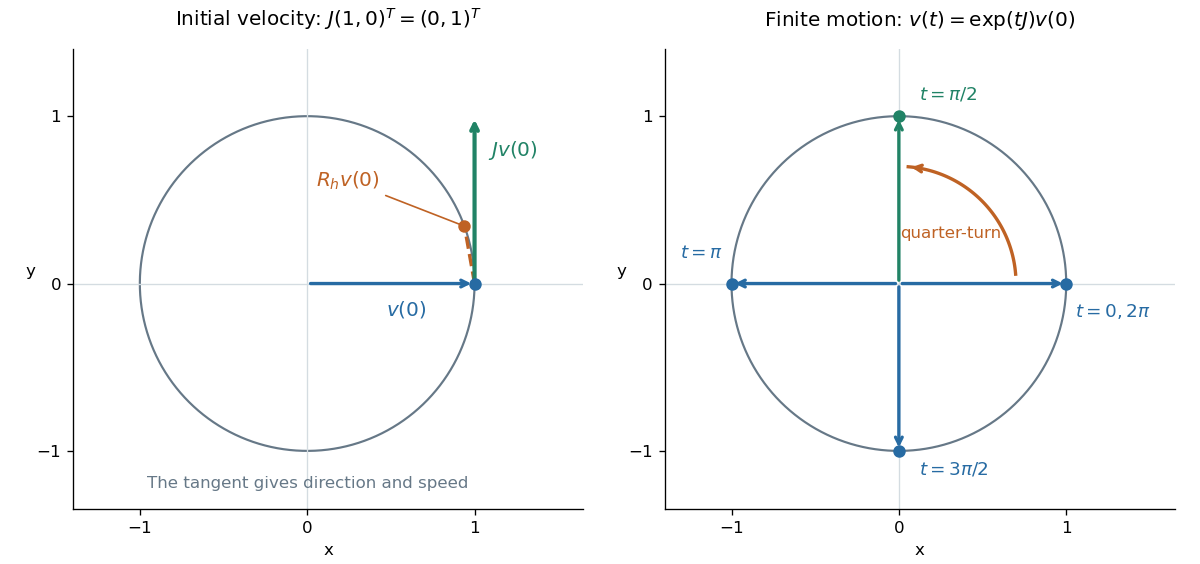
For a moving vector , the ordinary differential equation says its velocity is perpendicular to its position. The beautiful compression is that one constant matrix specifies every angle of this endless family of rotations.
For , the image of , with its intrinsic immersed Lie subgroup topology, is isomorphic to or the circle group. The kernel is respectively zero or for a least positive period . The case is the trivial group. An irrational winding in a two-dimensional torus need not be an embedded or closed subgroup, so its intrinsic topology must be distinguished from the subspace topology.
For , the image of its matrix exponential is compact precisely when or . If , then and its image is conjugate to the circle group. A nonzero nilpotent generator or a generator with real nonzero eigenvalues produces an unbounded image.
The circle group is the unit complex numbers under multiplication, equivalently planar rotations or the quotient .
The quotient metric of circumference one uses the shorter distance around the circle: . It also measures separation across the identified endpoints. This is the metric used by circular spacing in the analytic large sieve inequality.
The derived representation of a smooth Lie-group representation is . It is a Lie algebra representation because .
The adjoint representation of a Lie group is its action on its Lie algebra by differentiating conjugation. For a matrix Lie group, .
Let be connected and compact with nonzero irreducible real Adjoint representation. Its Lie algebra has no proper invariant Lie algebra ideal. If it is Abelian, irreducibility forces dimension one, so is the circle group. Otherwise its centre has zero-dimensional Lie algebra and is finite. A proper closed normal subgroup likewise has zero-dimensional Lie algebra, hence is finite; connectedness of makes conjugation on that finite subgroup trivial, so the subgroup is central. A Lie group homomorphism onto a nontrivial connected target with surjective differential consequently has finite central group kernel. The qualifications “proper” and “nontrivial” are essential.
With Adjoint representation convention , the matrix exponential identity is . Inverse conjugation reverses product order, so it is a right action or antirepresentation, whereas is an ordinary left group representation. The first-order terms detect a sign mismatch immediately. Negating every adjoint generator without reversing the Lie bracket does not give a new Lie-algebra homomorphism.
Conjugation by on its three-dimensional real Lie algebra of traceless skew-Hermitian matrices preserves and defines a surjectionwith kernel . It is the universal double covering of .
A SU(2) representation descends to the SO(3) group exactly when acts trivially. In it acts by , so descent holds precisely for even , or integer spin . This is the inflation of a group representation criterion for the kernel . Half-integer-spin representations instead remain representations of the covering group.
A local group law is the coordinate expression of multiplication near the identity of a Lie group. The identity, inverse, and associativity equations for encode the group structure locally.
For a matrix Lie group, the left-invariant Maurer-Cartan form is . It identifies each tangent space with the Lie algebra and obeys .
When sums over ordered pairs, the Maurer-Cartan equation determines only . Symmetric additions vanish in the exterior product. The usual coefficients are the unique antisymmetric representatives; summing instead over removes the factor one half.
The real affine group used here is the orientation-preserving subgroup of the affine group on the real line. It acts by and has multiplication . The positive dilation distinguishes this connected component from the full group, which also contains negative dilations.
Here is a small Lie group where order matters. Write a point as , and letThe one-parameter subgroups and give dilations and translations. With matrix multiplication acting rightmost first, sends to , whereas sends to . At and , translate then double gives , while double then translate gives . Starting at gives endpoints and .
The same order dependence survives infinitesimally: the matrix commutator is . Indeed, the group commutator satisfiesAt , the residual translation is , close to the leading product . It measures a second-order failure of the four moves to cancel. This connects finite composition directly to the Lie bracket on the Lie algebra; see Meinrenken, Section 4, Proposition 4.7.
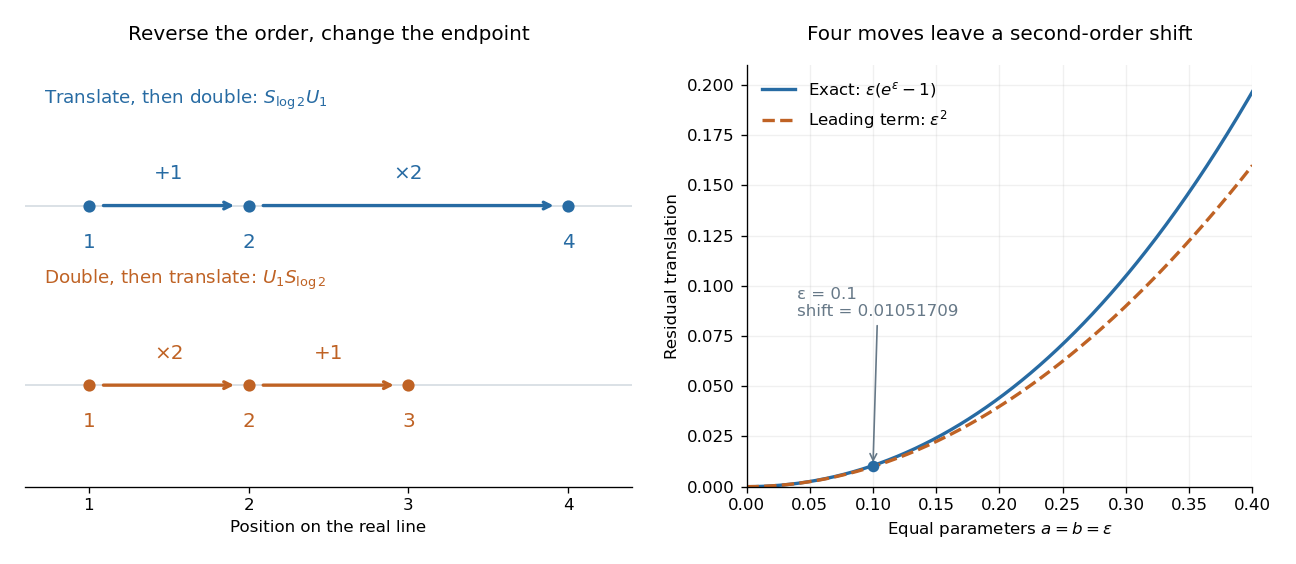
Scaling and translation have different endpoints when their order is reversed
. Details. In exponential scale coordinates, the real affine group has matrices . The left and right Maurer-Cartan forms are respectively and . Their dual vector fields obey and , displaying the opposite bracket sign for right-invariant vector fields.
In the faithful matrices with , the Maurer-Cartan form has entries and . Thus the left-invariant differential forms , obey and . The Lie algebra generators satisfy .
A left-invariant Riemannian metric is preserved by every left translation. Its Killing fields generated by left translations are right-invariant vector fields.
A Riemannian metric on a Lie group is bi-invariant if both left and right translations are isometries. Its identity inner product is invariant under the Adjoint representation of a Lie group; infinitesimally,This skew-adjointness is the key additional property beyond left invariance.
If a Lie group has an Adjoint representation of a Lie group element with a real eigenvector of eigenvalue whose modulus differs from one, it has no bi-invariant Riemannian metric. Conjugation is a composition of left and right translations, hence would preserve the positive identity inner product. Applying it to that eigenvector gives , a contradiction. The orientation-preserving affine group of the real line supplies a connected example: conjugation by dilation of factor two multiplies the infinitesimal translation by two.
For a bi-invariant Riemannian metric on a Lie group, the induced inner product on its Lie algebra makes every adjoint operator skew-adjoint. The Levi-Civita connection of a bi-invariant metric gives . Thus for orthonormal , andThe nullspace of this quadratic form is exactly the center of a Lie algebra. A zero center therefore gives positive Ricci curvature, uniformly bounded below by a positive constant times the metric through left invariance and compactness of the unit sphere in the Lie algebra.
Integral curves through the identity of left-invariant vector fields are one-parameter subgroups, by flow uniqueness and left translation. They extend for all time because a fixed local existence interval translates to every point. Under a bi-invariant Riemannian metric they are geodesics by the Levi-Civita connection of a bi-invariant metric. Geodesic uniqueness proves that these are all geodesics through the identity.
Articles were limited to the first 100 out of 108 total.
Articles by others on the same topic




The key and central motivation for studying Lie groups and their Lie algebras appears to be to characterize symmetry in Lagrangian mechanics through Noether's theorem, just start from there.
Notably local symmetries appear to map to forces, and local means "around the identity", notably: local symmetries of the Lagrangian imply conserved currents.
More precisely: local symmetries of the Lagrangian imply conserved currents.
TODO Ciro Santilli really wants to understand what all the fuss is about:
Oh, there is a low dimensional classification! Ciro is a sucker for classification theorems! en.wikipedia.org/wiki/Classification_of_low-dimensional_real_Lie_algebras
The fact that there are elements arbitrarily close to the identity, which is only possible due to the group being continuous, is the key factor that simplifies the treatment of Lie groups, and follows the philosophy of continuous problems are simpler than discrete ones.
Bibliography:
- youtu.be/kpeP3ioiHcw?t=2655 "Particle Physics Topic 6: Lie Groups and Lie Algebras" by Alex Flournoy (2016). Good SO(3) explicit exponential expansion example. Then next lecture shows why SU(2) is the representation of SO(3). Next ones appear to eventually get to the physical usefulness of the thing, but I lost patience. Not too far out though.
- www.youtube.com/playlist?list=PLRlVmXqzHjURZO0fviJuyikvKlGS6rXrb "Lie Groups and Lie Algebras" playlist by XylyXylyX (2018). Tutorial with infinitely many hours
- www.staff.science.uu.nl/~hooft101/lectures/lieg07.pdf
- www.physics.drexel.edu/~bob/LieGroups.html
What is Lie theory? by Mathemaniac 2023
. Source.